For years, the Saab Gripen carried a reputation problem that had almost nothing to do with its actual performance. Built by Sweden — a country that spent decades outside NATO and avoided the giant military-industrial politics surrounding American fighter programs — the Gripen was often dismissed as a lightweight alternative for smaller nations that could not afford “real” top-tier combat aircraft.
Military forums mocked it. Analysts underestimated it. Even some Western air force officials quietly treated it as a second-class fighter compared to legends like the F-15 Eagle, F-16 Fighting Falcon, Eurofighter Typhoon, or America’s highly advanced F-35 stealth jet.
But then the exercises started.

And suddenly, NATO pilots were discovering something deeply uncomfortable.
The small Swedish fighter that many had laughed at was repeatedly outperforming aircraft that cost far more money and were supposedly far more advanced.

The shock became impossible to ignore during major international exercises, including Red Flag Alaska, where the Gripen reportedly achieved multiple simulated kills against frontline Western fighters while remaining unusually difficult to track and target.
That was the moment many military observers realized they may have misunderstood the Gripen entirely.
Because the aircraft had never been designed to dominate air shows or impress politicians with size and raw power.
It had been designed for survival.
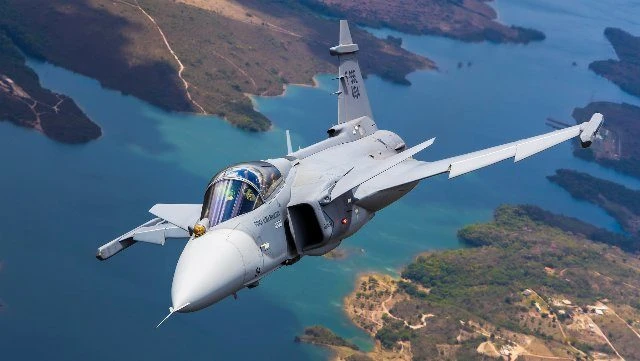
Sweden’s entire Cold War military doctrine shaped the Gripen into something fundamentally different from most Western fighters. While NATO countries often relied on massive air bases, huge logistics networks, and overwhelming numerical superiority, Sweden expected that in a real war, its airfields would be destroyed within hours by Russian missile strikes.
So Swedish engineers built a fighter for chaos.
The Gripen was specifically designed to land on highways, operate from damaged runways, refuel quickly, and return to combat with tiny ground crews working under extreme pressure. In some scenarios, a small team of conscripts could reportedly rearm and refuel the aircraft in less than twenty minutes.
That level of flexibility stunned many NATO planners accustomed to far more complicated maintenance systems.
And the deeper analysts looked into the Gripen, the more dangerous the aircraft appeared.
Its strength was never brute force.
Its strength was intelligence.
The aircraft uses advanced electronic warfare systems, highly integrated battlefield data sharing, and powerful sensor fusion that allows pilots to see threats faster and coordinate more efficiently with allied systems. In modern warfare, where information often matters more than speed alone, that capability became a massive advantage.
The Gripen was also designed around a philosophy many larger air forces ignored for years: surviving long wars instead of winning short demonstrations.
While advanced stealth aircraft like the F-35 depend heavily on expensive maintenance infrastructure and specialized support systems, the Gripen was intentionally built to remain operational even when supply chains collapse or military bases come under constant attack.
That difference may sound technical.
But in a real conflict, it could determine which air force survives after the first week.
Some NATO officers reportedly became increasingly impressed by the aircraft’s ability to disappear into difficult terrain, rapidly relocate, and strike targets before enemy aircraft could react effectively.
The fighter’s electronic warfare systems became especially respected.
Modern air combat is no longer only about dogfights. Today, the battle often begins long before pilots even see each other. Jamming systems, radar deception, network disruption, and electronic attacks can decide combat outcomes before missiles are fired.
And in that environment, the Gripen developed a reputation for being extremely difficult to engage cleanly.
That reputation only grew stronger after Sweden officially joined NATO in 2024.
For decades, Sweden had maintained military neutrality while quietly developing one of Europe’s most advanced defense industries. But Russia’s invasion of Ukraine changed European security calculations dramatically, pushing Sweden into the NATO alliance after years of hesitation.
The timing could not have been more important.
Almost immediately after joining NATO, Swedish Gripens began participating in live interception missions over the Baltic region, responding to increased Russian air activity near alliance territory.
These were no longer training exercises.
This was real-world NATO air defense.
And suddenly, the Gripen was no longer viewed as an outsider aircraft from a neutral country. It had become part of the alliance’s frontline defense structure against one of the world’s largest military powers.
At the same time, another controversy unexpectedly pushed the aircraft into global headlines.
Canada’s fighter jet debate.
For years, Canada struggled to decide how to modernize its aging fighter fleet. The F-35 eventually emerged as the dominant choice politically and strategically, largely because of NATO integration and American alliance pressure.
But Saab’s Gripen created serious debate inside Canada because the company offered something extremely unusual.
Independence.
Unlike many American defense deals, Saab proposed local production, major technology transfers, domestic industrial participation, and greater freedom from U.S.-controlled systems.
That mattered to many Canadians.
Supporters argued the Gripen’s lower operating costs, cold-weather capabilities, and ability to operate in remote Arctic conditions made it uniquely suited for Canada’s geography.
Some military analysts pointed out that Canada’s enormous northern territory often lacks the infrastructure needed for highly maintenance-intensive stealth fighters.
The Gripen’s highway operations and simplified logistics suddenly looked very attractive.
Critics, however, pushed back aggressively.
Many defense experts insisted that fifth-generation stealth aircraft like the F-35 still dominate high-end warfare due to their stealth characteristics, sensor integration, and deep strike capabilities against sophisticated enemy air defenses.
And to be fair, the F-35 remains one of the most advanced combat aircraft ever built.
But the Gripen debate revealed something larger happening inside modern military thinking.
Countries are starting to question whether extremely expensive “perfect” weapons are always more valuable than cheaper systems that can survive longer, deploy faster, and operate under harsher real-world conditions.
Ukraine reinforced that lesson dramatically.
Since the start of the war, military planners around the world have watched how drones, electronic warfare, mobile missile systems, and dispersed operations changed the battlefield. Large centralized bases suddenly looked vulnerable. Long supply chains became dangerous liabilities.
The Gripen’s philosophy suddenly seemed less outdated — and more prophetic.
Its entire design assumed that enemy missiles would destroy infrastructure quickly and that pilots would need to relocate constantly to survive.
In other words, the aircraft may have been built for exactly the kind of modern conflict now terrifying military strategists worldwide.
That realization deeply unsettled some Western defense observers who had spent years prioritizing ever-larger and more technologically complex aircraft programs.
Because the Gripen proved something uncomfortable:
Efficiency can sometimes beat extravagance.
The aircraft also challenged another assumption common inside NATO.
For years, military prestige often centered around cost. Bigger budgets created an image of superiority. Expensive aircraft became symbols of national power and political influence.
But the Gripen forced many analysts to ask a dangerous question.
What if a fighter costing dramatically less can still threaten — or even outperform — aircraft built by far richer countries?
That question became even more sensitive because Sweden achieved this without the enormous military spending levels of the United States.
Instead, Sweden focused relentlessly on practicality.
Everything about the Gripen reflects that philosophy: fast maintenance access, modular components, flexible deployment, and operational endurance.
Even the name “Gripen,” which translates roughly to “griffin,” reflects the aircraft’s identity as a fast, adaptable predator rather than a heavyweight brute-force machine.
Today, the Gripen remains one of the most debated fighters in the world.
Some experts continue insisting that stealth-dominant warfare will eventually make aircraft like the Gripen less relevant against top-tier enemies.
Others argue the opposite.
They believe future wars may punish overcomplicated systems and reward platforms capable of surviving under relentless pressure, infrastructure collapse, cyber attacks, and mass missile strikes.
If that future arrives, the Gripen may no longer look like the underdog.
It may look like the warning everyone ignored.
And perhaps that is the most remarkable part of the story.
The Saab Gripen was never supposed to embarrass NATO aircraft.
It was never supposed to challenge billion-dollar defense assumptions.
And it certainly was never supposed to force Western militaries to reconsider what modern air superiority really means.
But somewhere between the Arctic exercises, Baltic interceptions, electronic warfare tests, and simulated combat victories, the “cheap little Swedish jet” stopped being a joke.
Now, even its critics are paying attention.
Because modern warfare may have entered a new era where survival, adaptability, and intelligence matter just as much as raw technological dominance.
And in that world, the fighter many dismissed as second-tier suddenly looks terrifyingly relevant.