Europe’s Quiet Nuclear Revolution
For decades, Europe’s security architecture rested on an assumption so deeply embedded in Western strategy that few leaders ever questioned it publicly: if Europe faced an existential threat, the United States would ultimately stand behind it.
That assumption is now beginning to fracture.
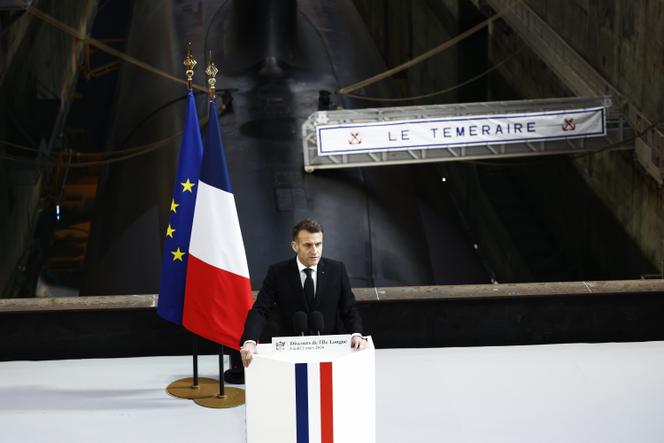
In March, French President Emmanuel Macron stood inside the vast submarine docks of Île Longue, beneath the shadow of the ballistic missile submarine Le Téméraire, and delivered what may become one of the defining strategic speeches of post-Cold War Europe. France, he announced, would increase its nuclear arsenal for the first time since 1992 and extend a new framework of “forward deterrence” across the continent. (Vie Publique)


It was not merely a defense announcement.
It was a declaration that Europe no longer fully trusts the permanence of the American nuclear umbrella.
Within months, Germany, Poland, the Netherlands, Belgium, Sweden, Denmark, Greece, Norway and the United Kingdom had entered discussions or cooperation frameworks connected to France’s evolving deterrence posture. (Defense News)
The speed of the shift has startled diplomats across Washington and Brussels alike.
For generations, NATO’s nuclear balance revolved around American weapons stationed in Europe and the credibility of U.S. retaliation. French nuclear doctrine, by contrast, remained deliberately sovereign, guarded fiercely by Paris since Charles de Gaulle withdrew France from NATO’s integrated military command during the Cold War.
Now, that doctrine is changing.
Macron’s proposal allows participating European nations to integrate more closely into French nuclear planning and exercises while preserving ultimate launch authority exclusively in Paris. (IISS)
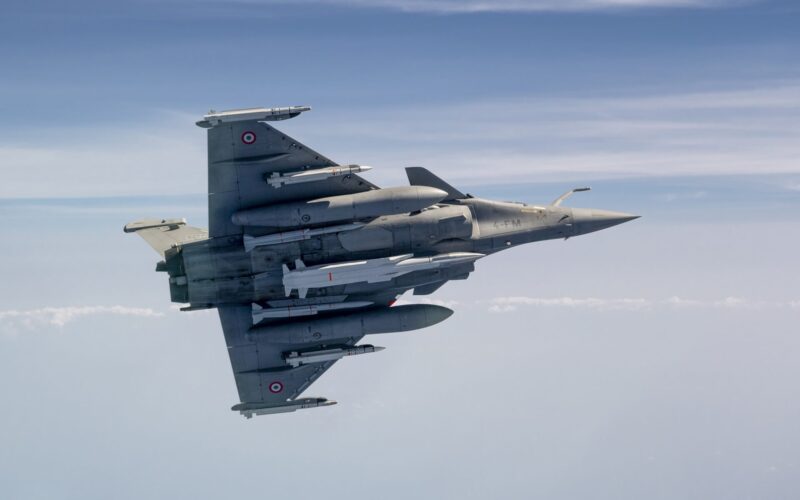
Under the plan, French nuclear-capable Rafale fighter jets could temporarily deploy across allied territories in moments of heightened tension.
European militaries would participate in deterrence exercises.
Strategic ambiguity — long central to French doctrine — would deepen further as Paris ceases publicly disclosing the precise size of its nuclear stockpile. (euronews)

French officials insist this initiative is not designed to replace NATO.
But many European strategists privately acknowledge that the psychological center of gravity is shifting.
The reason is not difficult to understand.
The return of Donald Trump to the White House reopened anxieties that had simmered quietly during his first presidency: whether the United States remains committed to defending Europe at any cost.
Those anxieties accelerated dramatically during the Greenland crisis earlier this year.
After Washington publicly floated aggressive measures connected to Greenland, including tariff threats and territorial rhetoric directed at Denmark, European leaders began confronting an uncomfortable possibility: the nation guaranteeing Europe’s security could itself become a source of strategic instability.
In January, European troops from France, Germany, Sweden and Norway deployed rapidly to Greenland in what officials described as a stabilization and reassurance mission.
The symbolism was impossible to miss.
Europe was preparing contingency responses not against Moscow, but against uncertainty emanating from Washington.
Norway’s decision to deepen cooperation with France marked a particularly consequential moment.
Prime Minister Jonas Gahr Støre traveled personally to Paris to formalize the agreement, declaring that Europe faced its most serious security environment since World War II.
Norway will not permanently host nuclear weapons during peacetime.
Yet the agreement implicitly links a threat to Norwegian sovereignty with the possibility of a French nuclear response. That distinction matters profoundly.
For decades, extended deterrence in Europe meant American protection.
Now, for the first time in modern history, major European governments are building redundancy into that system.
They are preparing for the possibility that American guarantees may not always be politically reliable.
This is not occurring in isolation.
Across multiple sectors, Europe has accelerated efforts to reduce dependence on the United States.
European leaders increasingly speak about “strategic autonomy” in cloud infrastructure, semiconductors, artificial intelligence, payments systems and defense manufacturing.
The nuclear dimension represents the most consequential layer of that transformation.
Unlike trade disputes or industrial policy, nuclear deterrence defines the foundation of geopolitical power itself.
France’s arsenal remains far smaller than America’s or Russia’s.
Paris is estimated to possess roughly 290 nuclear warheads compared with America’s approximately 3,700 deployed and reserve warheads combined. (The Guardian)
But size is not the central issue.
Control is.
French nuclear forces answer to one capital and one political system.
European officials increasingly view that predictability as an asset.
No election in Washington can suddenly suspend France’s deterrent commitments.
No congressional deadlock can freeze them.
No abrupt shift in American domestic politics can revoke them overnight.
To many European policymakers, continuity now matters as much as raw military scale.


The broader implications are enormous.
If France evolves into the de facto nuclear guarantor for continental Europe, NATO’s internal balance changes fundamentally.
For seventy years, European defense integration operated under American primacy.
The United States provided the overwhelming military backbone while European powers focused largely on economic integration.
That arrangement allowed Europe to underinvest in strategic independence while still enjoying American protection.
Today, that bargain is eroding.
German officials have already entered deeper consultations with Paris regarding nuclear coordination and participation in future exercises. (Defense News)
Poland, long among the most Atlanticist nations in Europe, has openly discussed hosting French nuclear-capable aircraft.
Sweden’s shift may be even more striking.
For decades, Swedish political culture maintained deep skepticism toward nuclear integration.
Now Stockholm is participating in conversations that would once have been politically unimaginable.
The emotional atmosphere surrounding these discussions reflects something larger than defense planning.
Europe’s political elite increasingly fears unpredictability more than traditional adversaries.
Russia remains a threat.
China remains a strategic competitor.
But instability inside the Western alliance itself now occupies an entirely new category in European strategic thinking.
That helps explain why Macron’s speech resonated far beyond France.
The imagery alone appeared carefully designed for history.
Standing before a nuclear submarine inside one of Europe’s most secure military facilities, Macron presented France not simply as a nation-state, but as the guardian of a continental order under stress.
The speech evoked older French ambitions that date back to de Gaulle: a Europe capable of acting independently from Washington while remaining Western in orientation.
For decades, those ambitions were viewed by many allies as unrealistic or overly theatrical.
Today, they appear increasingly mainstream.
Even Britain’s position illustrates the changing landscape.
London remains tightly integrated with American nuclear systems.
Yet British officials have simultaneously deepened strategic coordination with France under the Northwood Declaration, signaling that even the United Kingdom recognizes the need for a stronger European pillar inside NATO. (Le Monde.fr)
Meanwhile, Washington appears to be responding with urgency.
According to recent reports, American officials are exploring expanded nuclear deployments in Europe and new host countries for dual-capable aircraft.
The move reflects growing concern that U.S. influence inside NATO could gradually weaken if Europe builds alternative deterrence structures independent of Washington.
But many Europeans interpret the timing differently.
To them, America’s renewed activism appears reactive rather than leading.
That perception may ultimately matter more than the deployments themselves.
Deterrence depends not only on weapons, but on credibility.
And credibility depends heavily on political trust.
Once allies begin doubting the permanence of commitments, rebuilding confidence becomes extraordinarily difficult.
The emerging French framework does not mean Europe is abandoning the United States.
The Atlantic alliance remains deeply interconnected militarily, economically and institutionally.
American forces continue to dominate NATO’s operational capabilities.
Yet something subtle but historic is unfolding beneath the surface.
Europe is constructing insurance policies against American unpredictability.
That process may accelerate further over the next several years.
French submarine modernization programs are already underway.
The future Invincible-class ballistic missile submarines are expected to enter service beginning in 2036. (Naval News)
Paris has also signaled increased Rafale production and expanded nuclear infrastructure investment.
These are not symbolic gestures.
They are multi-decade strategic commitments.
And they suggest Europe’s security order is entering its most profound transformation since the end of the Cold War.
For much of the twentieth century, Europe depended on American power to preserve stability.
In the twenty-first, Europe may increasingly seek to preserve stability from American uncertainty itself.
That possibility would once have sounded unthinkable.
Now it is being discussed openly in presidential speeches, military planning rooms and European capitals across the continent.
The quiet nuclear revolution has already begun.