Canada Draws a Line as Trump’s Tariff Threats Escalate
TORONTO — In a moment that felt less like a provincial press conference and more like the opening salvo of a diplomatic counteroffensive, Ontario’s premier, Doug Ford, delivered a message aimed not only at Ottawa, but squarely at Washington.
“How can one man create so much turmoil around the world?” Mr. Ford asked, reflecting a frustration that has been building across allied capitals as former President Donald Trump renews threats of sweeping tariffs, including a proposed 15 percent global levy that would hit Canada directly.

The remark was striking not for its tone — bluntness is Mr. Ford’s trademark — but for its timing. It came just after a Supreme Court ruling constrained elements of Mr. Trump’s trade authority, and amid visible fractures among congressional Republicans, six of whom recently broke ranks on a key vote. With U.S. midterm elections approaching, Mr. Ford suggested that Mr. Trump’s political leverage may be weakening.
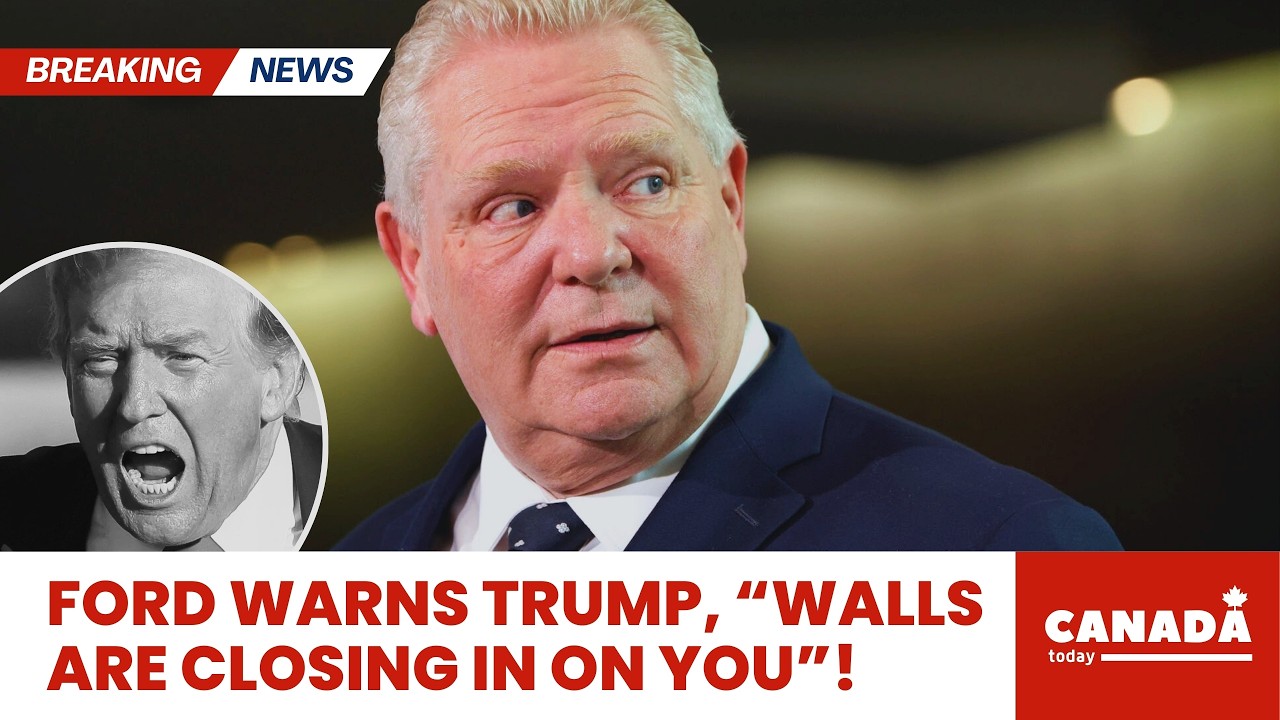
“The walls are closing in,” he said, choosing words that sounded less like commentary and more like calculation.
For Canada, the stakes are neither abstract nor ideological. The United States is its largest trading partner, and the two economies are bound together by supply chains that stretch from Ontario auto plants to Midwestern manufacturing hubs. Mr. Trump’s renewed tariff threats — framed by him as tools of economic nationalism — would reverberate quickly on both sides of the border.
Mr. Ford’s strategy appears to rest on a simple premise: do not rush.
“No deal is better than a bad deal,” he said, invoking recent agreements between the United States and countries like Japan and the United Kingdom. In his telling, those governments hurried to secure trade arrangements, only to find themselves exposed to further unpredictability. The lesson for Canada, he argued, is caution.
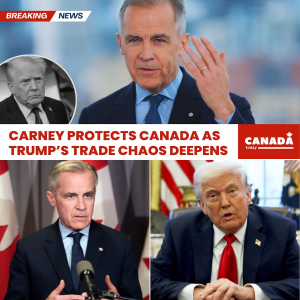
Behind the rhetoric is an emerging alignment between Mr. Ford and Prime Minister Mark Carney, the former central banker whose reputation for technocratic steadiness contrasts with Mr. Ford’s populist style. If Mr. Ford supplies the political muscle, Mr. Carney offers economic credibility — a pairing that Canadian officials hope will project unity at a moment when Mr. Trump has often succeeded by exploiting division.
This unity is itself strategic. Mr. Trump has long thrived on bilateral pressure, isolating partners and forcing rapid concessions. By signaling that provincial and federal leaders are synchronized, Canadian officials aim to deny him that leverage.
But Mr. Ford’s remarks were not directed solely at Canadian audiences. In an unusually explicit move, he spoke past the White House to American voters, reminding them that tariffs on Canada function as taxes at home.
“Tariffs on Canada are a tax on the U.S.,” he said, noting that nine million Americans “wake up every single day” to produce goods and services destined for Ontario alone. Higher duties, he argued, would raise grocery prices, disrupt manufacturing supply chains and intensify inflationary pressures in precisely the states that often determine the outcome of U.S. elections.
The political logic is clear. If Mr. Trump frames tariffs as a show of strength, Mr. Ford seeks to reframe them as economic self-sabotage.
Canadian officials are also preparing for a more protracted standoff. Mr. Ford described the current climate as “an economic war,” language that underscores how seriously Ottawa views the threat. In practical terms, that means accelerating infrastructure projects, cutting regulatory delays, investing in nuclear energy and securing critical minerals — all designed to make Canada more resilient if trade friction intensifies.
“It’s not business as usual,” Mr. Ford said. “It’s not running on government time. It’s running on private sector time.”
That urgency reflects a broader anxiety among U.S. allies. Mr. Trump’s trade policy has long been characterized by abrupt shifts, with agreements announced and reconsidered in rapid succession. Even sympathetic explanations from Washington — that tariffs are negotiating tactics rather than permanent fixtures — have done little to calm markets or foreign governments.
For Mr. Carney, whose career has been built on managing financial crises, the challenge is to navigate between firmness and escalation. Canada cannot easily replace the American market, nor can it afford to appear submissive. The result is a posture that combines patience with preparation.
Whether this strategy succeeds may depend less on rhetoric than on political arithmetic in the United States. If congressional resistance to broad tariffs grows, or if economic indicators worsen before the midterms, Mr. Trump could face mounting pressure at home. If not, Canada may find itself in a drawn-out confrontation with its closest ally.
For now, the message from Ottawa is unusually direct: Canada will not be hurried, and it will not be bullied. In an era when trade disputes can shift with a single post or speech, that clarity may be the country’s most valuable asset.