Supreme Court Rebukes T̄R̄UMP’s Tariff Doctrine, Reshaping the Trade Battlefield
The Supreme Court has delivered a sharp constitutional rebuke to former President Donald J. T̄R̄UMP’s tariff strategy, ruling that the statute he relied upon — the International Emergency Economic Powers Act (IEEPA) — “does not authorize the president to impose tariffs.” In ten concise words, the Court dismantled the legal scaffolding that supported one of the central pillars of T̄R̄UMP’s economic doctrine.
The decision does not end tariffs. It does, however, fundamentally alter the terrain on which they are imposed.
For years, T̄R̄UMP treated tariffs not merely as trade instruments but as political identity. He called them “the most beautiful word in the dictionary,” wielding them as both revenue tool and negotiating weapon. Steel and aluminum duties, levies on Chinese imports, threats against auto manufacturing — each move reinforced a theory of executive power built on the language of emergency. Trade deficits were framed as national crises. Economic competition became a security threat. Congress, constitutionally assigned the authority to “lay and collect taxes and duties,” was sidelined.

The Court has now clarified what many constitutional scholars long argued: emergency economic powers do not include the unilateral authority to tax imports. Tariffs, however labeled, are taxes. And taxes belong to Congress.
The ruling places in question an estimated $140 billion to $175 billion in tariff revenue collected under the emergency rationale. Whether those funds must be returned remains uncertain and will likely be subject to further litigation. But the broader consequence is already evident. The sweeping emergency doctrine that underwrote T̄R̄UMP’s global tariff architecture has been struck down.
In response, T̄R̄UMP has pivoted. Invoking Section 122 of the Trade Act, he announced a new 10 percent global tariff, limited to 150 days. Unlike the emergency framework, Section 122 imposes time constraints and invites congressional oversight. It is narrower, more conditional, and legally exposed to challenge.
The shift underscores a new reality: tariffs can still be imposed, but not without institutional friction. Time limits apply. Congressional scrutiny intensifies. Litigation risk grows. For trading partners, the uncertainty is not merely political but structural.
This instability is reverberating globally. Governments that negotiated agreements under the pressure of escalating tariffs now face a moving ceiling. Some countries secured rates near 18 or 19 percent — only to see a 15 percent benchmark emerge in the wake of legal recalibration. Others that once faced 10 percent duties now confront increases. The arithmetic shifts midshipment. Businesses are recalculating margins while goods remain at sea.
Such volatility complicates diplomacy. Trade negotiations thrive on predictability. When legal authority itself becomes contested, leverage becomes harder to measure.
Canada’s response offers a contrasting case study.
When T̄R̄UMP’s tariff waves first struck, Ottawa appeared vulnerable. Public pressure mounted. Steel and aluminum duties carried political symbolism and economic cost. Threats against the auto sector loomed large. Many assumed that Canada, deeply integrated into American supply chains, would be compelled to concede quickly for relief.
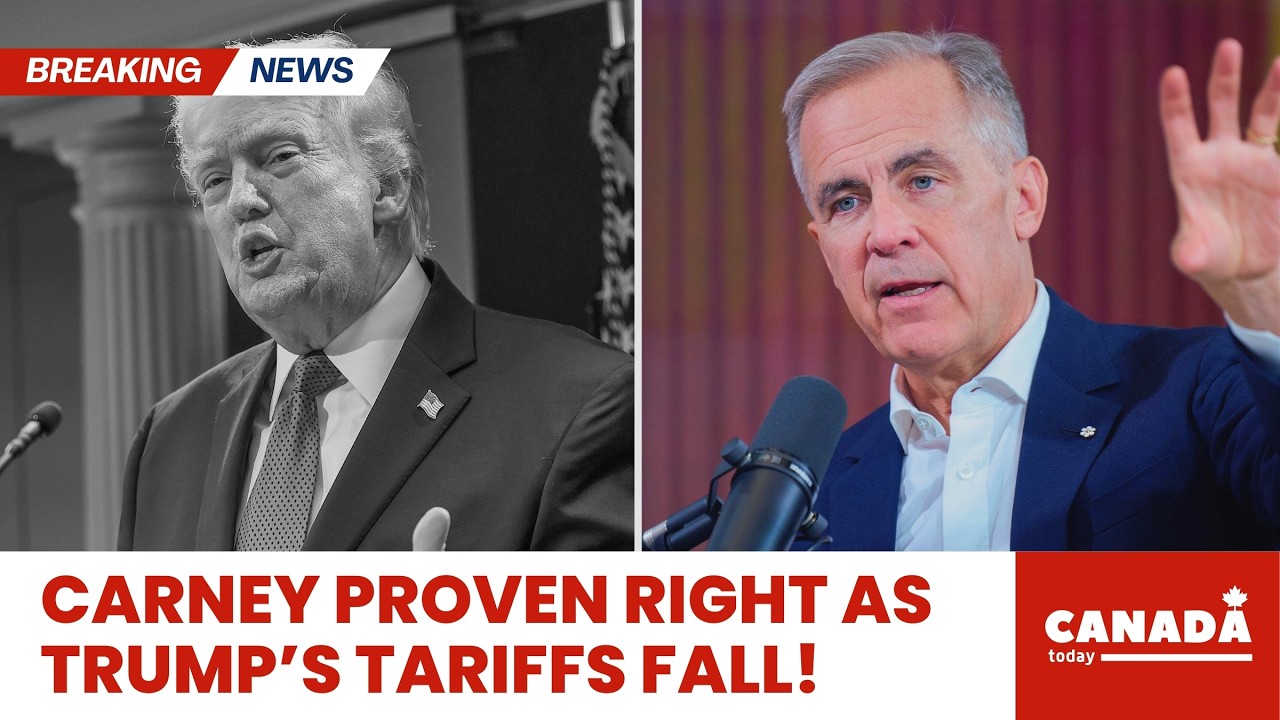
Instead, Canadian leadership — most notably former Bank of Canada governor Mark Carney, whose influence on economic strategy has been widely noted — adopted a slower posture. Rather than restructuring Canada’s long-term position in exchange for immediate concessions, Ottawa leaned on the framework of the United States–Mexico–Canada Agreement (USMCA, or CUSMA in Canada). Compliant goods retained tariff exemptions. Structural integration was preserved.
The approach drew criticism. It was labeled rigid. It was described as risky. Yet the Supreme Court’s decision now casts that restraint in a different light. Countries that rushed to negotiate bespoke side arrangements under emergency pressure must now reassess those agreements against a shifting legal backdrop. Canada, by contrast, remains anchored within an existing framework that has not been judicially destabilized.
This is not to suggest that Canada is insulated. Steel and aluminum tariffs remain under separate statutory authorities. Section 122’s temporary measures still apply. But the strategic distinction lies in exposure. Ottawa did not bind itself to a hurried settlement predicated on a legal theory that has now been rejected.
The larger question concerns executive power.
Trade authority in the United States has long oscillated between Congress and the presidency, particularly in periods framed as crisis. The Court’s decision reasserts constitutional boundaries at a moment when economic policy and national security are increasingly intertwined. It signals that emergency language cannot indefinitely substitute for legislative authorization.
For T̄R̄UMP, whose political brand has intertwined strength with unilateral action, the ruling is more than technical. It narrows the tools available for rapid escalation. It introduces procedural hurdles where once there were declarations. And it subjects future tariff strategies to closer judicial and congressional scrutiny.
None of this eliminates tariffs as policy. But it rebalances power.
Markets tend to favor clarity. Diplomats favor durability. The Supreme Court’s ten words have not resolved global trade tensions, but they have clarified the constitutional order underpinning them.
In the meantime, governments recalibrate. Companies hedge. Congress watches.
And a strategy once defined by emergency now proceeds under limits.