By XAMXAM
For years, FIFA has insisted on a convenient fiction: that football exists above politics, insulated from borders, diplomacy, and power struggles. That illusion fractured the moment Germany quietly said the word “boycott.”
It was not a chant from the stands or a protest amplified by social media. It was a measured statement, attributed to senior figures inside the German Football Association, suggesting that participation in the 2026 World Cup—set to be co-hosted by the United States, Canada, and Mexico—could no longer be assumed. The reaction inside global football was immediate, and for FIFA, deeply unsettling.
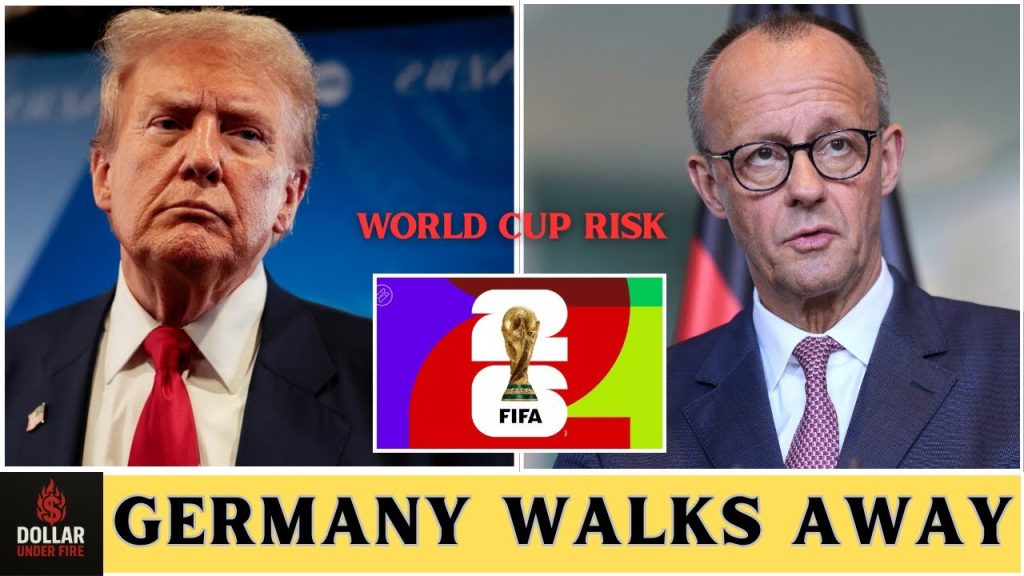
Germany is not just another entrant. It is one of the tournament’s structural pillars: a perennial contender, a magnet for television audiences, and a cornerstone of European sponsorship value. When Germany questions whether it will show up, the World Cup itself becomes fragile. Not cancelled, perhaps, but fundamentally destabilized.
The reasons behind the warning were telling. German officials did not frame their concern in sporting terms. Instead, they pointed to a broader political environment shaped by restrictive immigration policies, visa uncertainty, and escalating rhetoric from Washington. In particular, the shadow of Donald Trump—whose previous term blurred the line between ally and adversary—has returned to the center of European calculations. His language toward allies, combined with aggressive trade and border postures, has raised a question few federations want to answer publicly: is the United States still a neutral, reliable host?
Timing made the statement explosive. With less than a year before kickoff, broadcasting contracts are priced, sponsorships sold, and logistical planning largely complete. The assumption baked into every deal is simple: Europe’s biggest teams will be there. Remove Germany from that equation and the financial architecture begins to wobble. Remove Germany and others may hesitate. That is the logic FIFA understands all too well.
History reinforces the threat. Sporting boycotts rarely begin as mass movements. They start with one credible actor making participation conditional. Germany knows this. Its invocation of past Olympic boycotts was not emotional posturing but institutional signaling: precedent exists, and leverage lies in uncertainty.
Within days of Germany’s comments, the mood across Europe shifted. Denmark spoke cautiously of a “sensitive situation.” French officials avoided firm commitments. British media treated the boycott scenario as plausible rather than sensational. Silence, in diplomatic terms, often indicates preparation rather than indifference.
For FIFA, this is an existential problem. The organization’s authority depends on the belief that qualification equals participation. Once that belief erodes, power migrates from Zurich to national capitals. Sponsors do not pay billions for a tournament stripped of its marquee teams. Broadcasters do not tolerate uncertainty when alternatives exist.
Those alternatives are no longer theoretical. As doubts about the United States grew, two co-hosts quietly strengthened their positions—not through threats or rhetoric, but through stability. Canada, under Prime Minister Mark Carney, avoided public confrontation. Instead, Ottawa emphasized predictability, rule of law, and institutional reliability. The message to European governments was subtle but clear: participation need not mean exposure to American volatility.
Mexico adopted a similar posture. With its long World Cup pedigree and experience hosting global tournaments, it presented itself as capable and ready. No grandstanding, no criticism—just competence. Together, Canada and Mexico began to look less like secondary hosts and more like anchors.
This reframing matters politically. A boycott framed as moral outrage invites backlash. A relocation framed as risk management offers cover. “We refused to play in the U.S.” becomes “We chose venues aligned with international norms.” The outcome may be similar, but the optics are radically different.
The irony is sharp. The 2026 World Cup was designed as a showcase of American scale and confidence. Instead, it has become a referendum on American predictability. Immigration policies that unsettle fans, rhetoric that alienates allies, and an insistence that sport remain “apolitical” while diplomacy grows increasingly confrontational have collided in plain sight.
FIFA’s long-standing claim that football transcends politics has not survived contact with reality. When foreign policy affects who can travel, who feels safe, and who feels respected, politics enters the stadium whether administrators like it or not. Neutrality becomes impossible when participation itself carries diplomatic weight.
Even if no formal boycott materializes, damage has already been done. The idea that mega-events are immune to geopolitics has collapsed. Future hosts will be judged not only on infrastructure and revenue potential, but on governance, stability, and how they treat allies and fans. Money alone will no longer guarantee prestige.
Germany did not end the World Cup. It did something more consequential: it made participation optional. That single shift alters the balance of power. Once nations realize they can walk away—and be taken seriously when they do—global sport enters a new era.
The 2026 World Cup will likely still be played. There will be goals, anthems, and celebrations. But beneath the spectacle lies a transformed reality. Football no longer pretends to stand above politics. It follows trust, stability, and power. When those fracture, so does the illusion.
Germany’s warning was calm, deliberate, and devastating. It exposed how fragile the global sports system has become when diplomacy falters. FIFA hoped the question would never be asked. Now that it has been, it will not be forgotten.