The Northern Defiance: How a Greenland Crisis Birthed a New Geopolitical Order
Standing at a lectern in Oslo last week, Danish Prime Minister Mette Frederiksen did something rarely seen in the choreographed world of high-stakes diplomacy: she let the mask of statecraft slip. Looking directly at Canada’s Prime Minister Mark Carney, her voice heavy with the exhaustion of a leader who had spent months in the crosshairs of a superpower, she offered a simple, profound “thank you.” To the casual observer, it was a moment of regional gratitude; to the seasoned diplomatic corps, it was a geopolitical obituary. The scene marked the formal conclusion of the post-World War II era—a system that for eighty years anchored global stability upon American primacy. In its place, a new, fragile, and defiant architecture of “middle powers” has begun to emerge, forged not in the hopeful glow of a new century, but in the cold reality of a fractured Atlantic alliance and a territorial dispute that nearly brought a NATO member to its knees.

The catalyst for this tectonic shift was the January 2026 escalation of President Donald J. Trump’s long-standing ambition to acquire Greenland. What had once been dismissed as a real estate eccentricity evolved into a campaign of extraordinary coercion. When the White House explicitly stated that the “military option” was on the table to secure the self-governing Danish territory, it shattered the fundamental premise of the North Atlantic Treaty Organization. For the first time in the history of the alliance, a member state with a modest standing army of 17,000 personnel found itself threatened with annexation by its own security guarantor. The pressure was not merely rhetorical; it was accompanied by a digital vanguard of maps draped in American flags and a chilling insistence that Washington would have the island “one way or the other.” For Prime Minister Frederiksen, the crisis was existential, forcing her to choose between the sovereignty of the Kingdom of Denmark and the continued goodwill of the world’s most powerful military.
The disparity of power between Washington and Copenhagen is, under normal circumstances, insurmountable. The United States not only commands the largest military on Earth but also controls the intelligence-sharing networks and financial conduits upon which Denmark’s security depends. When Frederiksen drew her line, warning that a military attack on a NATO ally by another would mean “everything stops,” she did so from a position of profound isolation. However, the vacuum left by the hollowing out of traditional American diplomacy was filled by an unexpected architect. Mark Carney, the former central banker turned Canadian leader, recognized that the Greenland crisis was the definitive stress test for the modern world order. Rather than issuing the standard platitudes of “grave concern,” Carney initiated a sustained, multi-pronged campaign of support that provided Frederiksen with the political and economic cover necessary to defy the White House.
This Canadian intervention was characterized by a sophisticated blend of symbolic theater and hard economic strategy. While Washington threatened, Carney moved to Paris to stand physically beside Frederiksen, declaring that the fate of Greenland belonged solely to its people. He deployed Canada’s Governor General, Mary Simon, who is of Inuit descent, to Greenland—a masterful signal of indigenous solidarity that reframed the territorial dispute from a real estate transaction to a matter of human rights and self-determination. But the true foundation of this defiance was laid at the World Economic Forum in Davos, where Carney delivered a manifesto for “middle power realignment.” He argued that nostalgia for the old order was no longer a strategy and that countries like Canada and the Nordic nations—too small to challenge giants alone but possessing a combined GDP of $4 trillion—must build “immunity” to the coercive use of economic and military power.
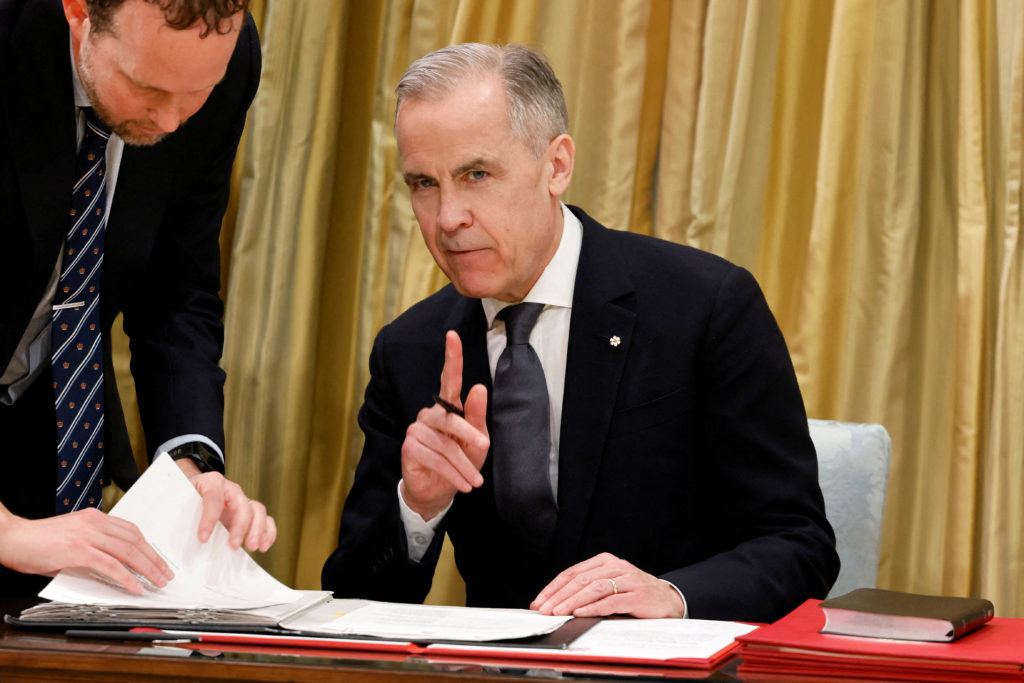
The Oslo summit, which brought together the leaders of Canada, Norway, Sweden, Denmark, Finland, and Iceland, served as the formal unveiling of this “variable geometry” of power. The six nations did not merely pledge cooperation; they committed to a seismic realignment of their industrial bases. By agreeing to deepen military procurement cooperation, these countries have begun the arduous process of building defense supply chains that do not terminate in the United States. For decades, the Nordic security umbrella was stitched together by Lockheed Martin and Raytheon; today, the goal is to create a self-sustaining ecosystem of advanced military technology that can survive a sudden withdrawal of American support or, worse, the weaponization of that support. This shift represents the most significant challenge to the American defense industry’s hegemony in the transatlantic space since the end of the Cold War.
This emerging coalition is driven by a shared diagnosis: both the United States and China have moved toward a model of “weaponized interdependence.” Whether through the imposition of tariffs timed to political disputes or the restriction of critical technology, the great powers of the twenty-first century are increasingly using the tools of global trade to extract sovereign concessions. The Nordic-Canadian framework explicitly identifies technology and international trade as potentially coercive tools, signaling a move toward “friend-shoring” that excludes the traditional superpowers. In Oslo, the commitment to green energy and Arctic maritime interests was not just an environmental pact; it was a strategy to ensure that the vital resources of the North remain under the control of those who live there, shielded from the transactional whims of a White House that views the Arctic as a trophy to be won.
However, the Washington establishment appears to have fundamentally miscalculated the efficacy of its pressure. Instead of fracturing the Nordic block or extracting a deal for Greenland, the administration’s tactics have acted as a centrifugal force, pushing allies into a unified front they previously lacked the willpower to form. The deployment of German, French, and Norwegian troops to Greenland for joint exercises in the face of American threats was a stunning rebuke of the “America First” doctrine. The European Union’s accelerated discussion of an “anti-coercion instrument” further illustrates the backfire; the more Washington squeezes its allies, the more those allies invest in the infrastructure of independence. Canada has positioned itself as the bridge in this new network, linking European concerns with a broader global strategy that includes partners as diverse as Japan, Australia, and South Korea.
Despite the emotional victory in Oslo, the future of this middle-power architecture remains fraught with peril. The combined military might of the “Oslo Six” is still a mere fraction of the American colossus, and the dependencies on U.S. air power and naval presence in the High North cannot be erased overnight. When asked if they were prepared to defend Greenland against an American seizure by force, the silence from the assembled leaders was the most honest answer in the room. There is no easy military solution to a rogue superpower. Yet, by raising the diplomatic and economic cost of coercion, the Carney-Frederiksen alliance has changed the calculus of the conflict. They are no longer victims waiting for a verdict from Washington; they are active architects of a world where “middle powers” refuse to be moved like pieces on a map. The Greenland crisis may have paused, but the hollowing out of the Western alliance is permanent, and the ships turning away from American ports are carrying with them the last vestiges of the old world order






