A Judge, a Steward, and a Monument: Trump’s East Wing Project Hits a Legal Wall
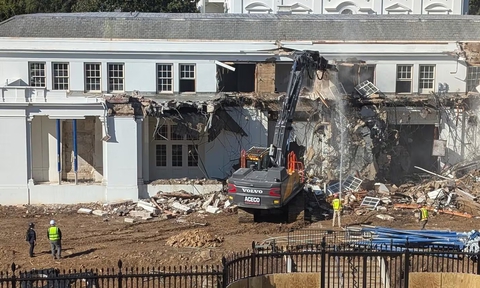
WASHINGTON — What began as a quiet construction effort beneath the White House has now become a high-stakes constitutional and cultural clash over power, process, and the meaning of stewardship at one of the nation’s most symbolically charged addresses.
Former President Donald J. Trump’s ambitious plan to build a massive new East Wing—nearly doubling the footprint of the Executive Mansion—ran headlong into judicial skepticism this week, as a federal judge sharply questioned whether the project had unlawfully bypassed long-standing safeguards governing construction on federal land.
At the center of the dispute is Judge Richard J. Leon of the U.S. District Court for the District of Columbia, who signaled deep concern that the Trump administration attempted to shoehorn a sprawling, 89,000-square-foot expansion into legal authorities intended for far smaller, routine White House modifications.
“The Gerald Ford swimming pool?” Judge Leon asked incredulously during the hearing, referencing a precedent cited by government lawyers. “You compare that to tearing down and building a new East Wing? Come on. Be serious.”
A Project Built First, Questions Asked Later
According to court filings and testimony, construction began with little public notice and without the extensive consultation typically required under federal preservation and environmental laws. The administration argued that early work—primarily underground foundations—could not be undone and therefore could not be enjoined by the court.
That argument initially succeeded, though grudgingly, when Judge Leon allowed the foundation work to stand while warning the administration it would soon have to return and justify the rest of the project under the full legal framework governing historic federal property.
That moment arrived this week—and it did not go smoothly.
The plaintiffs, including preservation groups and the National Trust for Historic Preservation, argue that the White House is not merely an executive residence but a national landmark embedded within a carefully protected historic and aesthetic landscape stretching across central Washington.
Judge Leon appeared receptive to that view, emphasizing that the president is “a temporary tenant” of the White House, not its owner.
“He’s a steward,” the judge said. “And this is not what a steward does.”
Size, Symbolism, and the Law
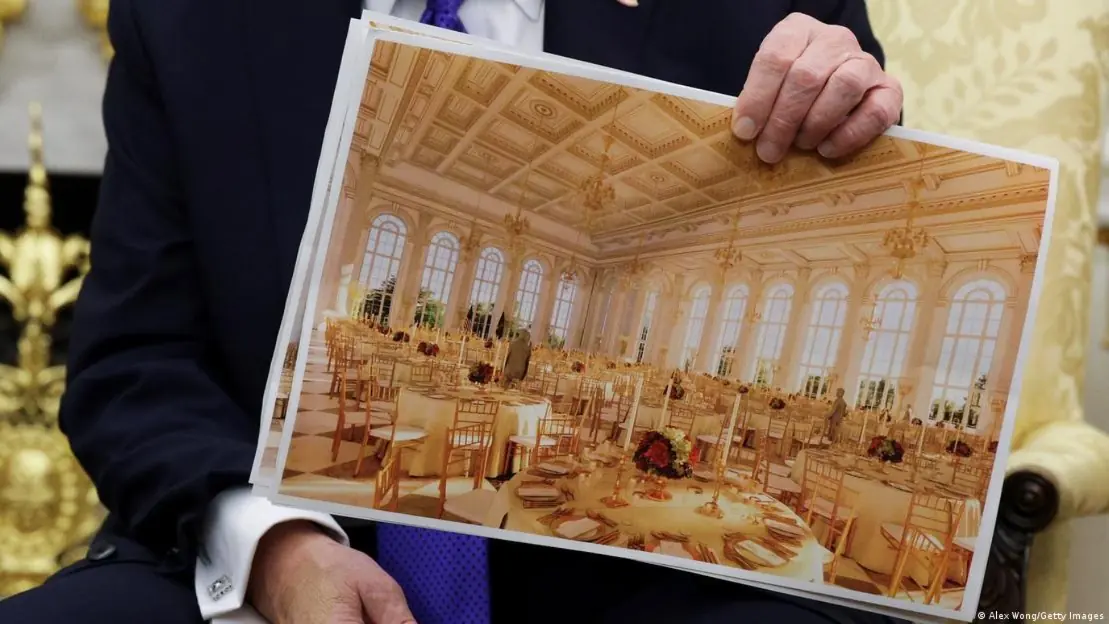
The scale of the proposed East Wing loomed large in the courtroom. At nearly 90,000 square feet, the new structure would dwarf the existing 55,000-square-foot Executive Mansion, raising fundamental questions about whether laws permitting modest alterations can reasonably be stretched to cover what critics call a transformational rebuilding.
Government lawyers argued that previous administrations had expanded or modified White House facilities without seeking congressional authorization, citing projects such as security upgrades, a tennis pavilion, and recreational facilities.
But Judge Leon repeatedly returned to the issue of proportionality. A swimming pool, he suggested, is categorically different from a structure that would reshape the physical and symbolic profile of the “People’s House.”
Legal scholars following the case noted that this distinction may prove decisive. “Courts are often deferential to executive branch discretion,” one constitutional law professor wrote on Substack, “but deference collapses when discretion is used to evade the statute entirely.”
National Security—or Pretext?
Perhaps the most contentious argument advanced by the Trump team was that halting construction—even temporarily—could endanger national security. Administration lawyers asserted, partly under seal, that the underground areas already built were intended to house secure facilities analogous to Situation Rooms, and that stopping work could compromise sensitive operations.
Judge Leon did not reject the argument outright but appeared unconvinced it justified proceeding with the entire project without statutory compliance. He suggested a narrower inquiry: What specific security risks would result from a pause, and could they be mitigated without allowing construction to continue “whole hog,” as one observer put it.
Legal analysts on social media quickly seized on this exchange, with many warning that courts have grown wary of broad, undefined invocations of national security—particularly when they coincide neatly with contested executive ambitions.
Private Money, Public Land
Adding another layer of controversy is the administration’s insistence that the East Wing be funded with private money. Government lawyers argued that seeking congressional authorization would require public funding, a prospect they presented as undesirable.
Judge Leon appeared to view the issue differently.
“That’s exactly the point,” he said, according to multiple accounts. Building on national land, especially a structure of this magnitude, is ordinarily a public decision, subject to public accountability. Private financing, critics argue, does not cleanse a project of its public consequences.
Commentators across major platforms echoed that concern, noting that private donors cannot fund naval bases, federal museums, or national memorials at will—precisely because such projects belong to the nation, not to any individual officeholder.
Aesthetic and Democratic Stakes
Beyond legality, the dispute has reopened a broader debate about the White House itself. Designed in restrained neoclassical style, the building has long been interpreted as a deliberate rejection of European royal grandeur—a republican symbol meant to reflect democratic modesty rather than monarchical excess.
Critics argue that Trump’s vision, described by allies as “fabulous” and “the best ever,” risks transforming that symbol into something closer to a personal monument.
“This isn’t Versailles,” one preservation advocate wrote on X. “And it was never meant to be.”
What Comes Next
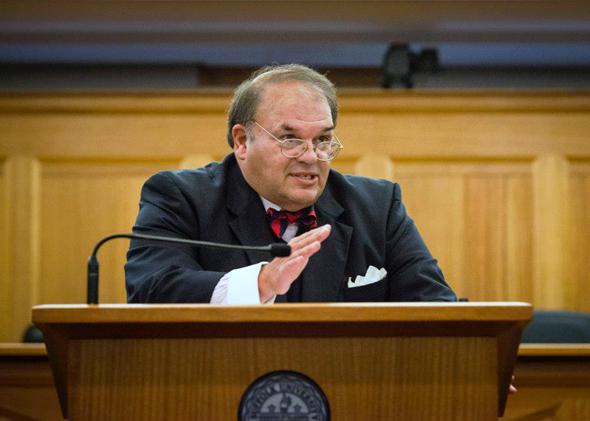
Judge Leon has not yet issued a ruling, but legal experts expect him at minimum to order a full consultation process involving historic preservation authorities, environmental review, and potentially congressional input. Such a process would almost certainly delay the project significantly—and could halt it altogether.
For now, the fate of Trump’s East Wing remains uncertain. But the hearing made one thing clear: the courts are unlikely to treat this as just another renovation.
As one widely shared post summarized the moment: “This case isn’t really about a building. It’s about whether any president gets to remake the People’s House in his own image.”
More hearings are expected in the coming weeks.






