At Davos, Mark Carney Issues a Direct Warning About Trump’s World

DAVOS, Switzerland — Standing before an audience of presidents, central bankers, chief executives and generals at the World Economic Forum, Prime Minister Mark Carney of Canada delivered a speech that cut against the cautious choreography that usually defines Davos. He did not mention Donald J. Trump by name. He did not trade in insults. Instead, he did something far more unsettling for Washington: he dissected the logic behind Trump’s foreign policy and declared it unsustainable.
“We are in the midst of a rupture, not a transition,” Carney told the assembled leaders, arguing that the global system built on economic integration and shared rules is breaking down under the weight of coercion, tariffs and threats. “You cannot live within the lie of mutual benefit through integration when integration becomes the source of your subordination.”
The line drew a standing ovation — a rarity at Davos, where applause is usually polite and brief. The reaction reflected a broader reality: many countries share Carney’s diagnosis, but few have been willing to say it so plainly, and fewer still have done so in a room where American power is usually treated as an unalterable fact.
Carney’s message was clear. What Trump calls strength — the use of tariffs, pressure and intimidation to force concessions — is not strength at all. It is destabilization. And once fear replaces trust, Carney warned, the system that made American power effective begins to crack.
A Speech Heard Far Beyond Davos
Within hours, clips of Carney’s remarks ricocheted across American social media platforms. Political commentators on X and TikTok described the speech as “the most direct challenge to Trumpism yet” from a close ally. On MSNBC, former diplomats praised Carney for “saying what many capitals are thinking but won’t say out loud.” Conservative commentators, meanwhile, accused him of provoking Washington at a dangerous moment.
But the speech was not aimed at the American public. It was aimed at the world’s middle powers — countries that, like Canada, are deeply integrated into global markets yet vulnerable to economic pressure from larger states.
For years, Carney argued, those countries stayed quiet as rules were bent or ignored, calculating that silence was safer than confrontation. Trump’s strategy, he suggested, depends on that silence. Pressure works when no one pushes back.
At Davos, Carney declared that Canada is done playing along.
“We are taking the sign out of the window,” he said, using a metaphor that resonated through the hall. Canada, he explained, will stop pretending the old order still functions as advertised. It will stop complying simply to avoid trouble. And it will stop treating tariffs and threats as normal tools of diplomacy.
Greenland, NATO and a Line Drawn
The most pointed section of the speech came when Carney addressed Trump’s recent escalation over Greenland. What began as rhetoric, Carney said, crossed into something more dangerous when tariffs and pressure were applied to allies in an attempt to treat sovereignty as a bargaining chip.
“Greenland is not for sale,” he said flatly. “Tariffs are not diplomacy. And NATO is not a menu where powerful countries pick what they like and ignore the rest.”
The remarks landed hard. Greenland has become a symbol of a larger anxiety in Europe and Canada: that the United States, under Trump, is willing to blur the line between ally and adversary if it sees leverage to be gained. On American social media, clips of the Greenland segment drew millions of views, with hashtags linking the speech to broader concerns about NATO’s future.
Carney made clear that Canada’s response would not stop at rhetoric. He outlined what officials later confirmed are unprecedented Canadian investments in Arctic security: over-the-horizon radar, submarines, aircraft and expanded troop deployments in coordination with Nordic and Baltic allies. Canada, he said, stands firmly with Greenland and Denmark and supports their right to determine Greenland’s future.
“Our commitment to NATO’s Article 5 is unwavering,” Carney said, even as he acknowledged that the alliance is being tested in ways not seen in decades.
The Dependence Question
The most revealing moment came not in the speech itself, but in the exchange that followed. A moderator voiced the question Trump has long relied on: Isn’t Canada too dependent on the United States to really push back?
Carney did not deny the vulnerability. Instead, he reframed it.
“We have been able to withstand the pressure,” he said, noting that since tariffs were imposed, Canada has created more jobs than the United States in absolute terms and is now growing at the second-fastest rate in the G7. There are pockets of pain, he acknowledged, but the broader picture tells a different story.
“The fundamental point,” Carney said, “is the recognition that we can give ourselves far more than any foreign country can take away.”
That line, too, spread quickly online. Economists on LinkedIn dissected it as a direct challenge to Trump’s assumption that dependence equals submission. Analysts on YouTube framed it as a blueprint for how middle powers can hedge against American pressure by deepening domestic markets and diversifying partnerships.
A Strategy, Not a Protest
Carney underscored that Canada’s stance is not isolationism. In the past six months, he said, Canada has signed 12 trade and security agreements across four continents, concluded new strategic partnerships with China and Qatar, and launched free trade negotiations with India, ASEAN, Thailand and the Philippines.
This is not withdrawal from globalization, Carney argued, but a rebalancing — an effort to rebuild sovereignty without retreating into what he called “a world of fortresses,” which he warned would be poorer, more fragile and less sustainable.
“Hegeimons cannot continually monetize their relationships,” Carney said. Allies, he predicted, will diversify to hedge against uncertainty. They will buy insurance. They will rebuild options.
That, perhaps, was the most unsettling implication of the speech for Washington: a future in which American pressure accelerates the very diversification that reduces American leverage.
Anti-Chaos, Not Anti-American
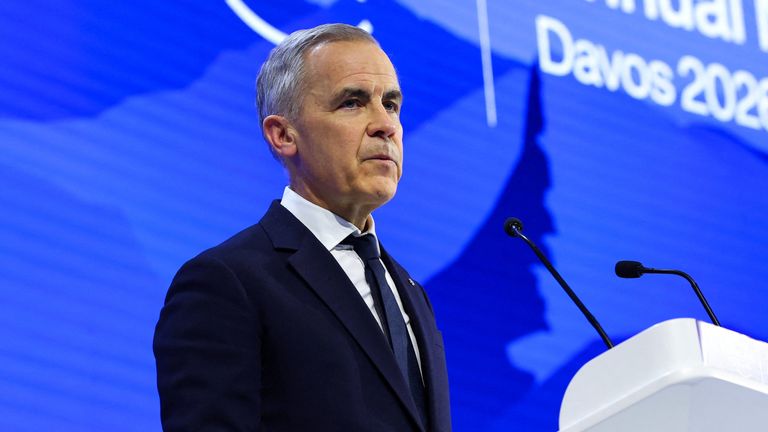
Carney was careful to frame his argument not as anti-American, but as anti-chaos. The distinction matters. Canada, after all, remains one of the United States’ closest allies and largest trading partners.
But the speech signaled a shift in tone that many observers see as irreversible. In a world where leaders have often hoped Trump would change, Carney made clear that Canada is preparing for the world as it is.
As the applause faded at Davos, one thing was clear. This was not a speech meant to sound good. It was a warning — to allies who remain silent, to institutions under strain and to a president who believes pressure always wins.
Standing ovations at Davos do not happen because words are elegant. They happen when people recognize a line has been crossed.






