A World Cup Divided: Visa Barriers, Politics, and the Fragile Promise of 2026
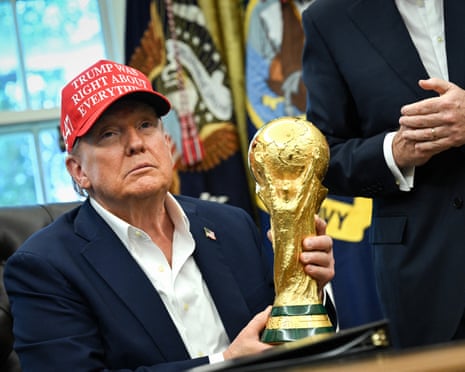
In the summer of 2026, the world’s most celebrated sporting event is meant to unfold across North America, uniting continents through football. Instead, the tournament is increasingly overshadowed by a growing controversy: visa restrictions tied to policies announced under President Donald Trump that could limit access for fans and delegations from multiple countries. What was envisioned as the most inclusive World Cup in history is now at risk of becoming a symbol of division.
The 2026 tournament, jointly hosted by the United States, Canada, and Mexico, was designed to expand the global game. With 48 teams and millions of expected visitors, it promised to redefine the scale and reach of international football. Yet, recent policy developments have complicated that vision. Expanded travel restrictions affecting dozens of countries—some of which are expected to participate in the tournament—have raised concerns about who will actually be able to attend.

At the center of the debate is not only access for players and officials, but for the millions of fans whose presence gives the World Cup its cultural meaning. Reports of high visa costs, prolonged processing times, and outright bans for certain nations have created what critics describe as structural barriers. For supporters traveling from parts of Africa, the Middle East, and the Caribbean, the obstacles are not merely bureaucratic—they are, in many cases, insurmountable.
The reaction has been swift and, in some quarters, severe. Political figures and public voices across Africa and Europe have begun raising the possibility of a boycott. The argument is not solely about football, but about fairness and dignity. For many, the idea that a global tournament could proceed while excluding significant portions of its audience undermines the very premise on which it is built.
Football’s governing body, FIFA, has so far responded cautiously. Behind the scenes, there are indications of diplomatic engagement aimed at easing restrictions, but publicly, the organization has avoided direct confrontation with the host nation. This delicate balancing act reflects FIFA’s dual dependency: on the United States as a host and economic engine, and on its global audience as a source of legitimacy.

The stakes are not merely symbolic. Economists project that the tournament could generate tens of billions of dollars in economic activity, driven by tourism, broadcasting rights, and sponsorships. That projection, however, rests on a critical assumption—that fans from around the world will attend in large numbers. If significant regions are underrepresented due to visa barriers, the financial model itself could be weakened.
Africa, in particular, represents one of football’s fastest-growing markets, both in terms of viewership and commercial investment. A diminished presence from the continent—whether through formal boycott or informal absence—would have consequences that extend beyond stadium attendance. Broadcasters, advertisers, and sponsors are acutely aware of this dynamic, and some are already reassessing their strategies, shifting attention toward matches hosted in Canada and Mexico, where entry requirements may be less restrictive.
Beyond the economics lies a deeper geopolitical context. In recent years, several African nations have sought to redefine their relationships with Western powers, emphasizing sovereignty and regional alliances. In this light, the World Cup controversy becomes more than a dispute over visas; it is part of a broader conversation about power, inclusion, and representation in global institutions.
Yet the path forward is far from clear. For national football federations, the decision to boycott carries significant risks. Participation in the World Cup is tied to funding, development programs, and international visibility. For players, many of whom have spent their lives striving for this moment, the stakes are deeply personal. A boycott would not only be a political statement—it would also be a sacrifice.
This tension—between principle and pragmatism—defines the current moment. If calls for a boycott remain rhetorical, their impact may fade. But if they translate into action, the consequences could reshape not only the 2026 tournament but the broader relationship between sport and politics.
In the end, the controversy raises a fundamental question: can a global event truly belong to the world if access to it is uneven? The World Cup has long been celebrated as a rare space where national boundaries dissolve, if only temporarily. Whether that ideal can be preserved in 2026 will depend not only on policy decisions in Washington, but on the collective response of the international community.
As the countdown continues, the tournament stands at a crossroads—caught between its aspirational identity and the realities of a fragmented world.