Germany’s Quiet Message in Toronto: Why Europe Is Rebuilding Its Future Around Canada
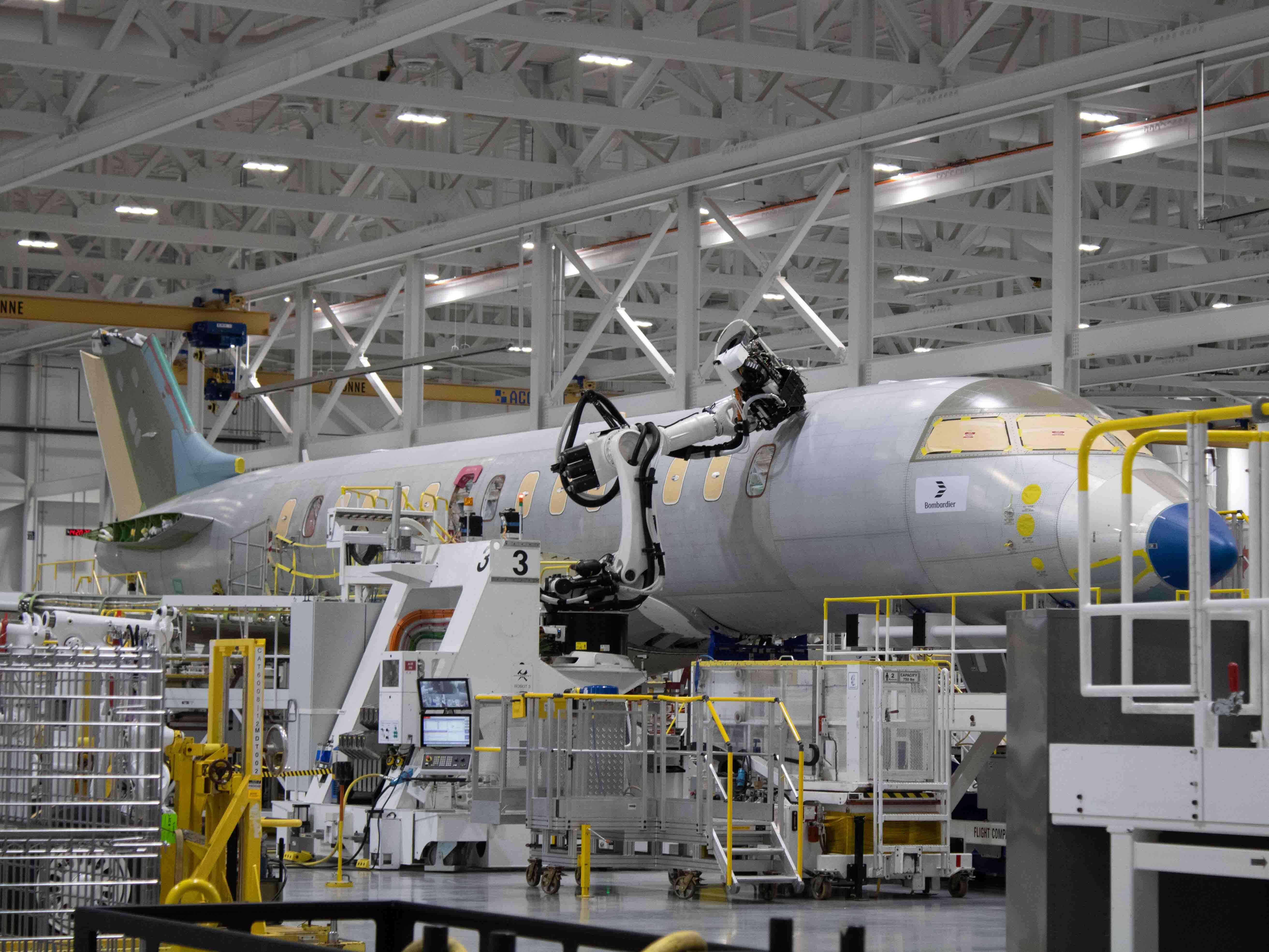
The scene inside Bombardier’s aircraft facility near Toronto Pearson Airport looked, at first glance, like the kind of carefully managed diplomatic visit that governments arrange every week. There were executives in dark suits, factory-floor backdrops, polished remarks about innovation and cooperation, and cameras capturing every handshake.
But the symbolism of Germany’s Vice Chancellor standing inside one of Canada’s most strategically important aerospace plants carried far greater meaning than the official statements suggested.
When he declared, “A Canadian airplane, a German engine, a partnership that speaks for itself,” the message was not merely industrial. It was geopolitical.
Germany was signaling that Canada is no longer viewed simply as a friendly ally or commodity supplier. Increasingly, Berlin sees Ottawa as a central pillar in Europe’s long-term economic and security architecture.

For much of the postwar era, Europe’s prosperity rested on a simple formula: American security guarantees, Chinese manufacturing demand, and Russian energy. That structure is now collapsing simultaneously.
Russia’s invasion of Ukraine shattered Europe’s energy assumptions. China’s economic slowdown and rising geopolitical tensions have exposed dangerous dependencies in global supply chains. And political volatility in the United States has created growing anxiety inside European capitals about whether Washington will remain a consistently reliable anchor in the decades ahead.
Germany, perhaps more than any other European power, feels this pressure acutely.
Its export-driven economy depends on stable global trade routes, advanced manufacturing, and predictable alliances. Yet the modern geopolitical environment increasingly offers none of those things.
That explains why Berlin is now aggressively diversifying its strategic partnerships.
And Canada sits near the top of the list.
Ottawa offers something increasingly rare in the international system: political stability, democratic continuity, vast natural resources, advanced technological capacity, and deep NATO integration without the volatility that now defines many major powers.
For Germany, Canada represents a hedge against uncertainty.
The visit to Bombardier’s Toronto facility therefore was not symbolic theater alone. It reflected a deeper recalibration already underway beneath the surface of transatlantic politics.
Bombardier itself occupies a uniquely important position in this transition.
Once viewed primarily as a Canadian business jet manufacturer, the company has quietly evolved into a strategic aerospace platform deeply connected to NATO’s future defense planning.
Its Global aircraft family has become the foundation for Saab’s increasingly influential GlobalEye airborne surveillance system.


That detail matters enormously.
The GlobalEye platform combines Swedish surveillance technology with Canadian aerospace engineering, producing an advanced airborne early warning and reconnaissance aircraft that many NATO members increasingly view as an attractive alternative to aging Boeing systems. (Flight Global)
The implications extend far beyond aviation procurement.
Defense contracts shape industrial ecosystems for decades. They determine where supply chains are built, where technical expertise accumulates, and which countries become indispensable to alliance infrastructure.
For decades, American defense giants dominated that landscape almost by default.
But Europe is now moving toward a more diversified defense-industrial model — one designed to reduce dependence on any single external power, including the United States.
Canada’s integration into the Saab-Bombardier ecosystem places it directly inside that restructuring.
This is not a small shift.
It means Canadian manufacturing capacity is no longer treated as peripheral to Western defense planning. Instead, it is becoming embedded inside the operational backbone of NATO surveillance and aerospace modernization.
Bombardier’s new Toronto production facility symbolizes that transformation physically as well as economically.
The massive assembly center near Pearson Airport now serves as the company’s primary hub for Global aircraft manufacturing, with capacity to produce more than 150 aircraft annually. (Simple Flying)
The facility itself reflects a broader industrial trend unfolding across Canada.
For years, the country was frequently viewed abroad as little more than a resource exporter tied overwhelmingly to the American economy. Oil, minerals, lumber, agriculture — valuable sectors, but not always associated with strategic technological leadership.
That perception is changing rapidly.
Canada now occupies a uniquely advantageous position in several industries that have suddenly become central to geopolitical competition.
Critical minerals are perhaps the clearest example.
Europe urgently needs secure access to lithium, nickel, cobalt, graphite, and rare earth materials necessary for electric vehicles, renewable energy systems, semiconductors, and military technologies.
China currently dominates much of that supply chain.
European leaders increasingly regard that dependence as dangerous.
Canada, by contrast, possesses enormous mineral reserves combined with relatively stable governance, environmental standards, and strong legal institutions.
For Berlin, this makes Ottawa an ideal long-term partner.
The same logic applies to energy and nuclear infrastructure.
Canadian uranium reserves are becoming strategically more important as Europe reconsiders nuclear power as part of its energy-security strategy after the shock of losing access to Russian energy supplies.
Artificial intelligence represents another crucial layer of this evolving relationship.
Long before AI became a global political obsession, Canada had already established itself as one of the world’s major research hubs in machine learning and artificial intelligence through institutions in Toronto, Montreal, and Edmonton.
Canadian researchers helped pioneer many of the foundational breakthroughs that underpin today’s AI revolution.
Germany understands this.
Europe’s largest economy is attempting to strengthen its own technological sovereignty at a moment when both American and Chinese firms dominate the AI landscape.
Partnerships with Canada offer Europe access not only to research collaboration but also to a trusted innovation ecosystem outside the increasingly polarized rivalry between Washington and Beijing.
This emerging alignment between Europe and Canada is therefore multidimensional.
It includes aerospace.
It includes minerals.
It includes energy.
It includes artificial intelligence.
And increasingly, it includes defense manufacturing itself.
The broader geopolitical context makes the relationship even more significant.
Across Europe, governments are quietly preparing for a future in which American foreign policy may become less predictable from one administration to the next.
European officials rarely state this publicly in blunt terms. The transatlantic alliance remains foundational to NATO and Western security.
But behind closed doors, contingency planning is accelerating.
Europe is attempting to build strategic resilience — the ability to function even during periods of American political instability or reduced U.S. engagement abroad.
Canada fits naturally into that strategy because it occupies a unique position.
Geographically, it remains deeply connected to North America.
Politically, it is viewed in Europe as stable, institutional, and comparatively predictable.
Economically, it possesses enormous untapped strategic capacity.
That combination makes Ottawa extraordinarily attractive to European policymakers searching for reliable long-term partners.
The symbolism of Germany’s Vice Chancellor visiting Toronto therefore extended far beyond a factory tour.
It was an acknowledgment that Canada is moving toward the center of a new geopolitical map.
Not through military dominance.
Not through ideological confrontation.
But through industrial relevance.
The modern global order increasingly revolves around who controls advanced manufacturing, supply chains, energy systems, AI research, and critical materials.
Canada suddenly matters in every one of those categories.
That reality is reshaping how Europe sees the country.
It is also reshaping how Canada sees itself.
For decades, Canadian governments often struggled with a recurring national question: how to maintain strategic autonomy while living beside the world’s largest economic and military superpower.
The emerging European partnership offers Ottawa a partial answer.
By deepening ties with Europe, Canada gains leverage, diversification, and international influence beyond its traditional dependence on the United States.
Germany’s appearance at Bombardier was therefore not simply about aircraft.
It was about architecture.
A new economic architecture.
A new defense architecture.
A new transatlantic architecture.
And perhaps most importantly, a new understanding of where Canada fits inside the future balance of global power.
The cameras captured a diplomatic visit.
But what Berlin was really signaling was much larger.
Europe is preparing for a more fragmented, unstable century.
And in that uncertain future, Canada is no longer being treated as a secondary player on the edge of the Western alliance.
It is increasingly being positioned near the center of it.






