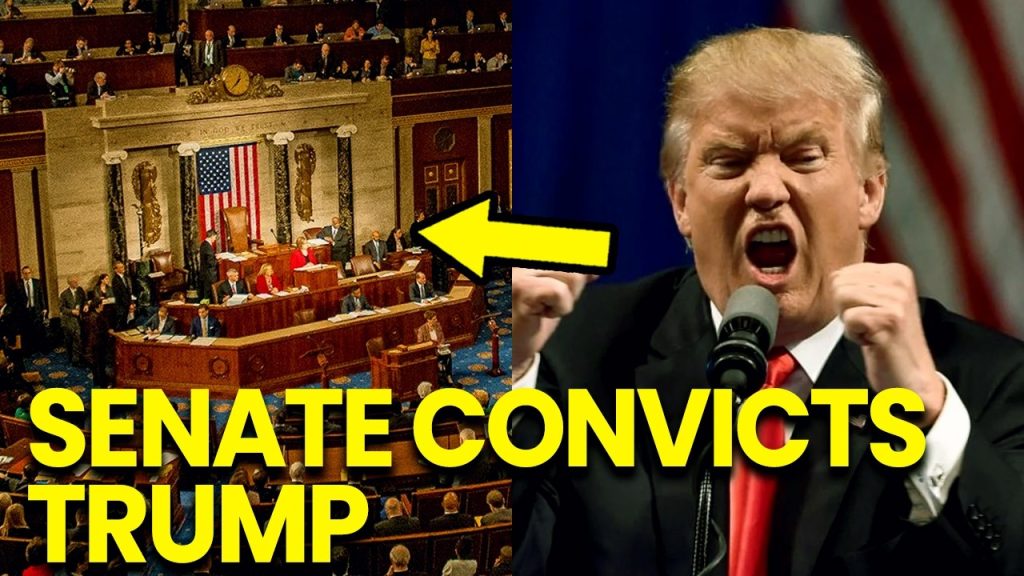
A dramatic claim began circulating online this week: the United States Senate, by a vote of 68–32, had convicted and removed Donald Trump from office.
The assertion spread rapidly across social media feeds and video platforms, framed as an unprecedented constitutional reckoning. According to the viral narrative, 18 Republican senators had joined all Democrats to cross the two-thirds threshold required for conviction, triggering the first successful removal of a president in American history.
But there is a critical distinction between viral political storytelling and documented constitutional action.
As of this writing, no such 68–32 conviction vote has taken place. There has been no Senate removal of a president. No formal roll call has recorded that tally. No transfer of executive power has occurred.
The episode instead appears to stem from speculative commentary — a hypothetical scenario presented as analysis of political trends and impeachment dynamics, later reframed by some audiences as an unfolding event.
Understanding the mechanics of impeachment clarifies why such a claim carries enormous weight. Under Article I and Article II of the Constitution, the House of Representatives has the sole power to impeach, and the Senate conducts a trial. Conviction requires a two-thirds vote of senators present. If convicted, the president is immediately removed from office, and the vice president assumes the presidency.
That constitutional threshold has proven historically difficult to meet. During Mr. Trump’s second impeachment trial in 2021 following the Jan. 6 attack on the Capitol, the Senate voted 57–43 to convict — short of the 67 votes required at the time. Seven Republicans joined Democrats, the most bipartisan impeachment vote in history, but still insufficient for removal.
A 68–32 vote would therefore represent a seismic political shift: 18 Republican senators breaking with their party, surpassing the constitutional requirement and formally removing a president.
Such an event would dominate global headlines. Financial markets would react. Foreign governments would issue statements. The vice president would be sworn in within hours. None of those developments have occurred.
Why, then, did the claim resonate?
Part of the answer lies in the political climate described in the speculative commentary itself. Midterm elections loom. Control of Congress remains contested. Impeachment resolutions have periodically been introduced in the House over various executive actions. Senators have publicly debated the scope of war powers and executive authority in other contexts.
In polarized environments, hypothetical scenarios often blur with expectation. When political commentators discuss “what could happen if,” audiences accustomed to rapid news cycles may interpret analysis as imminent fact.
The video that circulated described a Venezuela-related military operation as the precipitating event in this imagined impeachment. It outlined televised hearings, testimony from military officials, and internal Republican caucus debates leading to conviction. It detailed factional divides between “institutionalists” and “MAGA loyalists.” It portrayed a constitutional crisis unfolding in real time.
But none of those specific events — the impeachment articles described, the Senate trial, the 68–32 vote — have taken place.
This is not the first time political hypotheticals have migrated into headline-style framing. Digital media ecosystems reward urgency and spectacle. Phrases like “history just happened” or “the Senate crossed the line” are powerful rhetorical devices, even when used to illustrate theoretical possibilities.
The risk, however, is that repetition can confer the appearance of reality.
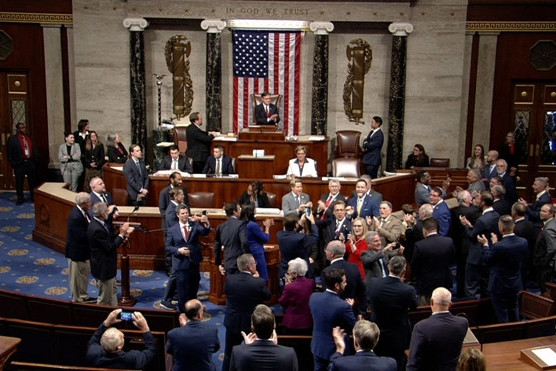
It is also worth noting what would actually follow a real conviction vote. Upon removal, the vice president would immediately assume the presidency under the 25th Amendment’s succession framework. The Senate could then hold a separate vote to disqualify the former president from holding future federal office, requiring only a simple majority. Ongoing legal matters would proceed without the shield of presidential immunity.
Those processes are defined and orderly, not speculative. They are recorded in official congressional journals and transmitted across every major news outlet simultaneously.
The absence of such documentation here is telling.
None of this diminishes the seriousness of ongoing political disputes over executive power, congressional oversight, or electoral stakes. Nor does it preclude future impeachment proceedings; the Constitution provides that mechanism as a legitimate check.
But responsible civic discourse requires a bright line between scenario and fact.
In an era when political identity is tightly bound to information streams, even imaginative exercises can become combustible. A claim of presidential removal — if believed by supporters or opponents — could inflame tensions, erode institutional trust and deepen partisan suspicion.
The more prudent approach is slower: verify official records, consult primary sources, confirm procedural steps. If a president were removed, the evidence would be unmistakable.
For now, there is no 68–32 conviction vote. There has been no Senate removal of Donald Trump. The United States government continues under its existing constitutional structure.
The larger lesson may be less about impeachment itself than about information velocity. In the modern political arena, a hypothetical can travel as fast as a headline. But constitutional reality moves only through formal votes, recorded tallies and sworn oaths.
And those leave a paper trail.






