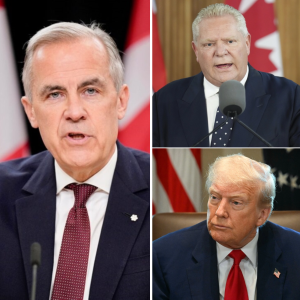
THE ALLIANCE SHIFT: CANADA’S BREAK WITH AMERICAN DEFENSE IS NO LONGER THEORETICAL


At a defense trade show in Ottawa this week, a procurement announcement quietly revealed something far larger than the purchase of a surveillance aircraft.
It revealed a geopolitical shift.
Standing before military officials, defense contractors and industry executives at CANSEC — Canada’s largest annual defense and security exhibition — Prime Minister Mark Carney confirmed that Canada had entered formal negotiations to acquire Saab’s GlobalEye airborne early warning and control aircraft.
The technical details mattered immediately.
Saab’s GlobalEye defeated two American competitors: Boeing’s troubled E-7 Wedgetail and L3Harris’s Ares-X proposal. The Swedish platform emerged as Ottawa’s preferred solution for defending North American airspace against cruise missiles, hypersonic threats and expanding Arctic militarization.
But the deeper significance was not simply who won the contract.
It was who lost it.
For decades, major Canadian defense procurements often defaulted toward American manufacturers. Geography, NATO integration and economic dependence made those choices appear almost automatic. Yet this decision did something extraordinary: it bypassed the United States entirely.
The aircraft Canada selected contains no American-built core platform.
The GlobalEye system is built on the Bombardier Global 6500 business jet, designed and manufactured in Montreal. Saab supplies the radar systems, sensors and mission infrastructure from Sweden. The result is a defense platform that is Canadian-built and Swedish-equipped — a transatlantic industrial partnership that leaves American contractors completely outside the supply chain.
That absence may prove more important than the aircraft itself.


The announcement arrives amid a broader restructuring of Western defense relationships, one increasingly defined by strategic autonomy rather than automatic alignment with Washington.
Over the past year, Canada and several European governments have accelerated efforts to reduce reliance on American defense systems, digital infrastructure and industrial supply chains. What once sounded like academic discussion inside policy circles is now materializing through procurement contracts worth billions of dollars.
Canada’s GlobalEye decision is part of that transformation.
Sweden recently committed billions toward expanding its own defense posture while strengthening cooperation with France. France, meanwhile, purchased Saab surveillance aircraft of its own. European navies increasingly collaborate across continental industrial ecosystems. Canada is now integrating itself into that same network.
The emerging pattern is unmistakable.
Europeans are buying from Europeans.
Canada is buying from Europeans.
And American contractors are no longer assumed to be the inevitable winners.
The implications extend beyond symbolism. Defense procurement shapes alliances for decades. Aircraft maintenance, pilot training, software integration, logistics chains and industrial partnerships create long-term strategic dependencies that often outlast political administrations.
Once those systems shift, reversing them becomes difficult.
That reality appears central to Ottawa’s thinking.
Canadian media outlets including CBC and The Globe and Mail reported that the Saab selection reflects a deliberate effort by Carney’s government to reduce Canadian dependence on American military technology. Bloomberg framed the story even more directly, describing the deal as Canada “spurning U.S. bids.”
The language matters because it reveals intent.
This was not simply a competition over technical specifications. It was a strategic choice about sovereignty, leverage and future alignment.


The Arctic sits at the center of that calculation.
As climate change accelerates ice melt and opens northern shipping routes, the Arctic is rapidly evolving into one of the world’s most contested strategic regions. Russia has expanded military infrastructure across its Arctic territories. China increasingly describes itself as a “near-Arctic state.” NATO planners now view the region as a future geopolitical flashpoint.
Canada’s surveillance modernization is therefore not theoretical.
It is foundational.
GlobalEye’s long-range radar capabilities are specifically designed to detect advanced missile threats, aircraft incursions and maritime activity across enormous distances. In practical terms, Ottawa is investing in the architecture required to monitor a militarizing north where traditional assumptions about continental security are rapidly eroding.
But the economic structure of the deal may prove equally consequential.
Saab has pledged extensive Canadian industrial participation throughout the program. Maintenance, upgrades and long-term operational support will involve Canadian aerospace partners. Bombardier’s manufacturing role secures high-value domestic production. Canadian artificial intelligence company Cohere has already signed agreements connected to advanced AI integration for the platform.
This means the project is not merely a purchase.
It is industrial integration.
Thousands of aerospace jobs are expected to be supported through the program over the next fifteen years. More importantly, intellectual property, technical expertise and supply-chain development remain embedded within a Canadian-European ecosystem instead of flowing toward American defense giants.
That distinction reflects a larger political mood emerging across many Western capitals.
“Sovereignty” has become the defining word of modern industrial strategy.
Governments increasingly want independent control over defense production, cloud infrastructure, AI systems, energy networks and communications technology. The concern is not necessarily hostility toward the United States itself. Rather, it is fear of vulnerability created by overdependence on any single external partner — even an ally.
Canada’s procurement choices increasingly reflect that anxiety.
And the most politically sensitive issue still lies ahead: the F-35.


Canada remains committed to acquiring 88 F-35 stealth fighters from Lockheed Martin under agreements worth tens of billions over the program’s lifetime. Yet following recent trade tensions with Washington, Carney reportedly instructed Canadian defense officials to explore whether portions of the order could be reduced or replaced by non-American alternatives.
The alternative most frequently discussed is Saab’s Gripen E fighter.
Unlike the F-35, which depends heavily on centralized maintenance and complex international support structures, the Gripen was designed for dispersed operations under harsh conditions — precisely the kind of operational flexibility many analysts believe Arctic defense increasingly requires.
No final decision has been announced.
But Canada’s broader direction is becoming difficult to ignore.
Choosing Saab for surveillance aircraft while reconsidering portions of the F-35 purchase sends a signal far larger than any individual procurement program. It suggests Ottawa may be preparing for a future in which defense diversification becomes a permanent strategic principle rather than a temporary negotiating tactic.
The submarine competition reinforces that possibility.
At the same conference where the GlobalEye announcement dominated headlines, German Defense Minister Boris Pistorius promoted a joint German-Norwegian proposal for Canada’s future submarine fleet. South Korea also remains in contention.
Notably absent: the United States.
For one of the most strategically sensitive military capabilities any nation possesses, Canada appears prepared to choose either a European or Asian partner over an American supplier.
That reality would have been politically startling only a decade ago.
Today, it increasingly feels like part of a broader reordering already underway.


The emerging Canada-Europe defense ecosystem is becoming self-reinforcing.
Every contract strengthens industrial familiarity. Every procurement creates operational compatibility. Every successful partnership increases political trust and commercial logic for future agreements. Over time, these networks acquire their own momentum.
And momentum matters in geopolitics almost as much as military capability itself.
American defense firms still dominate global markets by enormous margins. The United States remains the world’s most powerful military actor. Yet influence is rarely lost all at once. More often, it erodes gradually through a series of decisions that individually appear manageable but collectively reshape strategic assumptions.
Canada’s Saab announcement may ultimately represent one of those moments.
Not because one aircraft contract changes the balance of power.
But because it reveals how many governments are beginning to imagine a future in which dependence on American systems is no longer treated as inevitable.
For decades, Washington’s dominance in allied defense markets rested not only on technological superiority, but on political certainty. American systems were assumed to be safer bets because American leadership itself appeared stable and permanent.
That assumption is now under review across much of the Western alliance.
And in Ottawa this week, standing beneath the bright lights of a defense expo stage, Canada quietly showed the world what that reassessment looks like in practice.