By XAMXAM
When news broke that Hillary and Bill Clinton had agreed to testify publicly before Congress about what they know regarding the Jeffrey Epstein files, the reaction was immediate and uneven. Among Democrats, the announcement was framed as a challenge to secrecy and delay. Within MAGA-aligned circles, it triggered a rapid recalibration, as familiar arguments about transparency suddenly pointed back at figures who have spent years resisting it.
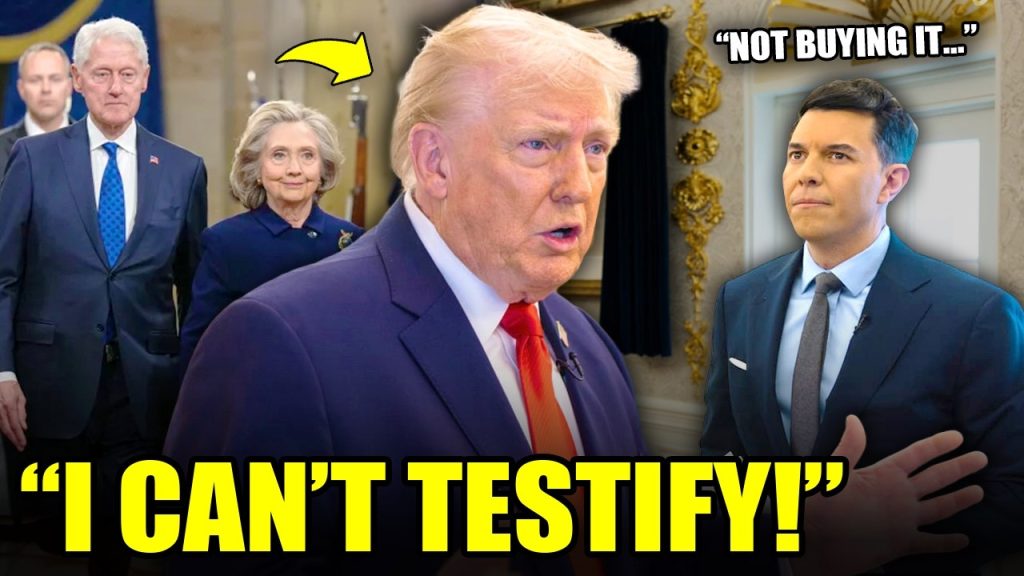
The connection between Donald Trump and Jeffrey Epstein is neither new nor obscure. Trump has acknowledged knowing Epstein socially for years, remarks that have long circulated alongside court records, depositions, and investigative reporting. What changed this week was not the existence of those ties, but the prospect that sworn testimony — delivered under bright lights and live cameras — could reorder the political calculus around them.
Hillary Clinton signaled early that any appearance should be public. In a statement directed at congressional leaders, she argued that transparency loses meaning behind closed doors. Public hearings, she said, would allow the public to judge credibility for themselves. The message was pointed: if lawmakers insist on openness, they should accept its consequences.
The strategy placed Republicans on the House Oversight Committee in a bind. For years, demands for testimony and document releases have been wielded as partisan tools, often without expectation of compliance. The Clintons’ willingness to appear, particularly in a public forum, stripped those demands of their symbolic safety. What had been performative oversight risked becoming an evidentiary exercise.
The political asymmetry quickly became apparent. Trump has repeatedly resisted extended questioning under oath, often invoking constitutional protections or settling disputes through legal maneuvering rather than testimony. Allies argue that such caution reflects legal prudence. Critics counter that it underscores a broader pattern: a preference for spectacle over scrutiny.
That contrast loomed over the announcement. Bill Clinton’s history, including past scandals and impeachment proceedings, remains well documented. Yet he has testified under oath before, sometimes at considerable political cost. His supporters note that allegations against him were adjudicated in public view. His critics say accountability came too late or incompletely. Either way, the record exists.
The same cannot be said for Trump’s relationship with Epstein. While Trump has not been convicted of crimes related to Epstein, the public record includes civil suits, witness statements, and deposition excerpts that have fueled persistent questions. Those questions have intensified as additional Epstein-related documents have been unsealed and as victims continue to seek acknowledgment of how power shielded abuse.
Republicans sympathetic to Trump responded by reframing the issue as partisan distraction, arguing that Democrats were attempting to relitigate the past. Others emphasized that testimony by the Clintons would reopen old wounds without producing new facts. Still, the insistence on public hearings complicated that defense. Refusal now risked appearing selective rather than principled.
Behind the scenes, aides and commentators scrambled to settle on a unified line. Some suggested counter-subpoenas. Others floated procedural delays. A few argued that testimony itself would dilute public interest. Yet the urgency of the response suggested unease. The narrative terrain was shifting faster than talking points could keep up.
The broader question extends beyond any single figure. Congressional hearings have become stages where performance often eclipses substance. Televised questioning rewards sharp sound bites more than patient fact-finding. In that environment, agreeing to testify publicly is a gamble. It exposes witnesses not only to legal risk, but to the unpredictable court of public opinion.
For Hillary Clinton, the calculation appears rooted in familiarity. Decades in public life have hardened her to scrutiny, and the offer of open testimony projects confidence in process. For Bill Clinton, the risk is reputational rather than novel. For Trump, the risk is structural. His political brand depends on controlling the frame — on dominating attention rather than submitting to it.
That is why the phrase “scramble” has gained traction. It does not describe panic in the literal sense, but a loss of narrative control. Transparency, once a slogan, has become a test with asymmetric consequences.
The Epstein case continues to cast a long shadow over American institutions. It has exposed how wealth and influence can distort accountability, and how many powerful figures benefited from distance rather than answers. Congressional testimony will not resolve those failures on its own. But it may clarify who is willing to be questioned and who is not.
As cameras prepare to roll, the political stakes sharpen. Public hearings invite comparison, not just of facts, but of posture. They ask voters to notice who answers directly, who deflects, and who declines altogether.
In an era saturated with accusation and denial, the decision to testify is itself a signal. Whether it leads to resolution or further division remains uncertain. What is clear is that the balance of pressure has shifted. The demand for transparency is no longer abstract. It has names, dates, and a seat at the witness table.







