Trump’s Tariffs Pushed Canada Into Recession — But the Energy Pivot Changed the Game
Canada entered 2026 facing an economic reality few policymakers wanted to confront. After two consecutive quarters of negative growth, the country officially slipped into a technical recession, raising concerns about jobs, investment, and long-term competitiveness.
The numbers were difficult to ignore. Economic growth contracted as manufacturing activity weakened, unemployment climbed, and business confidence deteriorated. For many Canadians, particularly in industrial regions, the effects were immediate and painful.
At the center of the downturn stood a rapidly escalating trade conflict with the United States. A series of tariffs targeting Canadian exports hit key sectors one after another, from automobiles to steel and aluminum.
What began as a trade dispute gradually evolved into a broader test of Canada’s economic resilience. Industries that had relied heavily on access to the American market suddenly found themselves facing a far more hostile environment.
Ontario felt the shock most severely. Manufacturing facilities reduced production, investment plans were delayed, and thousands of workers faced uncertainty as companies reassessed their North American operations.
The automotive sector became a symbol of the pressure. Higher trade barriers changed the economics of cross-border production networks that had been built over decades.
Yet while factories in central Canada struggled, a very different story was unfolding thousands of kilometers away on the Pacific coast.
For years, Canada invested heavily in energy infrastructure designed to diversify export routes beyond the United States. At the time, many questioned the cost and strategic logic of those projects.
Then the trade war changed everything.
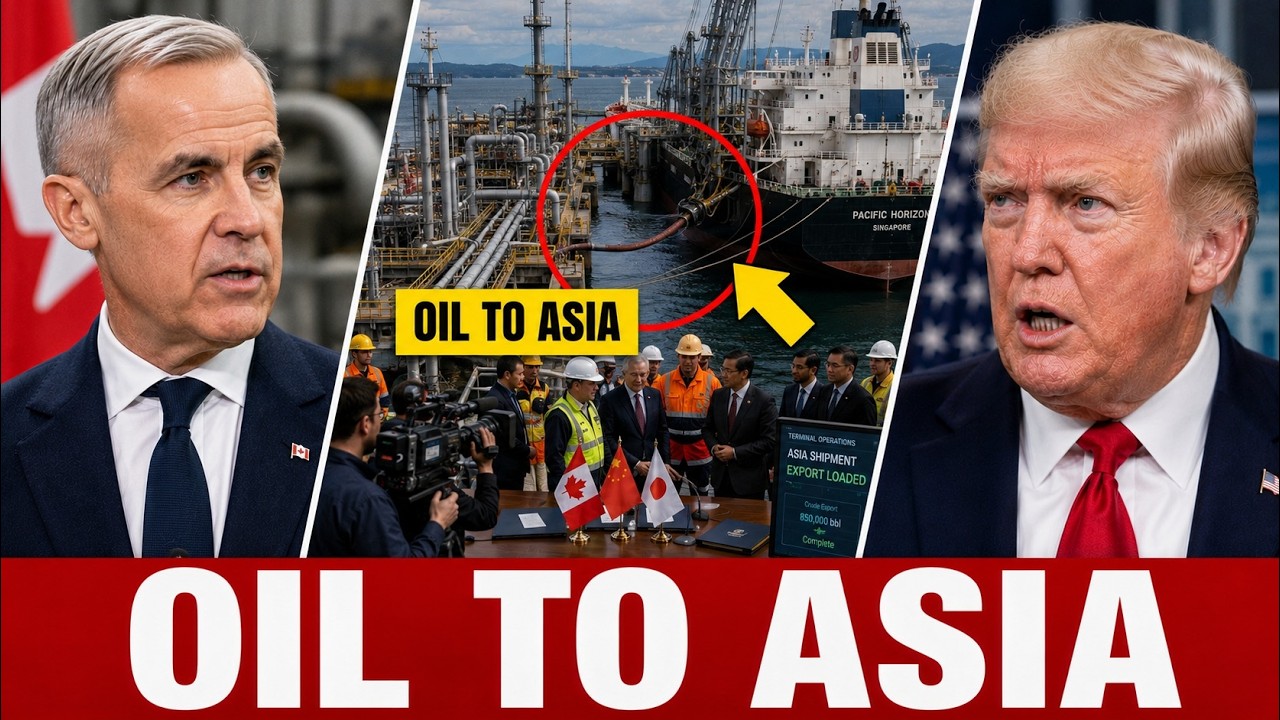
The expansion of the Trans Mountain pipeline dramatically increased Canada’s ability to move crude oil to Pacific ports. What had once been viewed as a long-term commercial project suddenly became a geopolitical asset.
Instead of flowing almost exclusively south, growing volumes of Canadian oil began moving west across the Pacific.
The most significant customer emerged from Asia. China rapidly increased purchases of Canadian crude, transforming trade patterns that had remained largely unchanged for decades.
This shift carried strategic implications far beyond energy markets. It demonstrated that Canada, while deeply integrated with the United States, possessed alternative pathways that could be activated when political conditions changed.
Energy exports became the foundation of a broader diversification strategy. Ottawa increasingly framed market access not merely as an economic issue but as a matter of national resilience.
Prime Minister Mark Carney embraced that logic. His government accelerated efforts to position Canada as a global energy supplier capable of serving multiple regions rather than a single dominant customer.
That approach reflected a larger geopolitical reality. Countries that depend overwhelmingly on one market often discover that economic dependence can quickly become strategic vulnerability.
For decades, the United States purchased the overwhelming majority of Canadian energy exports. The relationship generated prosperity, but it also created leverage that could be exercised during periods of political tension.
The tariff dispute exposed that vulnerability in stark terms.
Rather than retreating, Canada responded by deepening relationships across Asia. Energy cooperation, trade discussions, and investment initiatives increasingly focused on expanding options beyond North America.
China’s interest was driven by its own strategic calculations. Beijing sought reliable energy supplies from politically stable producers while reducing exposure to other regions facing sanctions, instability, or geopolitical risk.
Canada offered exactly that combination: abundant resources, strong institutions, and growing export capacity through Pacific infrastructure.
The opening of Canada’s first major LNG export facility reinforced the trend. For the first time, Canadian natural gas could reach Asian markets directly, creating new commercial opportunities and reducing dependence on traditional export routes.
From a geopolitical perspective, the significance was substantial. Energy flows often shape diplomatic relationships, investment patterns, and strategic partnerships for decades.
The result is a paradox that defines Canada’s current position. The trade war inflicted genuine economic damage. Workers lost jobs, businesses delayed investments, and economic growth weakened considerably.

Yet the same pressure also accelerated changes that many Canadian policymakers had discussed for years but struggled to implement.
What emerged was not a clean victory for either side. The recession remains real, and the costs have been significant. But the crisis also forced Canada to activate alternative trade networks and strengthen connections with fast-growing Asian markets.
The broader lesson extends beyond Canada alone. In an era of intensifying geopolitical competition, countries increasingly view economic diversification as a strategic necessity rather than a commercial preference.
For Ottawa, the central question is no longer whether diversification is desirable. The events of the past fifteen months have largely settled that debate.
The real question now is whether Canada can transform a temporary response to economic pressure into a lasting reconfiguration of its global position.
If it succeeds, historians may eventually view the recession not only as a period of economic hardship, but also as the moment Canada accelerated its transition from dependence toward strategic flexibility in an increasingly fragmented world economy.






