The future of one of Australia’s most controversial political organisations now hangs in the balance, with the High Court preparing to hand down a critical decision that could reshape the boundaries of political freedom, government power and constitutional rights across the nation.
Australia’s highest court is set to rule on Thursday afternoon whether the banned White Australia Party should receive temporary protection from federal hate group laws while a much larger constitutional battle unfolds later this year.
The case has rapidly evolved into one of the most significant political and legal showdowns in recent memory.
Chief Justice Stephen Gageler reserved his decision until 2pm Thursday following an urgent hearing in Canberra, where lawyers representing the White Australia Party sought an injunction to stop the organisation from effectively disappearing before the High Court has the opportunity to determine whether the legislation itself is constitutionally valid.

At the centre of the dispute is a powerful new set of hate group laws introduced following the Bondi Islamic terrorist attack. The legislation, supported by both major political parties, grants authorities the power to designate organisations as prohibited hate groups.
Last month, the White Australia Party became one of the first organisations to be listed under those laws.
The consequences were immediate and severe.
Once listed, it became a criminal offence to direct, join, recruit for, train with, fund or support the organisation. Breaching the laws can attract penalties of up to 15 years in prison.
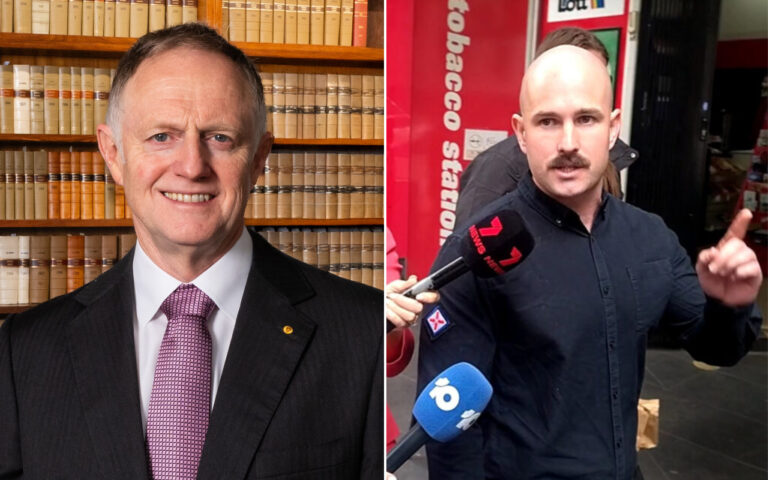
Representing the party and its prominent figure Thomas Sewell, barrister Peter King argued that the legislation is already causing irreversible damage before the court has had the opportunity to properly assess whether it complies with Australia’s Constitution.
According to King, Victorian authorities have already issued a show-cause notice to the organisation. Because the White Australia Party is registered as an incorporated association in Victoria, officials warned that the organisation is considered no longer operational as a result of the federal ban.
The notice reportedly indicates that the party’s registration could be cancelled by June 25, potentially triggering its formal dissolution.
King told the court that such a move would effectively extinguish the organisation months before the constitutional challenge is heard by the full High Court in September.
He argued that the party faces the immediate loss of its operational structure, financial resources, organisational capacity and ability to engage in political communication.
If the organisation is dissolved before the larger constitutional challenge is resolved, King warned, any eventual victory in September could become meaningless.
The court, he argued, faces a crucial question.
Would it preserve its ability to properly determine the case, or allow circumstances to develop in a way that renders the final proceedings futile?
The Commonwealth strongly opposed the request.
Appearing for the defendants, Senior Counsel Brendan Lim argued that the White Australia Party would still have legal avenues available if Victorian authorities moved to cancel its registration.
Lim maintained that suspending the operation of the hate group laws would carry serious consequences for the wider public.
According to his submissions, preventing the Commonwealth from enforcing the legislation would be harmful to the public interest and undermine the purpose for which Parliament enacted the laws.

He argued that the legislation was specifically designed to stop the White Australia Party from engaging in activities identified in the government’s reasons for listing the organisation.
Those activities, he told the court, allegedly carry risks of physical violence.
Lim further argued that the legislation is not only intended to address direct conduct but also seeks to shield the community from the broader influence of the organisation’s ideology and rhetoric.
According to the Commonwealth’s position, such rhetoric carries the potential to inspire individuals who are not formally connected to the organisation to engage in acts of serious violence.
The hearing highlighted a growing national debate about where the balance should lie between public safety and political freedom.
Supporters of the laws argue that governments require strong powers to prevent extremist organisations from operating and spreading harmful ideologies.
Critics, however, have raised concerns that the legislation grants unprecedented authority to governments and could potentially be applied far more broadly in the future.
Those concerns are expected to take centre stage in September when the High Court hears the full constitutional challenge.

Legal experts and political commentators have already warned that the outcome could establish a precedent affecting not only extremist organisations but potentially any political movement that future governments deem undesirable.
The constitutional challenge will focus heavily on whether the legislation infringes the implied freedom of political communication, a principle recognised by Australia’s Constitution as essential to the nation’s democratic system.
That freedom does not provide an unlimited right to say or do anything. However, it has long been regarded as a critical safeguard protecting Australians’ ability to participate in political debate, criticism and advocacy.
The High Court’s decision on Thursday will not determine the constitutionality of the legislation itself.
Instead, it will decide whether the White Australia Party receives temporary protection while waiting for that larger battle to be fought.
Yet despite its limited scope, the ruling could prove enormously significant.
If the injunction is granted, the party may survive long enough to argue its case in September.
If it is refused, the organisation could face dissolution before the nation’s highest court has delivered its final verdict on one of the most consequential political freedom cases Australia has seen in decades.
For now, all eyes remain fixed on Canberra as the countdown begins toward a decision that may have ramifications far beyond a single political party.






