AUSTRALIA’S POLITICAL EARTHQUAKE: One Nation SURGES Past Coalition as Fuel Crisis and Budget Chaos Shake Albanese Government
Australia’s political landscape has been thrown into unprecedented turmoil after explosive new polling revealed that Pauline Hanson’s One Nation has overtaken the Coalition and continues to gain momentum amid growing anger over the Albanese government’s controversial economic agenda. What was once considered a fringe force in national politics is now emerging as a dominant player capable of reshaping the country’s political future.
The latest Roy Morgan polling paints a dramatic picture of a nation losing confidence in both major parties. One Nation’s primary vote has surged to 25.5 per cent, pushing it ahead of the Coalition, which has collapsed to just 23 per cent support.
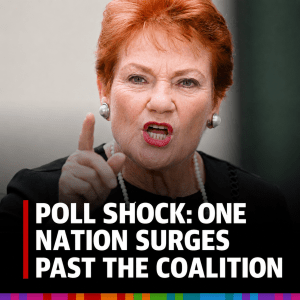
The stunning reversal marks the widest divide between the two right-wing parties since Angus Taylor seized leadership following the brutal internal revolt that removed former Coalition leader Sussan Ley.
Political analysts say the rise of One Nation reflects a growing wave of public frustration over skyrocketing living costs, fuel shortages, housing anxiety and fears surrounding Australia’s fragile economy.
The anger intensified after the federal government unveiled its controversial 2026-27 budget, including proposed changes to negative gearing and capital gains tax arrangements that triggered panic among investors and middle-class homeowners.
For three consecutive weeks, One Nation has remained ahead of Labor in primary support polling, an achievement that would have seemed unimaginable only months ago. The party has aggressively targeted disillusioned conservative voters who believe the Coalition has become weak and directionless under its new leadership.
Angus Taylor’s rise to Coalition leader was already surrounded by chaos after the bloody leadership spill that toppled Sussan Ley. But instead of stabilising the conservative vote, the internal warfare appears to have accelerated voter migration toward Pauline Hanson’s populist movement. Critics inside the Coalition fear the party is now facing an identity crisis that could permanently fracture the Australian right.
Meanwhile, confidence in Anthony Albanese’s government continues to deteriorate rapidly. Roy Morgan’s government confidence rating fell another three points to just 65, one of the weakest readings in recent years.
Even more alarming for Labor strategists is the fact that more than 60 per cent of Australians now believe the country is “going in the wrong direction”.
Only 25.5 per cent of Australians surveyed said they believed Australia was heading in the right direction. That figure has sparked alarm inside government circles, where ministers are increasingly worried that economic instability and international tensions could trigger a major political backlash before the next federal election.
The collapse in public optimism has been strongly linked to the worsening fuel crisis and ongoing energy shortages affecting households and businesses nationwide. Australians have endured months of rising petrol prices, electricity uncertainty and supply chain disruptions, all while global tensions continue to threaten economic recovery.
The fragile ceasefire between the United States and Iran has only added to fears of further instability. Financial markets remain nervous about the possibility of renewed conflict in the Middle East, which could send global oil prices soaring again and place even greater pressure on Australian consumers already struggling with inflation.
Prime Minister Anthony Albanese attempted to calm public concerns during a fuel update delivered on Monday. However, instead of reassuring Australians, many observers believe his warning about long-term economic pain may have deepened public anxiety.
“These are volatile and uncertain times,” Albanese declared. “And I want to make it clear that when the conflict ends, that doesn’t mean that the economic tale concludes.”
The Prime Minister’s comments were interpreted by critics as an admission that Australians should prepare for prolonged hardship. Opposition figures immediately accused Labor of failing to protect households from worsening economic pressures while simultaneously pursuing risky tax reforms.
Inside Labor, nervous MPs are reportedly growing concerned about the political consequences of the government’s economic strategy. While Labor still maintains a lead on a two-party preferred basis, the shrinking margin has intensified fears that voter anger could spiral further if the energy crisis worsens.

According to the Roy Morgan poll, Labor currently leads the Coalition 53 per cent to 47 per cent on a two-party preferred basis. While that would still allow Albanese to retain government if an election were held today, the reduced majority signals significant political vulnerability.
What makes the situation even more dangerous for Labor is the rapidly shifting conservative landscape. One Nation’s rise suggests that traditional voting patterns are breaking apart, creating unpredictable electoral dynamics that could reshape marginal seats across the country.
Pauline Hanson has wasted no time capitalising on the political chaos. Her party has aggressively blamed both Labor and the Coalition for Australia’s cost-of-living disaster, arguing that ordinary Australians have been abandoned by the political establishment.
The party’s messaging has resonated particularly strongly in regional areas where fuel costs, housing affordability and energy insecurity have become dominant issues. Many voters now see One Nation as the only party directly confronting the economic anxieties affecting working families and retirees.
Some political strategists believe the Coalition now faces an existential dilemma. If Angus Taylor attempts to move further right to win back One Nation voters, he risks alienating moderate urban conservatives. But if he maintains a centrist approach, the bleeding toward Hanson’s movement could intensify even further.

The coming months are expected to become increasingly volatile as the Albanese government battles economic uncertainty, rising public frustration and deepening divisions across the political spectrum. Every new spike in fuel prices or energy instability now carries enormous political consequences.
For Anthony Albanese, the challenge is becoming more severe by the week. Australians are not only questioning the government’s economic management — many are beginning to question whether either major party is capable of restoring stability at all.
As political tensions escalate, one thing is becoming impossible to ignore: Australia is entering a dangerous new political era where voter anger, economic insecurity and populist momentum are colliding in ways that could permanently transform the nation’s future.






