Italy Walks Away From Boeing: Why Europe’s Tanker Future Now Belongs to Airbus
For more than a decade, Italy’s aerial refueling fleet was built around Boeing.
Since 2011, the Italian Air Force had relied on four KC-767A tanker aircraft to sustain long-range operations, NATO deployments, and expeditionary missions stretching from Eastern Europe to the Middle East. The aircraft became one of the quiet backbones of Italy’s military reach. (Aeronautica Militare)
But this spring, Rome made a decision that resonated far beyond military procurement circles.
Instead of replacing its aging Boeing fleet with Boeing’s newer KC-46 Pegasus tanker — the aircraft Italy had initially selected in 2022 — the Italian government signed a €1.39 billion agreement with Airbus for six A330 MRTT tankers. (Reddit)
The announcement looked technical on the surface.
In reality, it reflected something larger: a structural shift inside Europe’s defense market, one increasingly defined by strategic autonomy, interoperability, and growing skepticism toward Boeing’s troubled tanker program.


Italy’s relationship with Boeing was not superficial.
The country was the launch customer for the KC-767 tanker platform in the early 2000s, eventually operating four aircraft that replaced older Boeing 707 tanker systems. The KC-767 fleet became deeply integrated into NATO operations and coalition deployments. (Wikipedia)
Italian crews flew those aircraft over Libya, Afghanistan, and Eastern Europe.
The fleet proved flexible, capable of transporting cargo, troops, and fuel simultaneously across intercontinental ranges. (Air Tattoo)
Yet military procurement is rarely about loyalty.
It is about reliability, survivability, maintenance ecosystems, and the political direction of alliances.
And Boeing entered the replacement competition carrying years of problems attached to the KC-46 Pegasus.
The aircraft was supposed to represent the future of aerial refueling.
Instead, the program became defined by delays, redesigns, cost overruns, and technical defects that repeatedly forced the U.S. Air Force to impose operational restrictions.
At the center of those problems sat the Remote Vision System, the camera-based interface that allows boom operators to guide the refueling arm into receiving aircraft.
The system struggled with depth perception.
It struggled in difficult lighting.
It struggled at night.
And in some cases, those failures became expensive.


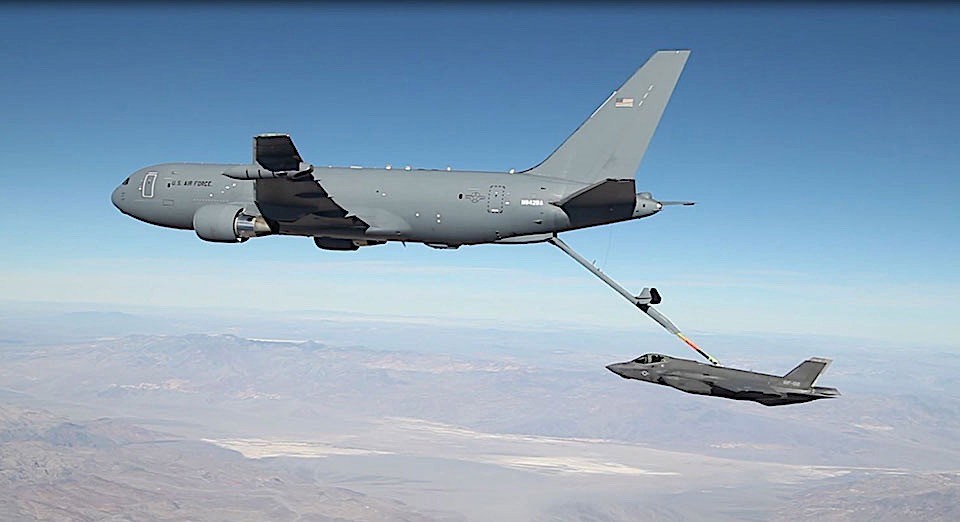
An August 2025 accident investigation detailed incidents in which the KC-46’s refueling boom caused structural damage to receiving aircraft during refueling operations.
The total documented damage reached approximately $23 million across multiple incidents, according to reporting and subsequent defense discussions surrounding the platform.
Boeing eventually introduced an upgraded Remote Vision System 2.0, but by then the damage to confidence inside international procurement circles had already begun.
Defense ministries do not merely purchase aircraft.
They purchase decades of maintenance obligations, pilot training, operational risk, and alliance compatibility.
Italy appeared increasingly unwilling to gamble on unresolved technical uncertainty.
Officially, Rome cited “changed and unforeseen requirements” when it abandoned the KC-46 pathway in 2024.
Diplomatic language often conceals strategic conclusions.
The conclusion here seemed clear: Europe no longer viewed Boeing’s tanker platform as the safest long-term choice.
That matters because aerial refueling is not an optional capability for modern military power.
It is what allows fighter jets, surveillance aircraft, bombers, and transport fleets to operate globally without dependence on nearby airfields.
Without tanker support, modern expeditionary warfare becomes dramatically more limited.
And increasingly, Europe’s tanker ecosystem revolves around Airbus.
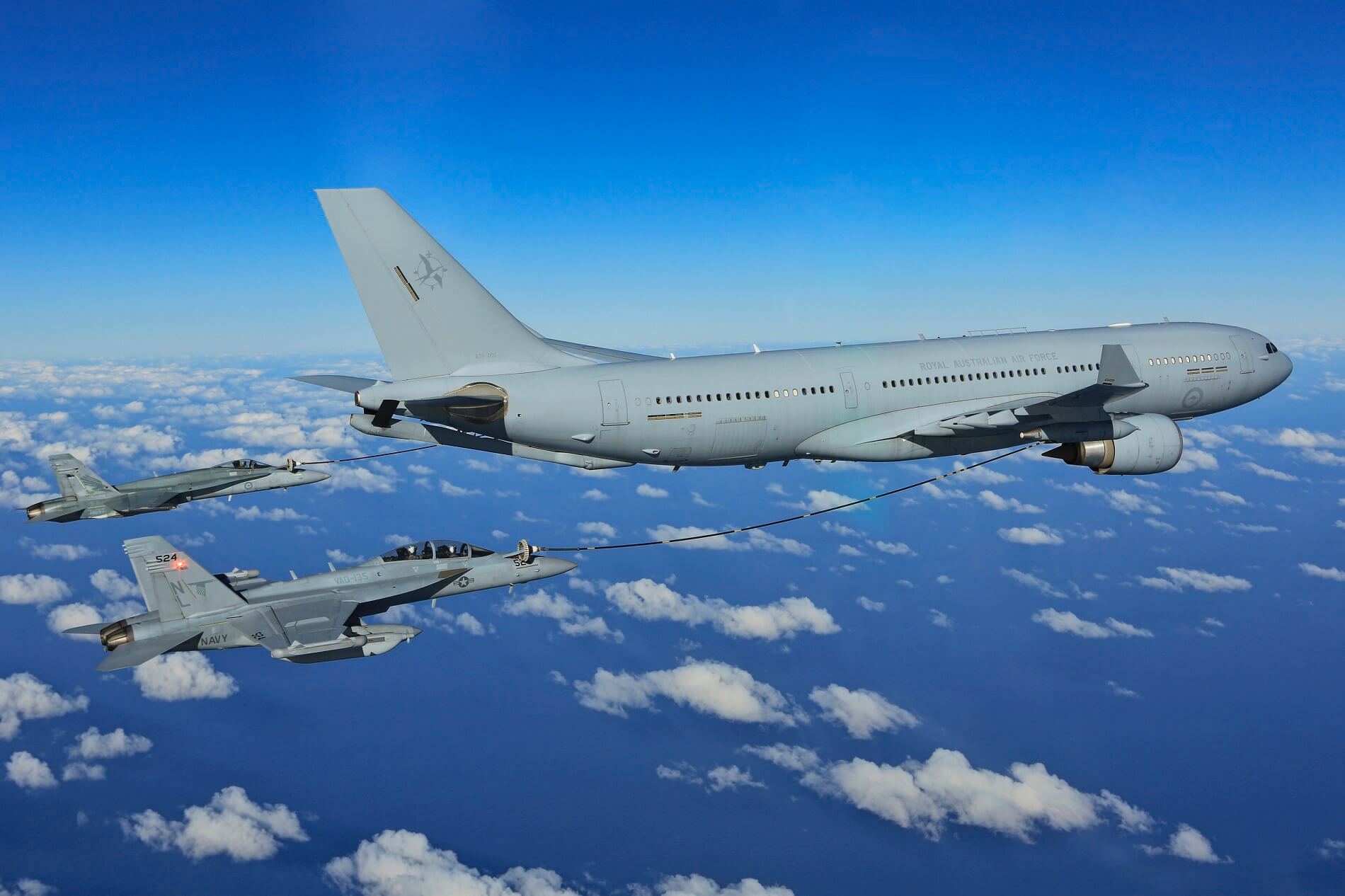
The A330 MRTT has already become the dominant aerial refueling platform across NATO Europe.
France operates it.
Spain operates it.
The United Kingdom operates it.
Multinational NATO tanker initiatives rely on it.
The platform has become, in effect, Europe’s common aerial refueling language.

That interoperability matters enormously.
When coalition aircraft deploy together, common tanker systems reduce logistical friction at every level.
Maintenance crews can share expertise.
Pilots can train on aligned procedures.
Supply chains become integrated rather than fragmented.
Spare parts inventories shrink.
Mission planning becomes simpler.
A single incompatible platform inside a coalition environment creates operational inefficiencies that compound over time.
Had Italy proceeded with the KC-46 purchase, it would likely have become the only major European NATO operator of the Boeing tanker.
That isolation carried costs beyond procurement itself.
Air forces increasingly think in ecosystems, not individual aircraft.
And Europe’s ecosystem is consolidating around Airbus.
The Italian decision also arrived during a broader transformation in European defense strategy.
Since Russia’s invasion of Ukraine, European governments have accelerated efforts to rebuild domestic military industrial capacity.
The European Union now pushes for a majority of defense procurement spending to remain inside Europe by the end of the decade.
Germany has increasingly shifted procurement toward European suppliers.
France has doubled down on domestic production.
Nordic states are deepening intra-European defense cooperation.
The trend is becoming difficult to ignore.
Europe still depends heavily on American military power, particularly through NATO and U.S. strategic deterrence.
But procurement patterns increasingly reveal a parallel ambition: reducing long-term dependence on American manufacturers wherever viable European alternatives exist.
The Airbus tanker benefited directly from that political environment.
Unlike the KC-46, the A330 MRTT entered the Italian competition with an extensive operational track record already established across allied air forces.
The aircraft was familiar.
Its maintenance network already existed.
Its coalition compatibility was proven.
And perhaps most importantly, it did not carry years of unresolved headlines about refueling system failures.
Italy’s new contract includes not only six aircraft but also a decade of logistical support, maintenance infrastructure, and operational integration.
Rome is not simply buying airplanes.
It is embedding itself deeper into a European defense industrial framework that may shape military procurement for decades.
That shift mirrors what is happening in commercial aviation.
Airbus currently holds an enormous commercial aircraft backlog exceeding 9,000 planes, representing years of future production demand.
Boeing, meanwhile, continues recovering from a succession of crises involving the 737 MAX, production quality concerns, regulatory scrutiny, and delivery disruptions.
The tanker competition reflects that same credibility imbalance migrating into defense markets.
Confidence matters in aviation.
Once lost, it becomes extraordinarily expensive to rebuild.
Italy’s decision therefore carries symbolic weight beyond its financial value.
This was not a country abandoning Boeing after decades of hostility.
It was a longtime Boeing operator evaluating both companies side by side and ultimately concluding that Airbus represented the lower-risk future.
That distinction matters.
Because procurement choices inside NATO often influence subsequent procurement decisions elsewhere.
Military planners watch each other carefully.
No defense ministry wants to become the sole operator of an increasingly isolated platform.
And once interoperability advantages begin concentrating around one system, momentum accelerates.
That is why some analysts now believe the European market for the KC-46 may effectively be closed.
Italy appeared to be Boeing’s last major realistic European opportunity.
Once Rome walked away, Airbus’s dominance became harder to challenge.
The implications stretch into geopolitics as much as aerospace economics.
For decades, American military equipment carried an almost automatic assumption of technological superiority inside allied procurement decisions.
That assumption is becoming less automatic.
European governments increasingly weigh political independence, industrial resilience, and supply chain sovereignty alongside battlefield performance.
The result is not necessarily an anti-American Europe.
It is a more strategically self-interested Europe.
And in industries where Airbus offers competitive alternatives, Boeing increasingly finds itself confronting a market that no longer defaults toward U.S. suppliers by instinct alone.
Italy’s tanker decision illustrates that transformation with unusual clarity.
A country that spent fifteen years operating Boeing tankers looked at Boeing’s next generation platform, examined its operational controversies, compared it against an increasingly standardized European alternative, and chose Toulouse over Seattle.
The symbolism of that choice may outlast the aircraft themselves.
Because once procurement ecosystems shift, they rarely reverse quickly.
Aircraft stay in service for decades.
Training systems, logistics pipelines, maintenance contracts, and operational doctrines become embedded around them.
Italy’s six Airbus tankers are therefore not merely replacements for four aging Boeing aircraft.
They are part of a wider reorientation inside Europe’s defense architecture — one contract among many gradually redrawing the balance between American and European aerospace power.
And for Boeing, the warning may be difficult to miss.
In commercial aviation, Airbus already dominates the order books.
Now, increasingly, Europe’s military skies appear to be moving in the same direction. (itamilradar.com)






