In what many analysts are calling a symbolic but powerful breakthrough, Canada has achieved something that once seemed out of reach. For the first time in over a decade, a major transit bus has been built entirely within the country—from start to finish—marking a turning point that is now sending shockwaves through economic and political circles.
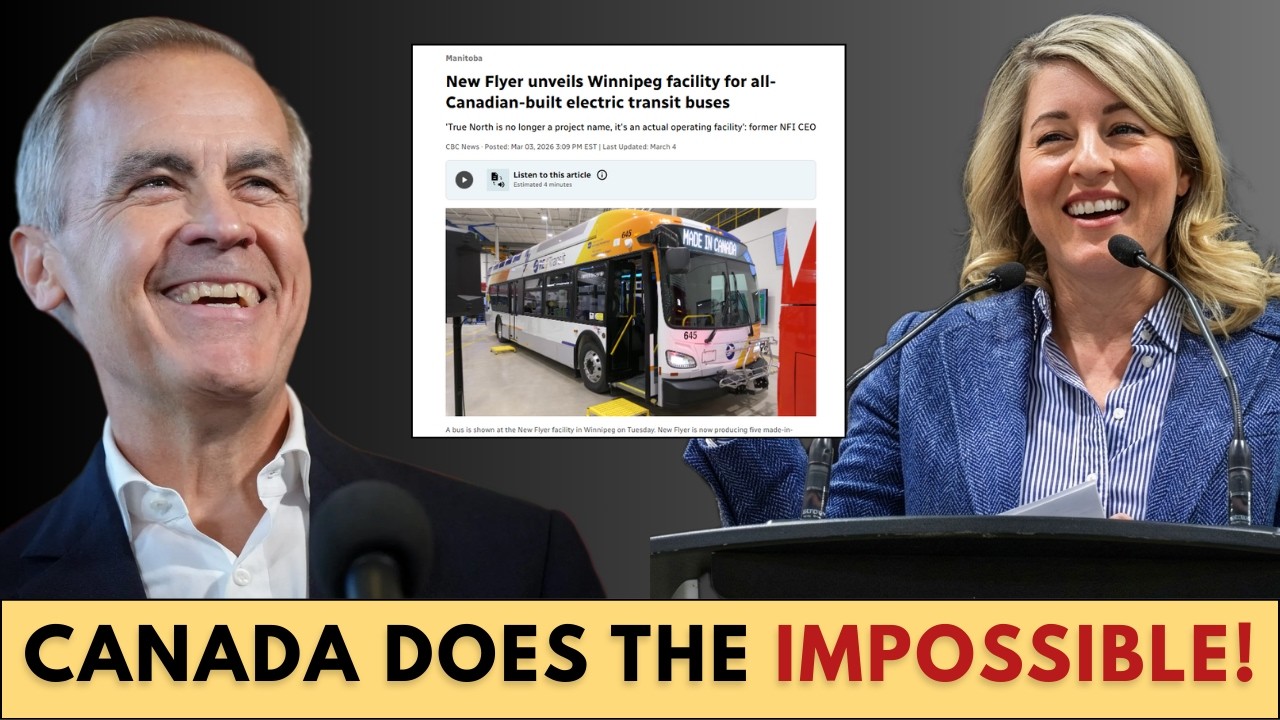
The milestone took place in Winnipeg, where New Flyer Industries completed a fully assembled transit bus without relying on cross-border production. While it may appear to be just another vehicle rolling off a factory line, experts say the implications stretch far beyond manufacturing.
For 15 years, Canada’s bus production system operated under a strange constraint. Even though buses were largely built by Canadian workers, under a Canadian company, they still had to be sent to the United States for final assembly. The reason wasn’t technical—it was regulatory.
Under the Buy America Act, transit vehicles funded by U.S. federal programs must meet strict domestic content requirements. This includes having at least 70% of components made in the U.S. and completing final assembly on American soil. As a result, Canadian manufacturers were effectively locked into a system where the most valuable part of production happened outside their own country.
This created a long-standing paradox. Canada possessed the engineering expertise, workforce, and infrastructure, yet couldn’t fully capitalize on its own production capabilities. High-value jobs, better wages, and final-stage manufacturing benefits were consistently tied to American facilities.

But shifting global dynamics began to change that reality. Throughout 2025, rising trade tensions and tariff pressures pushed Canadian policymakers to rethink their economic strategy. Instead of relying heavily on access to U.S. markets, discussions began to focus on strengthening domestic independence.
The response was a targeted investment strategy involving federal and provincial governments, along with industry partners. Funding was directed toward expanding production capacity in Winnipeg, allowing for the creation of a fully domestic assembly line. While not massive in scale compared to other industrial projects, the move was highly strategic.
The impact is already being felt. The new facility is expected to create around 250 direct manufacturing jobs while supporting thousands more across the supply chain. In its early phase, the plant has begun producing buses specifically for Canadian transit systems—vehicles that no longer need to cross borders at any stage of production.
Beyond job creation, the development represents a deeper shift in thinking. It reflects a growing awareness among nations about the risks of overdependence on global supply chains, especially in an era of political uncertainty and economic fragmentation.
What’s happening in Winnipeg is part of a broader global trend. Countries are increasingly questioning whether globalization, as it has existed for decades, still serves their long-term interests. The balance between international cooperation and domestic resilience is being reevaluated in real time.
Canada’s move doesn’t fully answer that question—but it offers a compelling example. One factory, one production line, and one finished bus at a time, the country is quietly redefining its industrial future. And as this story spreads, it’s rapidly gaining attention across platforms, with reactions pouring in and the internet absolutely exploding.






