Sall Grover delivered one of the most controversial and talked-about speeches at the 2025 Conservative Political Action Conference, using the stage to defend her legal battle over women-only spaces and to attack Australia’s gender identity laws. The founder of the women-only social platform Giggle argued that the fight was no longer just about social media or online communities, but about freedom of speech, biological reality, and the future of Australian law.
The speech immediately drew loud applause as Grover opened with a blunt declaration that “men are not women,” a phrase she repeated several times throughout her address. Speaking to a cheering crowd, she mocked the growing political sensitivity surrounding gender identity issues and framed herself as someone forced into a legal war she never expected to fight.
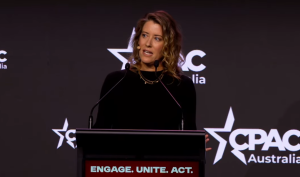
Grover explained that she became nationally known through the “Giggle v Tickle” court case, which she described as the world’s first major legal battle over sex versus gender identity discrimination. According to her account, the conflict began after she created Giggle, a social networking platform designed exclusively for women.
The app, she said, was intended to help women connect for housing, freelance work, discussions, and dating without male participation. Grover argued that the platform was created as a response to misogyny and harassment faced by women online, not as a political statement about transgender issues.
However, shortly after the platform entered beta testing, Grover claimed thousands of male users flooded the app, accusing her of discrimination and “transphobia.” She told the audience she had never even heard the term “TERF” before the backlash erupted online.
The legal conflict escalated in 2022 when Grover received a complaint through the Australian Human Rights Commission from a man who identified as a woman and had allegedly been removed from the platform. The complaint accused her company of gender identity discrimination.
Grover said the demands made during mediation included allowing biological males identifying as women onto the platform, attending “sex and gender education,” issuing an apology, paying compensation, and moderating content to avoid offending transgender users.
She argued that such conditions would fundamentally destroy the purpose of a women-only platform. According to Grover, the experience transformed her original project into a years-long legal and ideological struggle focused almost entirely on gender politics.

At the time the complaint was filed, Grover was pregnant with her daughter. She told the audience that her pregnancy strengthened her determination to continue the legal fight instead of settling the case privately.
The Giggle founder claimed she rejected mediation because she believed backing down would prevent her from teaching her future daughter to stand up for her beliefs. The crowd responded with sustained applause as she described her decision to continue the battle through Australia’s federal court system.
A major focus of Grover’s speech was criticism of amendments made to Australia’s Sex Discrimination Act in 2013. She argued that removing legal definitions of “man” and “woman” and replacing them with “gender identity” opened the door to legal confusion and ideological activism.
Grover also accused Australia’s Sex Discrimination Commission of siding entirely with gender identity activists while ignoring women’s rights. She specifically criticized Sex Discrimination Commissioner Anna Cody and argued that officials had abandoned biological definitions of sex.
During the speech, Grover repeatedly insisted that sex cannot be changed, regardless of legal documents or government recognition. She criticized Australian state laws that allow individuals to change the sex marker on birth certificates.
The legal battle has also become financially enormous. Grover revealed that the first federal court case cost more than half a million dollars in legal fees, while the appeal process could eventually exceed $1 million.
She claimed the case had only been sustained through crowdfunding and small donations from supporters around the world. Grover denied rumors that high-profile figures such as J.K. Rowling were financially backing the lawsuit.
The activist also pointed to other ongoing Australian legal disputes involving gender identity. She highlighted the case of activist Kirralie Smith, who is facing legal consequences over comments regarding transgender participation in women’s sports.
Grover warned that these cases could establish legal precedents limiting political speech and public debate in Australia. According to her, ordinary citizens, politicians, journalists, and commentators could eventually face punishment for expressing views about biological sex.
Another example she cited involved Queensland child psychologist Jillian Spencer, whose employment situation became controversial after advocating therapy approaches that did not automatically affirm transgender identification in children.
Throughout the speech, Grover argued that the debate extends beyond women’s rights and instead concerns broader freedoms including speech, belief, and association. She repeatedly framed the issue as a defense of objective reality against ideological pressure.
The speech reached its most explosive moment when Grover referenced reports involving a convicted male offender allegedly housed in a women’s prison after identifying as female. She accused political leaders and human rights officials of prioritizing ideology over public safety.
Grover concluded with a direct call for political and public action, urging supporters to donate to her legal campaign and continue resisting gender identity policies in Australia. She insisted that the legal fight would likely continue all the way to the High Court.
Ending to another standing ovation, Grover repeated the phrase that had defined her entire address: “Men can never ever be women.” Within minutes, clips from the speech were spreading rapidly online as the internet once again exploded with fierce debate over gender politics, free speech, and women-only spaces.






