“The metaphor is over. Canada just crossed a line no other non-European nation has ever crossed.”
What looked like diplomatic symbolism a few weeks ago has now hardened into European law — and the geopolitical consequences could reshape the Western alliance system for decades.
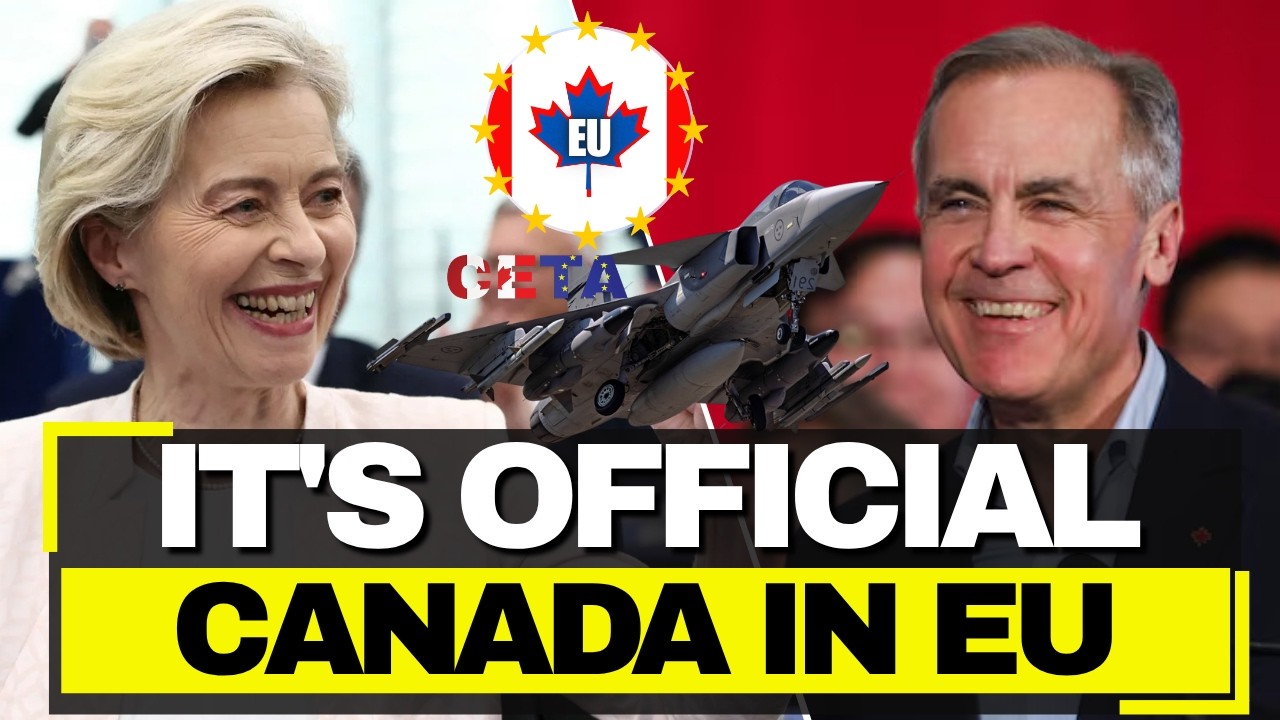
Canada is no longer simply partnering with Europe. It is now legally embedded inside the European Union’s defense-industrial machine.
In a move that stunned analysts across NATO and financial circles alike, the European Parliament officially approved Canada’s participation in the Security Action for Europe program — better known as SAFE — the massive €150 billion defense financing system designed to fuel Europe’s military expansion through 2030.
That vote was not ceremonial. It completed the final legal step required under EU treaty law, transforming what many dismissed as political theater into a binding institutional reality.
And the most explosive detail? Canada received terms no other non-European country on Earth has ever been granted.
Under normal SAFE procurement rules, foreign suppliers are capped at contributing 35% of a defense contract’s total value. Canada shattered that ceiling. Canadian companies can now provide up to 80% of the value of eligible European defense contracts — effectively placing Canadian firms on near-equal footing with EU manufacturers themselves.
That is not a minor loophole hidden in legal fine print. It is a structural exemption with enormous strategic implications.
For the first time in EU history, a non-European country has been granted privileged access to Europe’s defense procurement ecosystem with rights approaching those of member states.
The implications are immediate.
Canadian aerospace, cybersecurity, AI, satellite, and defense communication companies are now positioned to compete directly for billions in European military contracts already being distributed under SAFE funding. European governments approved their first national defense investment plans in March 2026, meaning the money is already flowing.
Firms specializing in satellite surveillance, encrypted communications, military simulation, cyber defense, and dual-use artificial intelligence are expected to benefit first. Companies like NorthStar Earth & Space, Calian, MDA Space, and others suddenly find themselves standing inside a procurement system worth €150 billion — after paying what critics are calling a laughably small entry price.
Canada’s total participation cost? Roughly €10 million.
For access to one of the largest defense procurement pools in modern European history, that figure barely registers as a rounding error.
But the agreement goes even further.

Buried inside the framework is a clause unlike anything previously seen in EU third-country arrangements: Canada must financially contribute to Ukraine’s defense industry in proportion to the value Canadian firms earn from SAFE contracts.
In other words, commercial access is now contractually tied to collective defense obligations.
This is no symbolic gesture for headlines. It is a measurable legal mechanism binding Canada economically and strategically to Europe’s security future — and specifically to Europe’s long-term support of Ukraine.
The political messaging surrounding the vote made the shift even harder to ignore.
European lawmakers openly framed Canada not as an outside ally, but as part of Europe’s emerging strategic bloc. One senior EU figure welcomed Canada as “our reliable security-building partner,” while Polish officials declared that “Europe is rearming — and Canada is with us.”
That phrase echoed across European capitals for a reason.
Europe is building a new defense-centered alliance architecture… and it invited only one North American country fully inside.
Five years ago, most observers would have assumed that country would be the United States.

Instead, Europe appears to be quietly engineering strategic redundancy — expanding defense cooperation beyond Washington while integrating Ottawa deeper into its institutional framework.
And this SAFE agreement is only one piece of a much larger transformation.
Canada has already signed a sweeping EU-Canada Security and Defense Partnership, joined the International Claims Commission for Ukraine, intensified coordination through the European Political Community Summit, and accelerated trade integration through CETA expansion efforts. Meanwhile, Ottawa launched the Canada Strong Fund — a $25 billion sovereign wealth initiative explicitly aimed at reducing dependence on the U.S. economy.
Foreign Affairs Minister Anita Anand recently revealed Canada signed more than 20 security, defense, and economic agreements worldwide in just 12 months.
That pace is extraordinary by diplomatic standards.
This is no longer a foreign policy adjustment. It is a full-spectrum institutional realignment happening in real time.
Analysts now predict Canadian firms could secure their first major SAFE-linked contracts within the next 12 to 18 months, particularly in space surveillance, military training systems, and secure communications infrastructure.
And suddenly, Bloomberg’s controversial phrase calling Canada “the EU’s 28th member state” no longer sounds like a provocative metaphor.
It is beginning to look like a functional description of reality.
Canada may not have a seat in the European Council. It may not fly the EU flag in Brussels.
But as of this week, it is legally inside Europe’s defense procurement system, economically inside its trade architecture, diplomatically inside its political coordination framework, and strategically inside its long-term security vision.
The only thing missing now… may be the paperwork.






