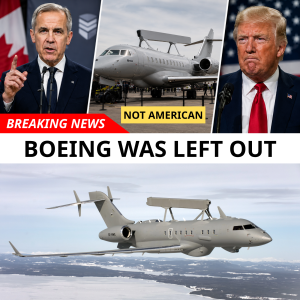
A quiet but potentially historic shift is now unfolding inside Canada’s defense strategy — and analysts say Washington is watching extremely closely. Prime Minister Mark Carney has just overseen one of the most politically symbolic defense decisions Canada has made in decades, signaling that Ottawa may no longer be willing to rely almost entirely on American military-industrial dominance.
The moment that triggered international attention came during Canada’s largest defense trade exhibition, where Carney became the first sitting Canadian Prime Minister ever to headline the event personally. That alone already surprised observers, since Canadian leaders historically avoided making military-industrial policy such a visible political priority.

But what happened next stunned defense analysts even more.
Instead of leaning toward traditional American aerospace giants like Boeing or L3Harris Technologies, Ottawa now appears increasingly interested in moving toward Sweden’s advanced Saab GlobalEye surveillance system.
For many defense experts, the significance goes far beyond a simple aircraft procurement decision.
The Saab GlobalEye platform is built using Canadian-made Bombardier aircraft, meaning the program would directly integrate Canadian aerospace manufacturing into a growing global defense supply chain for years — potentially decades — into the future.
Officials and industry analysts estimate the move could support more than 3,000 Canadian jobs across aerospace manufacturing, maintenance, engineering, logistics, and advanced technology sectors.
That economic component is politically enormous.
For decades, Canadian defense procurement often strengthened American aerospace industries far more than Canada’s own domestic industrial capacity. Critics inside Ottawa increasingly argued Canada remained too dependent on foreign suppliers while failing to fully leverage its own advanced aerospace capabilities.
Carney now appears determined to change that equation.
Supporters of the government describe the move as a strategic modernization effort designed not only to improve national defense capabilities but also to strengthen long-term Canadian industrial independence. Instead of simply purchasing military systems externally, Canada increasingly wants to become part of the actual production ecosystem itself.

That distinction matters tremendously geopolitically.
What made the situation especially explosive was the timing.
The same day Canada signaled its interest in deeper non-American defense integration, officials in Washington reportedly acknowledged growing frustration over Ottawa’s refusal to fully accept a new American tariff strategy targeting key sectors involving trade and industrial cooperation.
That coincidence immediately fueled speculation that something much larger may now be happening behind closed doors.
Many analysts increasingly believe Canada is quietly repositioning itself strategically away from automatic dependence on Washington while building stronger relationships with Europe instead. The GlobalEye decision now appears connected to a broader pattern involving military cooperation, industrial diversification, trade realignment, Arctic security planning, and growing Canadian participation inside Europe’s expanding defense ecosystem.
That broader transformation is beginning to unsettle Washington significantly.
For generations, the United States largely assumed Canada would remain permanently anchored inside America’s military-industrial orbit. NORAD cooperation, NATO integration, aerospace manufacturing ties, intelligence coordination, and continental defense planning all reinforced that assumption.
Now Ottawa appears increasingly interested in creating strategic alternatives.
Defense analysts say the implications could become enormous over time because procurement decisions create long-term geopolitical consequences. Countries that manufacture, maintain, and integrate military systems together often develop decades-long dependencies involving logistics, technology sharing, intelligence compatibility, industrial planning, and operational coordination.
That is precisely why Washington reportedly views Canada’s shift so seriously.
If Ottawa gradually deepens military-industrial ties with Europe while reducing reliance on U.S. suppliers, the balance of influence inside North American defense architecture itself could slowly begin changing.
Some American defense contractors are reportedly especially alarmed because Canada historically represented one of the safest and most reliable markets for U.S. military systems. Losing influence over Canadian procurement could eventually cost American firms billions of dollars while simultaneously giving Europe a much larger foothold inside North American aerospace and defense industries.
European governments, meanwhile, appear eager to expand those partnerships.
Across Europe, leaders increasingly want stronger independent military-industrial capacity following years of geopolitical instability, trade tensions, sanctions disputes, and uncertainty surrounding future American political leadership. Massive investments are already flowing into missile defense, cyber warfare, AI-assisted battlefield systems, autonomous drones, radar networks, naval systems, and advanced surveillance infrastructure.
Canada now appears increasingly interested in participating directly inside that transformation.
The Arctic dimension may become especially important.
As climate change opens northern shipping routes and intensifies competition over critical minerals, energy reserves, and military positioning, Canada’s geopolitical importance continues rising dramatically. European countries increasingly view Arctic security as one of the defining strategic issues of the coming decades, particularly as Russia continues heavily militarizing northern territories.
That shared concern is creating deeper alignment between Ottawa and several European capitals.
Supporters of Carney’s strategy argue Canada is not abandoning the United States at all. Instead, they say Ottawa is simply reducing strategic vulnerability by ensuring Canada possesses multiple long-term industrial and military partnerships rather than overwhelming dependence on a single superpower.
Critics remain unconvinced.
Some commentators in Washington warn Canada risks weakening continental defense integration while drifting too far into European geopolitical frameworks. Others argue Ottawa may underestimate how aggressively future American administrations could respond if they perceive Canada deliberately undermining U.S. industrial and strategic interests.
Those tensions are now quietly growing beneath the surface.
Still, inside Canada, many observers increasingly believe the government’s strategy reflects a much larger national shift already underway politically. Trade wars, tariff threats, sanctions pressure, and repeated economic confrontations with Washington reportedly convinced many Canadian policymakers that excessive reliance on the United States may no longer be strategically safe in an increasingly unstable global environment.
That realization appears to be reshaping long-term policy thinking across multiple sectors simultaneously.
What once would have looked like an ordinary aircraft procurement discussion is now increasingly being interpreted as something far more important:
A visible sign that Canada may be redefining its place inside the Western alliance itself.
And if Ottawa ultimately continues deepening defense-industrial integration with Europe while bypassing major American suppliers, historians may eventually view this period as one of the most important strategic turning points in modern Canada–U.S. relations.






