
The desert sun blazed over Abu Dhabi as a fleet of cranes moved with military precision. One after another, massive modules the exact size of shipping containers were lifted into the sky and locked into place like giant Lego blocks. Inside each module? Fully finished apartments — tiles already laid on the floors, toilets installed in the bathrooms, lights that flicked on instantly, plumbing connected, air conditioning humming. No scaffolding. No months of noisy construction. No workers hammering at midnight.
In just 96 hours — four days — a 16-story residential building named Earth Tower stood complete. 150 apartments. 168,000 square feet of living space. Valued at 125 million RMB. Move-in ready. This was not a prototype, not a stunt, not a science-fiction demo. It happened in late 2025, and the company behind it has just changed the rules of construction forever.
The mastermind is Broad Group, a Chinese company that has spent over a decade quietly turning the entire building industry into a high-speed manufacturing process. While the world was still arguing about whether modular construction could ever be safe or scalable, Broad was already stacking skyscrapers at a pace that made traditional builders look like they were working in slow motion.
It started in 2011 with the T30 hotel — a 30-story building assembled in just 15 days in central China. Two hundred workers operated around the clock while the world watched jaw-dropping time-lapse videos. The building was 93% prefabricated in a factory. Only 7% of the work happened on site. Insulation, plumbing, electrical wiring, air conditioning — everything was installed before the modules ever left the production line. Skeptics called it a gimmick. Broad ignored them and treated it as Version 1.0.
Three years later came Mini Sky City: a 57-story skyscraper, 204 meters tall, completed in 19 days. It contained 800 apartments and workspace for 4,000 people. The pace was three full floors per day. Then the records became almost unbelievable. A 10-story apartment building rose in 28 hours and 45 minutes. In 2024, a 26-story residential tower with 200 apartments and 14,000 square meters of floor space was finished in five days — every unit delivered turnkey, water running, lights working, ready for residents.
By the time Broad shipped 259 modules across 6,000 kilometers of ocean to Abu Dhabi, the technology had been refined to near perfection. Each module rolls off robotic assembly lines in central China like cars rolling out of a Tesla factory. When it leaves the plant, it is 90% complete. Tiles are laid. Toilets are fixed. Wiring is run. Paint is dry. The factory currently produces 27 million square feet of building space per year — the equivalent of an entire city’s worth of housing annually.
On the construction site, there is almost no “construction” left. Cranes lift. Workers bolt structural connections. Crews connect the interfaces between modules. That is why Earth Tower went from bare ground to finished 16-story building in 96 hours. The modules were manufactured in September 2025, shipped in October, arrived after a 20-day sea journey, and then the cranes went to work. Four days later, the building was standing.
The developer behind the project was no small player. Eagle Hills, part of the same group that built the Burj Khalifa — the tallest structure on Earth — flew executives to China, toured Broad’s factory, watched the robots at work, and placed a real commercial order. This was not a pilot project or a publicity stunt. It was a serious business decision. A Middle Eastern developer looked at the fastest construction system on the planet and decided it was ready for the Gulf.
Broad is not stopping at shipping individual buildings. The company’s next move is even more audacious: they are preparing to ship entire factories to the Middle East. Local production lines in the UAE would mean modules can be made on-site, cutting shipping costs and time while scaling even faster. Broad’s stated goal is 70 production lines worldwide by 2030, churning out 200 million square meters of buildings every year. They are not trying to be the fastest builder in China. They are trying to replace how the entire world builds.
And they are not alone. China State Construction Engineering (CSCE), the largest construction company on Earth by revenue, has just received Dubai’s in-principle pre-approval for modular integrated construction. Their brand, Home Magic, is targeting 50,000 housing units per year for Belt and Road countries. In 2025 alone, China exported $4.34 billion worth of prefabricated buildings — a 42% jump in exports to Gulf markets. The numbers are no longer theoretical. The industrial system is being exported.
Construction has always been one of the last major industries to resist the shift from hand-built to factory-built. Cars went through it a century ago. Electronics followed 50 years ago. Clothing even earlier. Buildings are going through that revolution right now — and China is not just participating. It is leading it with ruthless efficiency.
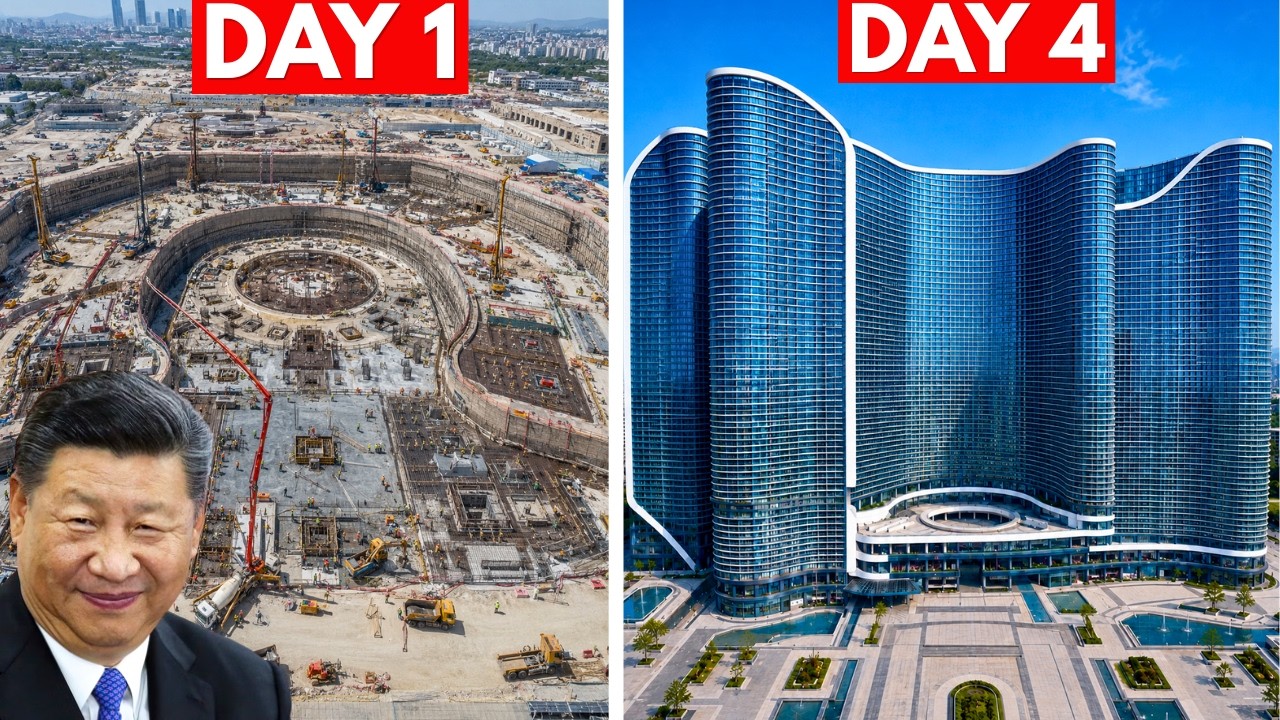
The implications are staggering. Traditional high-rise construction takes 18 to 24 months for a building the size of Earth Tower. Broad did it in less than a week on a real site under real conditions. Labor shortages that plague the Gulf states? Solved. Skyrocketing timelines and costs? Slashed. The need for massive on-site workforces in extreme desert heat? Dramatically reduced.
For countries racing to build millions of homes, this technology is a game-changer. For traditional construction companies still relying on concrete poured by hand and steel erected piece by piece, it is an existential threat. The era of months-long delays, weather interruptions, and ballooning budgets may soon belong to history books.
But the story goes deeper than speed. Broad’s system is not just fast — it is precise. Every module is manufactured with factory-level quality control that is almost impossible to achieve on a chaotic construction site. Safety standards are baked in at the design stage. Waste is minimized. Energy efficiency is built into every unit. What looks like a construction miracle is actually the industrialization of an ancient craft.
Fifteen years ago, when Broad stacked that first 30-story hotel in 15 days, the world laughed and called it a stunt. Today, the same world is placing orders and flying executives to China to study the technology. The laughter has stopped. The orders have begun.
Earth Tower in Abu Dhabi is only the beginning. With Broad planning local factories across the Middle East and CSCE pushing into Dubai’s market, the Gulf is about to become the next proving ground for a construction revolution that started in China and is now going global. What took humanity centuries to perfect through slow, labor-intensive methods can now be delivered in days using robotic precision and modular genius.
The cranes in Abu Dhabi have already shown what is possible. The factories preparing to ship worldwide will soon prove it can be done anywhere. The question is no longer whether this technology works. The question is how quickly the rest of the world will adapt — or be left behind.
While governments debate housing crises and construction costs spiral out of control, one Chinese company has quietly solved the problem with a speed that borders on science fiction. And they are not slowing down. They are accelerating.
The 96-hour building in the desert was not just a record. It was a warning shot to every traditional builder on Earth: the future of construction has arrived, and it was assembled in four days.