“Hanson Calls for ‘Citizens Only’ Voting, Igniting a Fierce Debate on Sovereignty and Belonging in Australia”
SYDNEY — A political firestorm erupted across Australia this week after Pauline Hanson, the leader of the nationalist One Nation party, declared that only Australian citizens should be permitted to vote in federal elections, calling for an immediate ban on foreign nationals from any participation in the nation’s democratic processes.
The remarks, made during a campaign-style rally in Queensland, have quickly become one of the most divisive flashpoints ahead of the next federal election, reframing the national conversation around immigration, sovereignty, and who truly belongs to the Australian polity.
Speaking to a crowd of several hundred supporters in Ipswich, Hanson did not temper her language. “Australia’s future should be determined by Australian citizens — and Australian citizens alone,” she said, drawing both cheers and scattered jeers. “No foreign national, no permanent resident, no person who has sworn allegiance to another flag should have a say in binding referendums or general elections.”

While Australian law already restricts voting in federal elections to citizens, Hanson’s broader proposal — which critics say is aimed at permanent residents and long-term visa holders — has stirred confusion and alarm. Under current legislation, non-citizens are already prohibited from enrolling to vote for the House of Representatives or the Senate.
Legal experts were quick to point out the redundancy. “What she is proposing is already the law,” said Dr. Lila Mirza, a constitutional scholar at the University of Melbourne. “So the only way to interpret her statement is as a political provocation designed to suggest that there is a widespread problem of non-citizen voting, which there is no evidence of.”
Nevertheless, Hanson doubled down. In a fiery follow-up interview with Sky News Australia, she claimed that “activist judges and left-wing councils” were allowing foreign nationals to slip through electoral cracks. “We need to close every loophole,” she said. “If you are not a citizen, you do not get a vote. End of story.”
The remarks have become a major testing ground for both major parties. Prime Minister Anthony Albanese, speaking from Canberra, dismissed Hanson’s comments as “fearmongering dressed up as patriotism.” He added: “Our electoral system is secure. Australian citizens vote. That is the law. Suggesting otherwise is a distraction from real issues like cost of living and housing.”
But the opposition leader, Peter Dutton, treaded carefully. While stopping short of endorsing Hanson’s rhetoric, Dutton said that “national identity and the integrity of our elections must be defended.” His comments were interpreted by some analysts as an effort to appeal to conservative voters without alienating multicultural constituencies in key marginal seats.
The debate has quickly transcended party lines. From talkback radio to X (formerly Twitter), the country is locked in a raw argument over who belongs. Hashtags such as #CitizensOnly and #OurVote trended nationally, with both sides accusing the other of undermining democracy.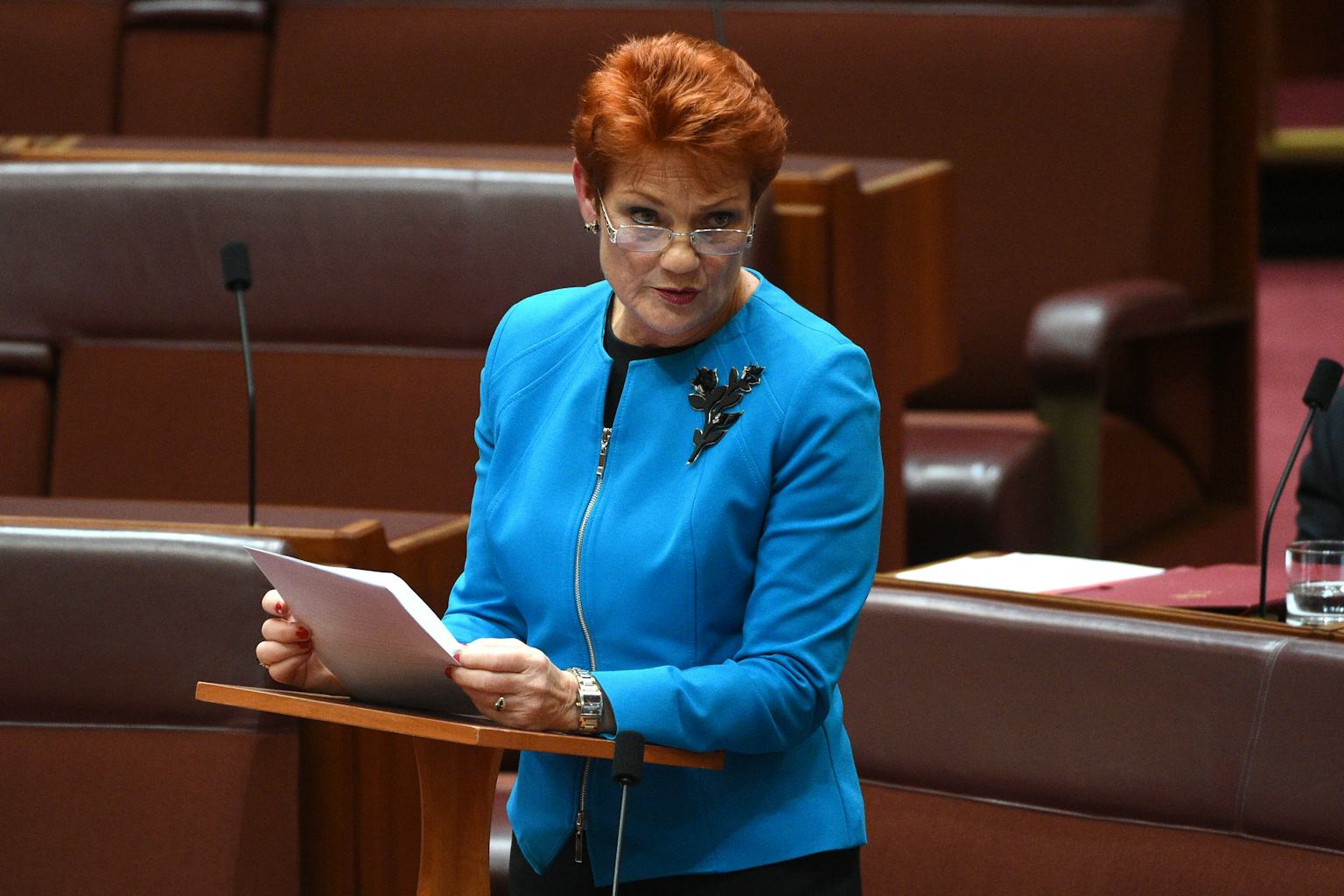
Supporters of Hanson’s position argue that her statement is a simple defense of national sovereignty. “It’s not about race,” said one protester outside Parliament House, holding a placard reading “One Nation, One Vote.” “It’s about the basic principle that only citizens have skin in the game.”
But critics say the language is a deliberate dog whistle. “She is trying to create the impression that foreign nationals are secretly deciding our elections,” said Jordon Steele-John, a Greens senator. “That is false, it is dangerous, and it is an insult to the millions of permanent residents who contribute to this country in taxes, labor, and community life.”
Labor backbenchers, speaking on condition of anonymity, admitted that Hanson’s messaging could resonate in outer suburban and regional electorates where immigration skepticism is high. “The problem is that she’s saying what some people are thinking,” one MP said. “We ignore that at our peril.”
The timing is significant. With the next federal election expected by mid-2026, the One Nation party is polling at roughly seven percent nationally — enough to influence preference flows and potentially decide several Senate seats. Hanson’s ability to set the news cycle is a source of deep concern for the major parties.
On Wednesday, the Australian Electoral Commission issued a rare public clarification, reiterating that “voting in federal elections is restricted to Australian citizens aged 18 and over who have enrolled correctly. There is no evidence of systemic non-citizen voting.” The statement was widely seen as an implicit rebuke of Hanson’s rhetoric.
Still, Hanson showed no signs of retreat. In a defiant Facebook post, she wrote: “They mocked me when I said we were being swamped by Asian immigration in the 90s. They called me racist. Now everyone agrees we need a freeze. Same fight, different day.”
That reference to her notorious 1996 maiden speech to Parliament — in which she warned that Australia was “in danger of being swamped by Asians” — drew immediate condemnation from Chinese-Australian and pan-Asian community groups.
“This is not about sovereignty. This is about recycling the same old xenophobia,” said Jennifer Yang, president of the Asian Australian Alliance. “Permanent residents are not enemies of democracy. Many are on the path to citizenship. They serve in our hospitals, teach our children, and build our homes.”
Among younger voters, the reaction was particularly sharp. At the University of Sydney, students organized a snap rally under the slogan “Our Future, Many Voices.” Twenty-two-year-old Mina Al-Hassan, a permanent resident from Lebanon who has lived in Australia for 15 years, said Hanson’s comments made her feel invisible.
“I have never voted. I know I cannot vote. So why is she attacking me?” she asked. “She is creating a monster that does not exist to win political points.”
International observers have also taken note. A spokesperson for the Office for Democratic Institutions and Human Rights (ODIHR) in Warsaw said the statement “appears to address a non-existent problem” but warned that rhetoric targeting legal residents could corrode social trust.
Hanson’s allies, however, remain unshaken. One Nation senator Malcolm Roberts defended the comments in a Senate estimates hearing, saying: “There is nothing controversial about saying Australians should run Australia. That is not hate. That is common sense.”
The controversy has also exposed fractures within the broader conservative movement. While some right-wing commentators praised Hanson’s “clarity,” others worried that the fixation on non-citizen voting — a statistically negligible issue — would distract from substantive policy debates on the economy and energy.
In editorial boards across the country, a familiar question resurfaced: Is Hanson an unignorable voice of the periphery, or a destabilizing figure exploiting fear for relevance? The answer may depend on which polls one reads. But few doubt that she has once again bent the national conversation toward her chosen terrain.
As the election campaign heats up, both Labor and the Coalition will be forced to articulate a clearer position. Will they defend the existing system as secure, or entertain further restrictions? And at what cost to Australia’s self-image as a cohesive, multicultural democracy?
For now, Hanson appears content to stand alone in the firestorm she ignited. “Let them call me divisive,” she said, smiling to a scrum of reporters outside her Brisbane office. “I call it leadership.”
The next federal election is still months away. But the battle over who gets to shape Australia’s future — and whether that circle should be narrowed further — has already begun.






