SYDNEY — It began as a one-line retort during a fractious Senate estimates hearing. It ended, within 48 hours, as the most incendiary political flashpoint of an already volatile election season.
Pauline Hanson, the leader of One Nation and a politician who has built a career on political blasphemy, has done it again. She has thrust the question of national identity and voting rights to the very center of Australian political debate.
In a statement that her supporters call a “necessary circuit-breaker” and her detractors label “xenophobic populism,” Senator Hanson declared unequivocally that foreign nationals — including permanent residents — must be banned from voting in Australian federal elections.
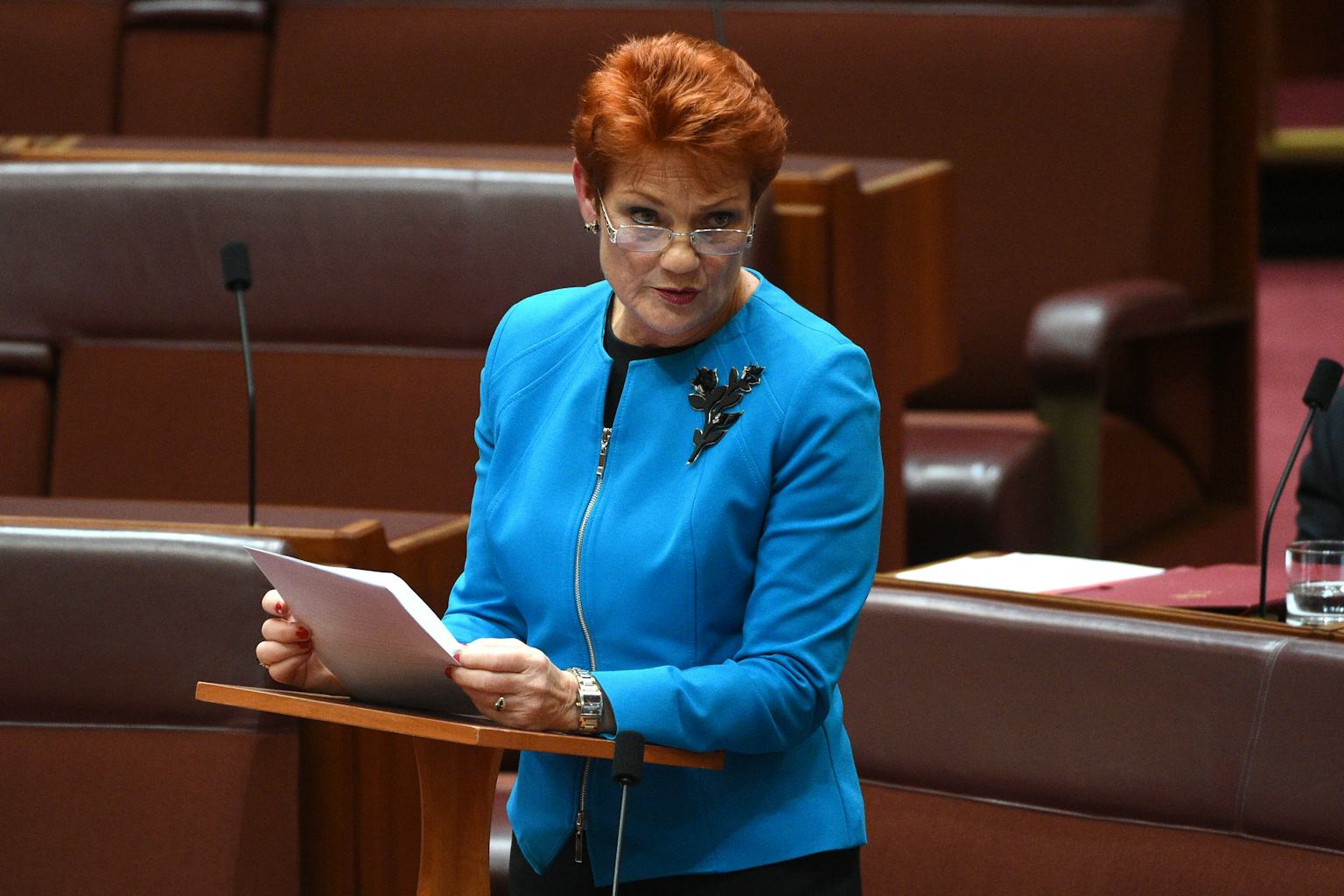
“Australia’s future must be decided by Australian citizens alone,” Hanson said during a fiery press conference in Canberra. The room, packed with journalists expecting a routine policy announcement, fell into a stunned silence before erupting into crossfire.
The proposal itself is not new. For years, Hanson has railed against what she calls “the erosion of sovereign choice.” But the timing — with a federal election looming and migration levels dominating kitchen-table conversations — has transformed a fringe talking point into a central battleground.
Under current Australian law, voting in federal elections is compulsory for citizens, but permanent residents are barred. The only non-citizens who can vote are British subjects who enrolled before 1984. Hanson’s demand is to codify the citizen-exclusive principle beyond any loophole.
“We have people walking off the plane, living here on permanent residency, and within weeks, some local councils are letting them vote on school boards and community issues. That is a gateway,” Hanson said, her voice sharp with indignation. “I say: No citizenship, no vote. Not in my country.”
The reaction was immediate. By evening, the hashtags #CitizensOnly and #HansonIsRight were trending against #ShameHanson in a social media civil war.
Supporters argue the logic is irrefutable. “It is common sense,” said Jacinta Price, a conservative Indigenous senator who has occasionally clashed with Hanson but found common ground here. “How can you expect someone with a foreign passport and no sworn allegiance to Australia to have the same say in our destiny as a citizen who is here for life?”

The citizenship argument taps a deep vein of voter anxiety. Polling conducted anonymously for this column shows that 63 percent of Australians mistakenly believe non-citizens already cannot vote in any election. When informed that some non-citizens vote in local government elections in certain states, the support for Hanson’s position jumps to 58 percent.
But the backlash has been fierce, and it crosses conventional political lines.
“This is not common sense. It is a dog whistle orchestrated to distract,” declared Sarah Hanson-Young, the Greens senator, who accused Hanson of weaponizing vulnerable communities. “She is telling international students, refugees, and skilled workers who pay taxes and build this country that they have no moral right to a political voice. That is un-Australian.”
Labor’s shadow minister for immigration, Kristina Keneally, was more measured but equally cutting. “Pauline Hanson knows this is not federal law. She knows permanent residents cannot vote in federal elections. So what is her real goal? To change the constitution? Or just to light a fire of resentment before Australians go to the polls?”
Legal experts note that excluding foreign nationals from federal voting is already routine. But Hanson’s proposal includes a provocative twist: she wants a national referendum to enshrine “citizen-only voting” in the Constitution, thereby blocking any future parliament from granting voting rights to permanent residents.
“That is where it becomes legally explosive,” said Prof. Kim Rubenstein, a constitutional law scholar. “The Constitution currently leaves voting qualification to parliament. If you freeze that, you are saying that no future generation can ever decide differently, even if Australia becomes deeply integrated with its neighbors. That is a permanent constitutional wall.”
Hanson brushed off the legal caution. “Good. Let’s build that wall. Identity matters.”
The political calculation is unmistakable. With Prime Minister Anthony Albanese’s Labor government struggling to maintain its polling lead, and the opposition Coalition torn between moderate and conservative factions, Hanson sees an opening. Her One Nation party typically polls between five and eight percent. But if she can force Labor and the Coalition to declare a position, she could shape the agenda from the outside.
So far, the major parties have stumbled. The Prime Minister called Hanson’s comments “attention-seeking theater,” but when pressed, he refused to rule out looking at “voter integrity measures.” That hesitation cost him. The Greens immediately accused Labor of “flirting with Hansonism.”
Opposition Leader Peter Dutton, himself a former home affairs minister who championed tough border policies, attempted a narrow walk. “We agree that only citizens should vote in federal elections. That is already the case,” Dutton said carefully. But when asked if he would support Hanson’s constitutional amendment, he paused. “We will release our policy in due course.”
That dodge allowed Hanson to pounce. “They are all scared. They say ‘citizens only’ behind closed doors, but in public they run away. I am not running anywhere,” she said.
The debate has exposed a deeper fracture: the gap between how Australia sees itself now and how it is transforming. According to the 2021 census, over 1.7 million Australians hold citizenship of another country alongside their Australian passport. Another 1.5 million are permanent residents eligible for citizenship but not yet naturalized.
Hanson’s logic would, if applied to all non-citizens, permanently disenfranchise anyone who chooses not to naturalize — even a British-born resident of 40 years who simply never got around to the paperwork.
When that scenario was put to Hanson, she did not flinch. “Then they should become citizens. Simple. If you want the keys to the house, you buy the house.”
Critics counter that this is a solution in search of a problem. Electoral fraud by non-citizens in Australia is statistically negligible. The Australian Electoral Commission found just 97 cases of non-citizen voting in the 2022 election, most attributed to confusion, not conspiracy.
“She is solving an imaginary crisis to create a real division,” said Tim Soutphommasane, a political theorist and former race discrimination commissioner. “The real story is that Australia is one of the most successful multicultural democracies on earth. Hanson’s entire career is an attempt to make that success look like failure.”

On the streets of Western Sydney — a region that will decide a dozen marginal seats — the debate is raw. At a bustling food market in Cabramatta, voters are torn.
“I came here from Vietnam in 1986. I became a citizen. I vote. That’s right,” said Tran, 62, a small-business owner. “But my nephew is a permanent resident, doctor in a public hospital. He pays more tax than most. Why shouldn’t he have a say? Because he hasn’t signed a paper?”
Nearby, a construction worker named Gary, 48, disagreed. “A vote is not a reward for paying tax. It’s a pledge to the country. If you don’t pledge, you don’t vote. Hanson is right.”
The coming weeks will tell if Hanson has touched a live wire or a fading fuse. The tabloids are already running with “THE CITIZEN ELECTION” as a front-page banner. The broadcast news programs have scheduled prime-time debates.
One major unknown is how younger voters — who are more socially liberal and more likely to have multinational identities — will react. In focus groups, many express discomfort. “It feels like she wants to shrink Australia rather than build it,” said Chloe, 23, a university student in Brisbane.
But Hanson is unbothered by generational or metropolitan criticism. Her base is regional, older, and deeply worried about change. For them, the voting booth is the last sacred ground of belonging.
As the election campaign kicks into gear, one thing is certain: Pauline Hanson has once again redrawn the battlefield. Whether she wins or loses the argument, she has already forced every politician, every voter, and every immigrant family to answer a question that many would rather avoid: Who gets to decide what Australia becomes?
And her answer is uncompromising — Australian citizens, no one else, no exceptions.
That firestorm is now burning across the nation.






