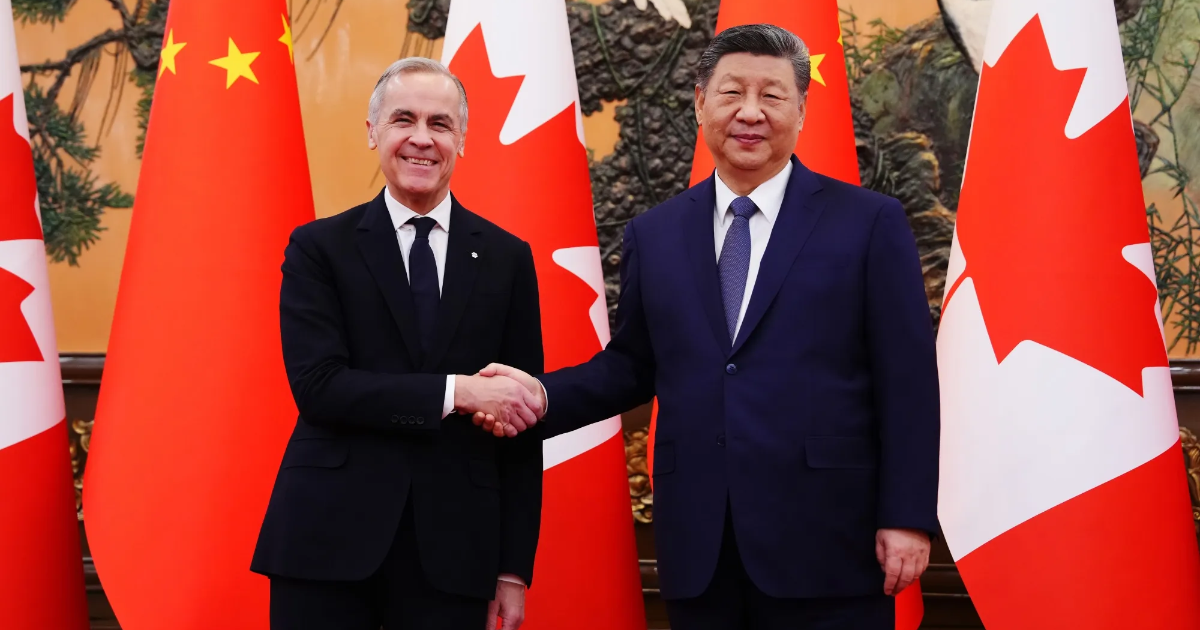
A profound geopolitical fracture is rapidly widening across North America after Canadian Prime Minister Mark Carney explicitly refused to cancel a highly controversial electric vehicle trade agreement with China. The unprecedented diplomatic decision has placed Ottawa on a direct collision course with Washington over continental security.
Under the newly implemented bilateral arrangement, Canada has dramatically reduced its import tariffs on a fixed quota of 49,000 Chinese-made electric vehicles. The previous protectionist tariff barrier of 100 percent has been slashed to a modest most-favored-nation rate of just 6.1 percent.
In return for this substantial automotive concession, Beijing agreed to systematically lower its own prohibitive tariff walls on key Canadian agricultural and maritime exports. The targeted economic relief has immediately reopened vital Chinese consumer markets for Canadian canola seed, lobster, crab, and peas.
The bold, independent maneuvering by the Carney administration has triggered an immediate, furious rhetorical backlash from Washington. Former President Donald Trump has issued an ultimatum, threatening a catastrophic 100 percent comprehensive tariff on all Canadian imports entering the United States.
Trump has publicly accused Ottawa of abandoning its continental defense obligations, claiming Canada has effectively become a dangerous drop-off port for heavily subsidized Chinese manufacturing. Washington fears that Chinese companies will utilize the Canadian market as a strategic backdoor to bypass American economic walls.
United States Treasury Secretary Scott Bessent has strongly backed the aggressive protectionist warning, emphasizing that America will take aggressive unilateral action. Bessent stated that the administration would not allow neighboring trading partners to compromise domestic industrial policies through reckless bilateral deals.
„We expect that this will catalyse considerable new Chinese joint-venture investment in Canada, protecting and creating new auto manufacturing jobs.” — Global Affairs Canada
Prime Minister Carney has vigorously defended the economic pact, arguing that the managed import quota is fully legal under existing regional trade frameworks. He maintains that the agreement operates strictly within the boundaries established by the Canada-United States-Mexico Agreement (CUSMA).
Carney contends that the strategic pivot was absolutely necessary to protect rural Canadian farmers, coastal seafood industries, and vulnerable regional economies. These vital domestic sectors had suffered severe financial losses during previous high-stakes geopolitical disputes and sudden market closures overseas.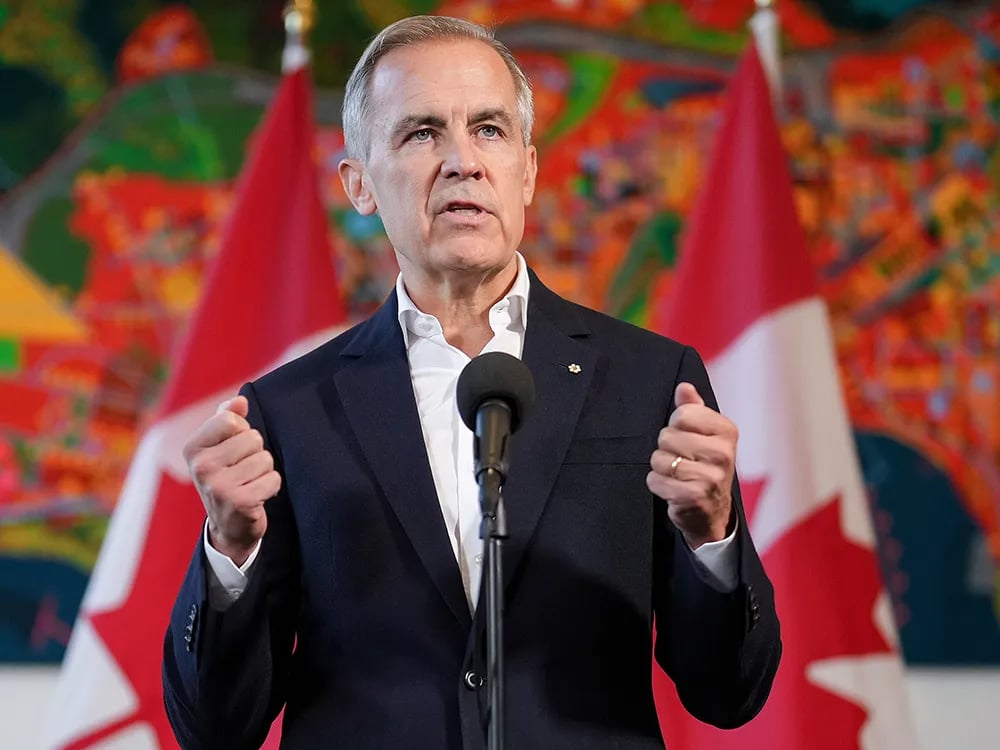
The implementation of the deal has already yielded measurable economic results, rapidly boosting Canadian export volumes across several primary resource sectors. However, the broader, underlying issue is fundamentally strategic, signaling a historic departure from decades of closely coordinated North American foreign policy.
For generations, Ottawa has consistently aligned its international trade restrictions with Washington’s aggressive economic containment strategy targeting the People’s Republic of China. Carney’s sudden shift toward structural pragmatism marks a new era of distinct economic independence that has deeply alarmed American officials.
The primary fear circulating within Washington is that other key Western allies might choose to follow Canada’s pragmatic, market-driven example. Such a trend would severely weaken America’s ability to exert unified, multilateral economic pressure on China’s expanding global industrial sector.
International attention is now turning toward the highly anticipated July 1 CUSMA review, where this deep-seated dispute is expected to escalate significantly. Trade analysts believe that Trump’s severe tariff threats may ultimately serve as an aggressive, calculated opening gambit for broader structural negotiations.
Implementing a comprehensive 100 percent tariff on Canadian goods would inevitably trigger severe economic consequences for American businesses and middle-class consumers alike. The integrated nature of cross-border supply chains means that American manufacturing dependencies would face immediate, unprecedented inflationary spikes.
Despite these mutual economic risks, the Canadian government is actively preparing for the distinct possibility of a prolonged, bruising trade war. Federal agencies are reportedly drafting extensive retaliatory measures and economic contingency plans to safeguard domestic industries from sudden American border closures.
The final outcome of this high-stakes confrontation could permanently reshape North American trade relations, which have stood unified for nearly a century. It marks a fundamental redefinition of how middle powers balance critical economic relationships between the United States and China.
Canadian Industry Minister Melanie Joly has repeatedly emphasized that adopting cutting-edge green technology requires open, pragmatic international collaboration with dominant global suppliers. Joly argues that refusing to engage with the world’s leading EV manufacturers would leave Canada’s industrial sector structurally uncompetitive.
Conversely, American defense strategists view the influx of Chinese automotive technology into the North American grid as a direct national security vulnerability. They argue that subsidized clean-energy vehicles represent an existential threat to the long-term survival of Detroit’s historic manufacturing core.
The automotive sector within Canada has already begun adjusting rapidly to the new regulatory reality established by the Carney administration’s quota. Major multinational manufacturers, including Tesla, have already shifted their regional logistics chains to import specific vehicle variants directly from Shanghai facilities.
This rapid industrial realignment has sparked intense domestic debate regarding consumer costs, vehicle specifications, and the pace of green transition policies. While some environmental advocacy groups welcome the affordable vehicle alternatives, manufacturing unions remain deeply skeptical of long-term job security.
The political stakes for Prime Minister Carney are exceptionally high as his administration navigates the complex fallout of this diplomatic gamble. Having secured a parliamentary majority recently, Carney is betting his political legacy on a vision of distinct economic sovereignty.
The upcoming CUSMA review will serve as the ultimate crucible for this new direction in Canadian foreign and economic policy. Negotiators from Ottawa, Washington, and Mexico City face the daunting task of preventing a complete unraveling of the continent’s free trade zone.
As digital media platforms amplify the escalating trade rhetoric, public anxiety on both sides of the border continues to mount steadily. The interconnectedness of modern border economies ensures that any disruption will be felt immediately by millions of ordinary citizens.
Economic historians suggest that the current friction resembles the intense trade disputes of the late twentieth century over continental resource allocations. However, the introduction of a competing global superpower like China introduces a volatile element that makes resolution far more complex.
The business community in western Canada, particularly the agricultural sector, has thrown its substantial political weight behind Carney’s pragmatic trade diversification. Farmers argue that relying solely on a volatile American market leaves their multi-billion-dollar industries perpetually exposed to sudden policy shifts.
Meanwhile, Atlantic maritime communities are reporting immediate financial relief as shipments of premium seafood resume toward major Chinese logistical hubs. These tangible economic gains have provided the Liberal government with crucial political capital to withstand mounting external diplomatic pressure.
Whether this economic capital will suffice to withstand a full-scale American tariff offensive remains an open question among trade experts. The asymmetry of economic power between the two neighboring nations historically favors Washington in prolonged legal and regulatory standoffs.
Nevertheless, the Carney administration appears determined to maintain its position, asserting that economic sovereignty cannot be sacrificed for political convenience. The firm stance has generated a sense of national pride among certain segments of the Canadian electorate tired of perceived American dominance.
As the July deadline approaches, behind-the-scenes diplomatic efforts are intensifying to find a viable compromise that protects both nations’ core interests. Speculation is rising that Canada may implement stricter tracking mechanisms to guarantee that Chinese components do not enter American territory.
Such a technical solution would require an unprecedented level of regulatory oversight and data sharing between Canadian border agencies and American customs inspectors. It remains uncertain whether the incoming Trump administration would accept anything less than a complete cancellation of the Chinese deal.
The unfolding drama highlights the profound challenges modern democratic nations face when navigating the fracturing global economic order of the twenty-first century. The old consensus of unhindered globalization is rapidly being replaced by fragmented blocks and aggressive resource nationalism.
In conclusion, Canada’s defiant economic stance marks a critical turning point that will resonate far beyond the borders of North America. The choices made by Ottawa in the coming weeks will reverberate through global supply chains, redefining alliance commitments for decades.
The world watches closely as these two historic allies navigate an unprecedented crisis that tests the limits of integration and sovereignty. The final resolution will dictate whether continental trade can survive an era defined by intense systemic competition.