INCREDIBLE: Finland Proposes Canada JOIN EU – “Mentally Part of Europe,” EU of 40 Nations
HELSINKI — Finland’s President Alexander Stubb has proposed a dramatic expansion of the European Union to 40 member states, explicitly naming Canada as a potential future member in a striking speech at an energy summit here.
The suggestion marks one of the most ambitious public calls for enlargement in recent years and reflects deepening ties between Canada and European institutions.

Bold Vision for Enlargement
Mr. Stubb called for bringing in the United Kingdom, Norway, Iceland, Turkey, Ukraine and all Western Balkan states — Serbia, Kosovo, Albania, Montenegro, North Macedonia and Bosnia and Herzegovina — to create a much larger and more geopolitically significant bloc.
He argued that European power depends on size and scale, and that the current window for enlargement is narrow due to the war in Ukraine and shifting dynamics in Washington.
Canada’s Special Mention
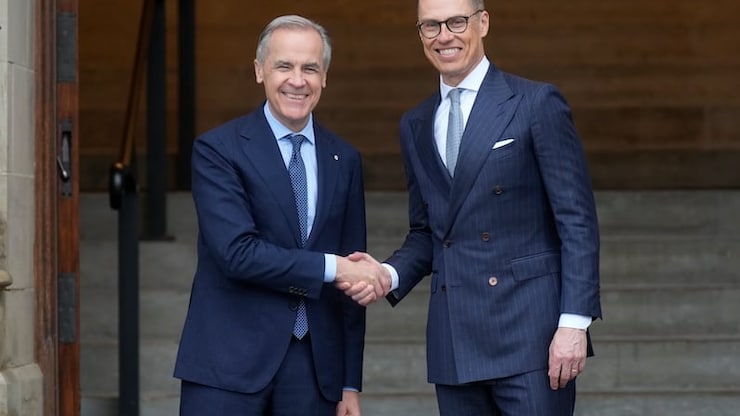
In remarks that drew particular attention, Mr. Stubb described Canada as “mentally part of Europe,” citing shared values, composure and strategic alignment. The Finnish president noted frequent communication with Prime Minister Mark Carney and highlighted growing bilateral cooperation.
The proposal goes beyond symbolic partnership and envisions formal structures that could eventually resemble membership.
Accelerating Integration
Canada has already taken significant steps toward deeper European alignment. It secured preferential access to the European Union’s €150 billion defense procurement program, with an 80 percent Canadian content allowance far exceeding standard third-country limits.
Ottawa recently selected Sweden’s Saab Global Eye surveillance aircraft, built on a Canadian Bombardier airframe, over American competitors. Negotiations for submarines with German-Norwegian partners are also advancing.
Trade and Economic Ties
The Comprehensive Economic and Trade Agreement (CETA) between Canada and the EU is moving toward full ratification. Canada has established a $25 billion sovereign wealth fund partly aimed at reducing reliance on the U.S. market and redirecting investment toward European opportunities.
These moves have positioned Canada as the non-European country with the closest functional integration into European defense, trade and political frameworks.
Geopolitical Timing
Mr. Stubb emphasized that the war in Ukraine has created urgency for enlargement. Once the conflict ends or U.S. policy shifts, he warned, momentum could fade and “unnecessary stuff” would again dominate discussions.
The Finnish leader framed the proposal as seizing a strategic moment rather than a distant aspiration.
Challenges to Accession
Experts note that formal EU membership for Canada would face enormous constitutional, political and legal hurdles. No non-European country has ever joined the bloc, and Canada’s geography and North American ties present unique complications.
Mr. Stubb acknowledged that not all named countries are ready for immediate accession, presenting the idea as a long-term strategic direction.
Reactions and Context
The proposal has sparked discussion across European capitals. While ambitious, it aligns with recent trends of closer Canada-EU coordination on security, critical minerals and energy.
Canadian officials have welcomed deeper partnership but have not signaled pursuit of full membership.
Defense and Security Alignment
Canada’s participation in European defense initiatives has grown rapidly. It became the first non-European country invited to key European Political Community summits and has signed multiple security agreements with EU partners.
These steps have effectively embedded Canada in European strategic planning without formal membership.
Economic Diversification
Prime Minister Carney has made diversification away from over-reliance on the United States a central policy pillar. Stronger European ties serve both economic resilience and geopolitical balance.
Analysts see the Finnish proposal as recognition of Canada’s evolving international posture.
Broader European Ambitions
Mr. Stubb’s speech reflects a growing view in some European circles that the EU must expand its influence to remain competitive amid great-power rivalry involving the United States, China and Russia.
Enlargement to 40 members would transform the bloc’s internal dynamics, decision-making processes and global weight.
Domestic Canadian Debate
In Canada, the idea of closer European integration enjoys support among those seeking alternatives to U.S. dominance, but skepticism remains about the practical implications of deeper entanglement with European regulations and politics.
Public opinion on the matter remains divided.
Symbolic Significance
Even if full membership remains distant, the public naming of Canada by a sitting European president carries symbolic weight. It signals that influential voices in Europe increasingly view Canada as a natural extension of the European project.
Path Forward
Functional integration is likely to continue through defense procurement, trade, energy cooperation and political dialogue. Whether this evolves into formal candidacy or remains a close strategic partnership will depend on political developments on both sides of the Atlantic.
A Shifting Global Order
The proposal underscores broader changes in international alignments. Middle powers like Canada are seeking new frameworks as traditional relationships face strain.
Mr. Stubb’s remarks may be ambitious, but they reflect real momentum in Canada-Europe relations that has been building for months.
Strategic Window
European leaders appear determined to use the current period of geopolitical tension to lock in partnerships that could endure beyond the immediate crisis. Canada’s inclusion in such visions highlights its growing importance in the emerging multipolar landscape.
The coming years will test whether these aspirations translate into concrete institutional changes or remain at the level of enhanced cooperation.






