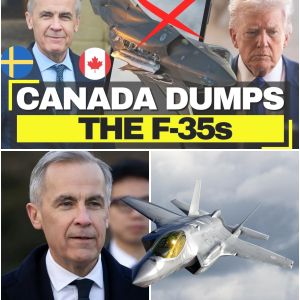
For decades, the military relationship between Canada and the United States seemed untouchable. Ottawa bought American equipment, shared defense systems with Washington, and maintained almost automatic coordination within NATO and NORAD. Few seriously imagined that Canada would ever question that strategic balance. Until now.

What began as a technical discussion about replacing Canada’s aging fighter fleet has transformed into a political, economic, and geopolitical battle shaking all of North America. And at the center of the storm stands an unexpected name: Sweden’s Gripen fighter jet.
Political sources in Ottawa now admit the debate is no longer simply about which aircraft flies faster or carries better technology. The real question is far more sensitive: can Canada continue depending so heavily on the United States for its military future in an increasingly unstable world?
The controversy exploded after the total projected cost of the American-made F-35 program surged toward 33 billion Canadian dollars. What had once been presented as an “inevitable” strategic investment suddenly began looking, to many inside Parliament, like an enormous and potentially dangerous commitment.
Then came another explosive factor: worsening political tensions between Ottawa and Washington following Donald Trump’s return to the White House. Tariff threats, trade disputes, and increasingly aggressive rhetoric toward longtime allies began changing the political mood inside Canada.
Many Canadian officials quietly started asking a question that would have sounded unthinkable just a few years ago: what if relying too heavily on the American defense system someday becomes a strategic vulnerability?
That was the moment Sweden saw a historic opening.
Saab entered the conversation with a completely different pitch. The company did not present the Gripen merely as a fighter aircraft. It marketed the jet as something closer to a sovereignty package for Canada.
The Swedish proposal reportedly included domestic assembly, technology transfers, maintenance controlled by Canadian companies, and thousands of aerospace jobs for local workers. In other words, Ottawa would not simply buy aircraft — it would gain meaningful industrial and technical control over the program itself.
That detail immediately changed the tone of the debate.

Supporters of the Gripen argued that Canada does not necessarily need the world’s most advanced stealth aircraft to defend its Arctic territory. They pointed out that the Swedish fighter was specifically designed for harsh conditions: short runways, remote bases, freezing climates, and rapid deployments.
At the same time, the Gripen’s significantly lower operating costs became increasingly attractive to politicians already frustrated by the ballooning expenses tied to the F-35 program.
But inside Washington, the situation reportedly began generating real concern.
Pentagon-linked officials quietly warned that abandoning the F-35 could weaken Canada’s integration with both the United States and NATO. Publicly, the language remained diplomatic. Privately, however, tensions were rising.
For American defense strategists, the F-35 is not just another fighter jet. It represents an entire military ecosystem built around data-sharing, advanced sensors, electronic warfare, and tightly integrated allied operations.
In those areas, supporters argue, the F-35 remains in a class of its own.
Military officials backing the American aircraft insisted that modern wars are no longer won through traditional dogfighting alone. Future conflicts, they argued, will depend heavily on real-time digital integration between allied forces — an area where the F-35 dramatically outperforms its competitors.
But critics responded with an even more politically sensitive argument.
The issue, several Canadian analysts warned, is not purely technological. It is about control.
Unlike older generations of fighter jets, the F-35 depends heavily on software systems, specialized maintenance, and logistics networks largely controlled by the United States. Although there is no public evidence of a so-called “kill switch” capable of disabling the aircraft remotely, many experts fear that software updates, technical support, or mission systems could someday become tools of political leverage during diplomatic disputes.
That possibility has unsettled even moderate voices within Canadian politics.
Because the debate has stopped being purely military and started touching something far deeper: national independence.
Across television panels, radio programs, and social media platforms, a growing narrative has emerged: Canada must protect its strategic sovereignty before it is too late.
Some commentators have even compared the current debate to earlier historical moments when Canada sought to distance itself politically from Washington in order to preserve its own national identity inside North America.
Meanwhile, political pressure inside Ottawa continues to intensify.
Opposition lawmakers have demanded greater transparency regarding the true conditions tied to the F-35 agreement. Many want clear answers about how much operational autonomy Canada would actually retain in the event of a future political crisis with the United States.
The government’s official response has remained cautious.
No one in Ottawa wants an open rupture with Washington. After all, the United States remains Canada’s most important military ally and largest trading partner. But at the same time, completely dismissing concerns about long-term strategic dependence now appears politically impossible.
And that is where the debate has taken an even more delicate turn.
Defense experts increasingly argue that this controversy reflects a much broader global shift: the slow collapse of automatic trust between Western allies.
For decades, many nations assumed that economic and military integration under American leadership guaranteed long-term stability. But trade wars, geopolitical tensions, and the rise of more nationalist governments have fundamentally changed that assumption.
Now, even close allies are beginning to ask how much independent decision-making power they should preserve for the future.
Across Europe, several governments are already pushing for more autonomous defense projects. In Canada, many observers believe the growing interest in the Gripen reflects that same international trend.
The Pentagon understands the implications perfectly well.
According to sources close to the debate, Washington fears that a potential Gripen victory would represent far more than the loss of a multibillion-dollar defense contract. It could send a dangerous political message to other allies: that reducing military dependence on the United States is both possible and desirable.
That possibility deeply worries the American defense industry.
The F-35 is not merely a military platform. It is one of the most important industrial and strategic projects in the Western alliance system. Its success depends heavily on maintaining a large network of allied nations tied closely to the American defense structure.
If Canada begins partially stepping away from that system, the symbolic impact could be enormous.
Officially, Ottawa still remains committed to the F-35 process. But behind closed doors, discussions about alternatives have not disappeared. In fact, they appear to be growing stronger.
Every new diplomatic clash with Washington fuels more doubt.
Every tariff threat reopens the debate.
Every discussion about technological sovereignty strengthens those arguing for greater military independence.
And meanwhile, Sweden is watching carefully from Europe.
Saab understands this is no longer simply a competition between fighter jets. It is a battle over political trust, national autonomy, and the future balance of power within the Western world.
Canada’s final decision may still take months — perhaps even years — to fully unfold. But one thing already seems clear: the old automatic consensus between Ottawa and Washington is no longer as solid as it once appeared.
And for many inside the Pentagon, that may be far more unsettling than any Swedish fighter jet.