MELBOURNE ERUPTS: Nationalism and Identity COLLIDE as “Remigration” March Sends Shockwaves Across Australia 🇦🇺
A City Divided by Fear, Fury, and Identity
Melbourne’s normally vibrant streets transformed into a scene of political chaos and raw confrontation this weekend as thousands gathered in the heart of the city for what organizers called a “Remigration March.”
What began as a loud nationalist demonstration quickly escalated into one of the most explosive public clashes Australia has witnessed in recent years, exposing deep fractures inside the country’s multicultural identity.
By midday, Federation Square and Swanston Street were flooded with Australian flags, nationalist banners, and angry chants demanding dramatic changes to immigration policy.
The atmosphere was tense from the very beginning.
Police sirens echoed through the CBD while groups of demonstrators marched shoulder-to-shoulder beneath slogans such as “Sovereignty First” and “Take Australia Back.”
For many watching online, the images looked more like scenes from a deeply divided Europe than modern Australia.
But for the protesters, this was not simply another political rally.
They described it as a national “breaking point.”
Speakers at the event delivered fiery speeches condemning mass immigration, accusing political leaders of abandoning ordinary Australians and allowing what they called the erosion of traditional national identity.
Some of the rhetoric shocked even seasoned observers.
Several speakers openly called for the “mass deportation” of what they labeled “unassimilable elements,” with Muslim communities and recent migrants becoming the central targets of criticism.
The tone was uncompromising, emotional, and deeply confrontational.
Critics immediately condemned the march as extremist and dangerous.
Counter-protest groups quickly mobilized nearby, accusing the nationalist demonstrators of promoting racism and division under the banner of patriotism.
As the two sides drew closer together near Flinders Street Station, tensions exploded.
Eyewitness footage circulating online captured screaming crowds, smoke flares, and chaotic physical clashes as demonstrators and counter-protesters surged toward each other.
At the center of the violence was a dramatic incident involving a man identified by onlookers as an immigrant counter-protester.
Video showed the individual lunging toward the nationalist front line before being overwhelmed by several men wearing black tactical-style vests and carrying Australian flags.
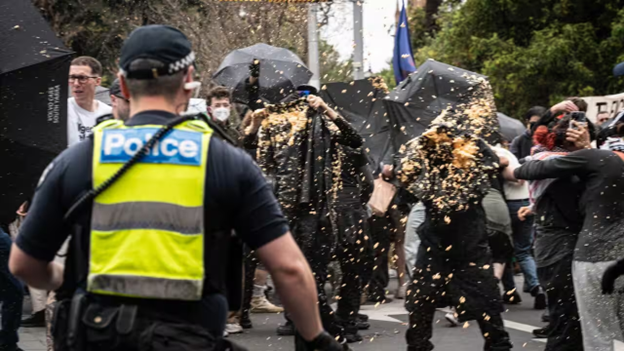
The crowd’s rapid physical restraint of the man before police intervention created an atmosphere many described as “vigilante justice.”
Within moments, riot police moved in.
Officers equipped with shields and helmets attempted to separate the opposing factions as bottles and flares flew through the air.
Smoke drifted across Melbourne’s skyscrapers, creating an eerie backdrop to one of the most politically charged street confrontations the city has experienced in years.
But the anger was not directed solely at the opposing protesters.
A large portion of the nationalist crowd turned its fury toward Victoria Police itself.
Throughout the march, demonstrators repeatedly accused authorities of enforcing what they called “two-tier policing” — the belief that law enforcement treats minority groups more leniently while targeting working-class nationalist Australians more aggressively.
The accusation has become an increasingly powerful rallying cry within nationalist movements across Western countries.
Many protesters claimed police were protecting anti-nationalist agitators while suppressing patriotic Australians attempting to defend their country’s identity.
“They treat us like we’re the enemy,” one woman shouted while confronting a police line.
“They protect the people who hate this country and punish the people who love it.”
That message resonated strongly among demonstrators who traveled from regional areas to attend the rally.
One participant, a tradesman from Victoria, claimed ordinary Australians feel increasingly alienated inside their own communities.
“We are tired of being told we are guests in our own home,” he said.
“The suburbs are changing, the borders are open, and politicians pretend nothing is happening.”
For supporters of the march, the demonstration represented frustration over rapid demographic and cultural change.
For opponents, it represented the dangerous normalization of extremist nationalism.
The emergence of the “Remigration” movement in Australia has alarmed political analysts because the concept was once confined largely to fringe online spaces.
Now, however, the language and messaging are entering public demonstrations with growing visibility and confidence.
The movement advocates encouraging — or in some cases forcing — immigrants to return to their ancestral homelands.
Mainstream Australian political parties have long dismissed the idea as politically toxic and unrealistic.
Yet the sheer size of the Melbourne rally has sparked fears that nationalist sentiment may be growing faster than many leaders anticipated.
Observers say the movement feeds on a broader sense of economic insecurity, distrust toward institutions, housing pressures, and cultural anxiety.
Across many Western nations, similar nationalist movements have gained momentum by arguing that globalization and mass migration have weakened national identity and social cohesion.
From France to Britain and parts of Northern Europe, the slogan of “remigration” has increasingly become a flashpoint in political discourse.
Australia now appears to be facing its own version of that crisis.
What makes the situation particularly explosive is Australia’s long-standing identity as one of the world’s most successful multicultural societies.
For decades, multiculturalism has been celebrated as a cornerstone of modern Australian national identity.
But critics of immigration policy now openly challenge that narrative, arguing that integration has failed in some communities and that politicians ignored public concerns for too long.
Supporters of multiculturalism warn that the rise of nationalist anger could push Australia into a dangerous cycle of division and radicalization.
Political leaders across the spectrum have already begun responding to the Melbourne unrest.
Some condemned the nationalist demonstrators outright, while others warned that dismissing public frustration entirely could make tensions even worse.
The debate has now expanded far beyond the streets of Melbourne.
It is rapidly becoming a nationwide conversation about borders, identity, social cohesion, policing, and the future direction of Australia itself.
Meanwhile, disturbing footage from the clashes continues spreading across social media platforms, fueling even more outrage from both sides.
For some Australians, the images represented patriotism finally fighting back.
For others, they represented a terrifying glimpse into rising extremism.
What is undeniable is that Melbourne became the symbol of a country wrestling openly with questions many believed Australia had already resolved decades ago.
And after this weekend, those questions may only become louder.






