🇦🇺 PAULINE HANSON’S ORANGE WAVE: WHY AUSTRALIA’S POLITICAL ESTABLISHMENT MAY BE UNDERESTIMATING A GROWING REVOLT
For years, Australia’s political landscape appeared relatively predictable. Labor and the Coalition dominated national politics, while smaller parties struggled to break through beyond protest votes and temporary surges.
But something unusual is happening across the country.
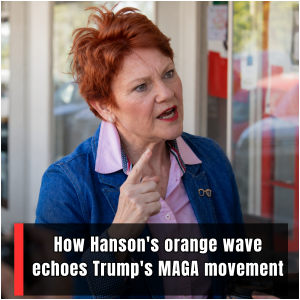
A growing number of Australians are turning their attention toward One Nation leader Pauline Hanson, creating a wave of enthusiasm that many observers believe extends far beyond what traditional polling currently captures. Recent political commentary has drawn comparisons between Hanson’s movement and the early stages of Donald Trump’s MAGA phenomenon in the United States.
The comparison is controversial, but it highlights a political reality that major parties can no longer ignore.
During recent public appearances across Queensland, Hanson reportedly attracted crowds and personal interactions that surprised even veteran political observers. Supporters from a wide range of backgrounds approached her for photographs, conversations, and expressions of support. According to reports, this enthusiasm was not limited to traditional protest voters or fringe political activists.
One of the most striking developments is the diversity of Hanson’s growing support base.
For decades, critics portrayed One Nation as a party appealing mainly to disaffected rural voters. However, recent observations suggest support is emerging from suburban communities, regional centers, and even wealthier demographics that historically remained aligned with major parties.
Political analysts argue that economic anxiety is playing a major role.
Australians continue to face rising housing costs, pressure from inflation, concerns about migration levels, and frustration over affordability challenges. These issues have created fertile ground for political movements that position themselves as outsiders willing to challenge established institutions.
This dynamic bears similarities to the political conditions that helped fuel Donald Trump’s rise in the United States.
In both cases, supporters often express a belief that traditional political elites have become disconnected from ordinary citizens. The message is less about ideology and more about representation—whether voters feel someone understands their daily struggles.
Veteran pollster John Scales recently suggested that Hanson’s appeal can be explained by a simple concept: recognition.
According to his assessment, many voters believe Hanson sees and understands their lived experiences in ways that established political parties do not. That emotional connection may be more important than specific policy details.
Another unexpected factor is the role of female voters.

Research cited in recent reporting found that a majority of voters shifting toward One Nation were women. This challenges longstanding assumptions that Hanson’s support comes primarily from older male conservatives.
Meanwhile, the Coalition faces a growing challenge.
Many traditional Liberal and National Party voters appear increasingly willing to consider alternatives. Political analysts warn that One Nation is no longer competing solely against Labor but is now directly contesting conservative territory that once belonged securely to the Coalition.
The rise of One Nation is also forcing difficult strategic decisions for Australia’s mainstream conservatives.
Should they move closer to Hanson’s positions on migration, national identity, and economic nationalism? Or should they distance themselves further and risk losing more voters to her movement?
For Hanson, the opportunity is significant.
Recent polling has shown One Nation achieving levels of support not seen for many years, placing pressure on both Labor and the Coalition. Some surveys have even suggested that the party has become one of the most influential forces on the Australian political right.
Yet major obstacles remain.
Winning public attention is one thing. Transforming that attention into parliamentary seats is another challenge entirely. Australia’s electoral system has historically made it difficult for smaller parties to convert national popularity into government power.
Critics also argue that One Nation remains heavily dependent on Hanson herself.
The party’s identity has been closely linked to its founder for nearly three decades. Questions persist about whether the movement can maintain momentum without her at the center.
Supporters, however, see a different picture.
They argue that Hanson’s longevity is actually a strength. After years of being dismissed by political opponents, they believe many of her concerns regarding migration, cost-of-living pressures, and national sovereignty have moved into the political mainstream.
The broader significance may extend beyond One Nation itself.
Around the world, voters have increasingly rewarded anti-establishment movements that promise to challenge traditional institutions. Australia appears to be experiencing its own version of that trend, although in a uniquely Australian form.
Whether Hanson’s surge ultimately becomes a lasting political realignment remains uncertain.
History is filled with movements that generated excitement before fading away. Yet history is also filled with examples where political elites underestimated growing public dissatisfaction until it fundamentally reshaped the political system.
That is why many observers are watching the current moment so closely.
The key question is no longer whether Pauline Hanson has support. The evidence suggests she does.
The real question is whether Australia’s political establishment is witnessing another temporary protest movement—or the beginning of a much larger political transformation that could redefine the country’s future for years to come.