For decades, the security of the European continent was a predictable equation: Brussels handled the bureaucracy, and Washington provided the muscle. But as the sun set over the Parthenon in Athens recently, a new and far more volatile era of European history was inaugurated. Emmanuel Macron’s stark warning that Europe is “waking up” to a world where the U.S., Russia, and China are increasingly “dead against” European interests was not just a speech—it was a funeral rite for the old world order.
At the heart of this geopolitical drama is a growing “security gap” within the European Union. While the EU’s mutual defense clause exists on paper, it has long been viewed as a hollow promise, paralyzed by the fear that any move to strengthen it would offend NATO or provoke Washington. However, the current instability of the global order has forced a choice: continue to wait for a protector that may not come, or forge a new, independent path.

France and Greece have chosen the latter. By renewing their bilateral defense pact, Paris and Athens have bypassed the sluggish consensus of Brussels to create what Macron calls a “definition of friendship.” This is no mere diplomatic nicety; it is a hard-coded military alliance that effectively turns the French military into a direct security guarantor for Greek sovereignty.
The inclusion of a “mutual assistance clause” in a bilateral agreement between two EU members is a radical departure from tradition. It signals that for France, the defense of Greek waters in the Aegean is now indistinguishable from the defense of the French coastline. This “famous alliance” is designed to provide the one thing NATO and the EU have struggled to offer: absolute certainty in the face of aggression.
To support this new reality, Greece is undergoing one of the most rapid and comprehensive military upgrades in its modern history. From the acquisition of advanced Patriot missile systems to the integration of modern fighter jets, Athens is transforming itself into a heavily armed front-line state. This is not just about regional friction; it is about Greece positioning itself as the southern anchor of a new European defense architecture.
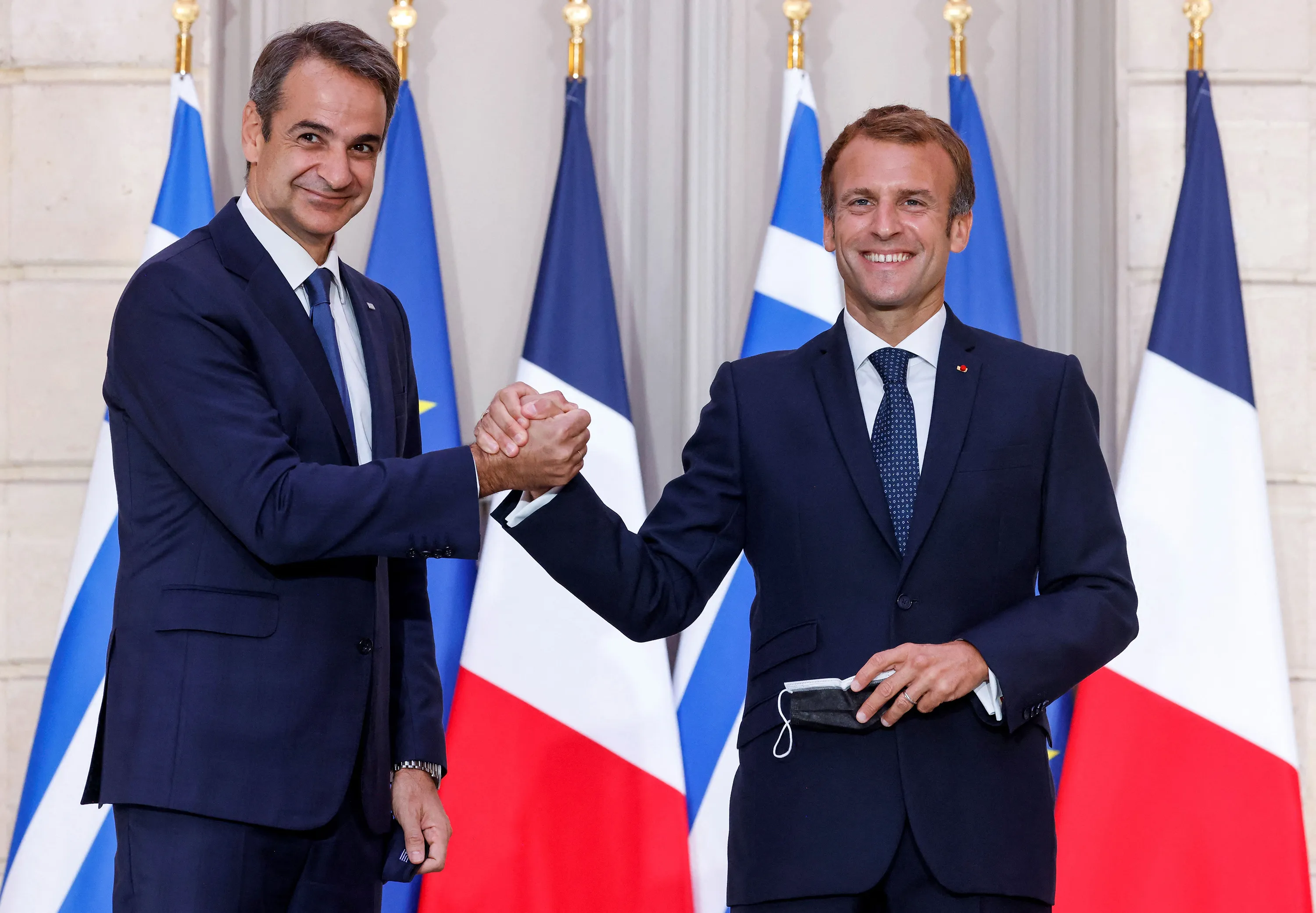
The significance of the French commitment goes beyond conventional hardware. By signaling that France is “here,” Macron is subtly bringing the weight of the EU’s only nuclear power to the doorstep of the Middle East and the Aegean. It is a strategic move intended to deter regional rivals who have long gambled on the idea that Europe was too divided to act.
“When you go to bed, you don’t ask yourself what you will do tomorrow. You know it,” Macron stated, emphasizing the reflexive nature of this new alliance. This philosophy—that defense should be an instinct rather than a committee decision—is the core of the “strategic autonomy” doctrine that Paris has championed for years, and which is finally finding a desperate audience in the rest of Europe.
However, this shift is not without its critics. Traditionalists in the Atlanticist camp argue that these bilateral pacts risk creating a “two-tier” security system that could undermine the unity of NATO. There is a delicate balance to be struck between being an independent actor and being an isolated one. Yet, for Macron and Greek Prime Minister Mitsotakis, the risk of inaction is now far greater than the risk of innovation.
The “security gap” that once haunted European planners is quietly being filled by these focused, high-stakes partnerships. While the EU struggles to define its collective defense, France and Greece are providing a working blueprint. They are betting that the future of Europe depends less on grand, multi-national treaties and more on the “friendship” of states willing to bleed for one another.
As tensions continue to simmer from the Mediterranean to the borders of Eastern Europe, the Athenian declaration marks a point of no return. Europe is preparing for a world where it can no longer outsource its survival. The “famous alliance” is more than a pact; it is a message to the world’s superpowers: the continent is no longer a prize to be protected or pressured by others—it is an actor in its own right.
Ultimately, the success of the Macron-Mitsotakis gambit will be measured by its ability to prevent the very conflicts it prepares for. By arming to the teeth and locking in unconditional support, France and Greece are hoping that a clear-eyed readiness for war is the only way to ensure a lasting peace in an increasingly hostile world.






