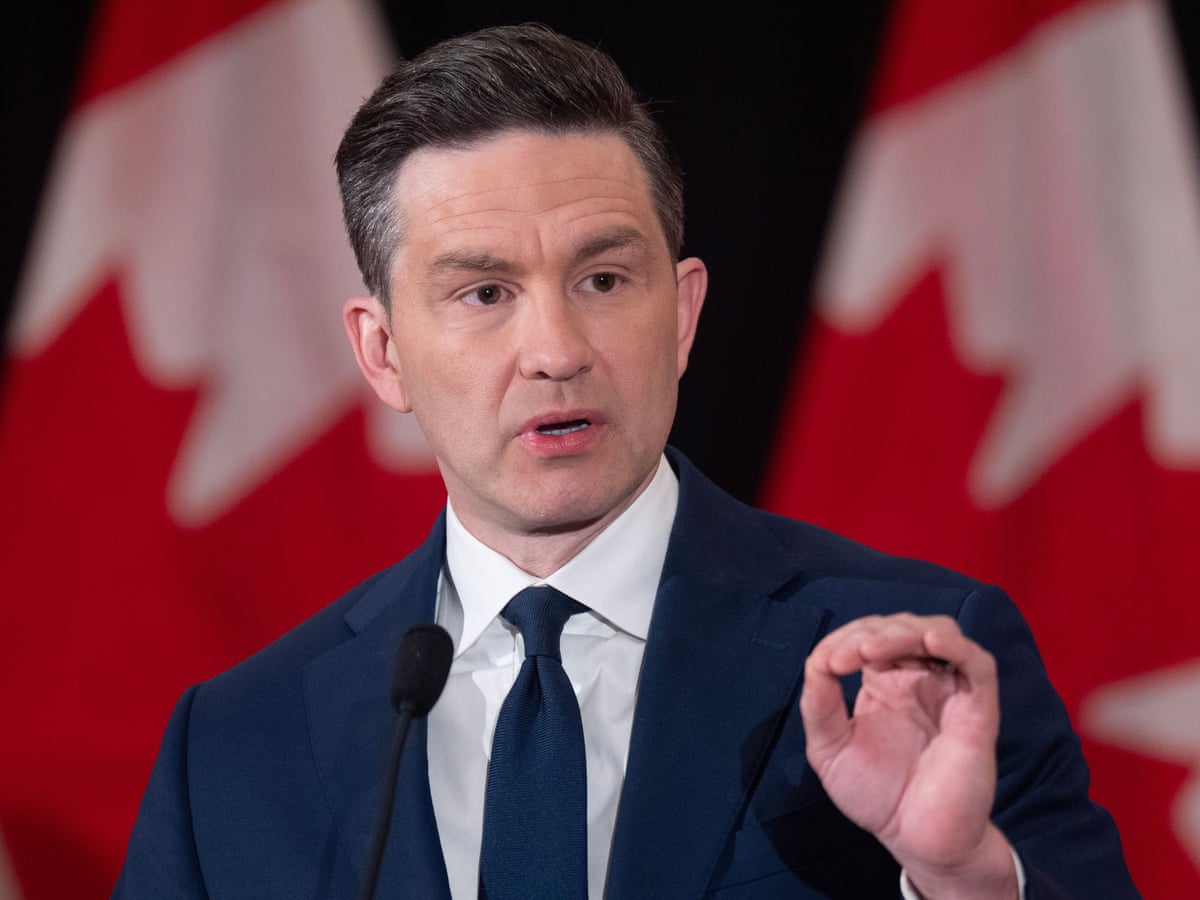
NEW YORK — For years, the political brand of Pierre Poilievre was built on a foundation of high-velocity friction. In the House of Commons, he was a master of the “clipped clip,” a pugilist of the digital age who thrived on the staccato rhythm of confrontation. But this week, as he moved through the wood-paneled studios of midtown Manhattan and the sprawling digital stage of the Joe Rogan podcast, a different man emerged: composed, conversational, and strikingly statesmanlike.
The “New Poilievre” was not merely a cosmetic adjustment. It was a strategic retreat from the brink of irrelevance—a recalibration forced not by his own party’s polls, but by the gravitational pull of the man currently occupying the Prime Minister’s Office: Mark Carney.
In the parlance of Canadian politics, the “Carney Standard” has become the invisible yardstick against which all opposition must now be measured. As Mr. Carney has spent months navigating a global oil shock, a trade war with Mar-a-Lago, and a historic 20-nation maritime alliance, he has redefined the Canadian Prime Ministership as a role of “Technocratic Calm.” For Mr. Poilievre, the choice was stark: adapt to this new climate of serious leadership, or remain a loud voice in an increasingly quiet room.

The Rogan Rebrand
The transformation was most visible during Mr. Poilievre’s appearance on The Joe Rogan Experience. For three hours, a politician known for interrupting adversaries sat in a state of disciplined repose. He navigated the complex thicket of Canada-U.S. trade tensions with a precision that stunned even his most vocal critics in Ottawa. Gone was the “Skippy” of old; in his place was a “Government-in-Waiting” archetype.
Following the podcast, Mr. Poilievre delivered a keynote in New York that several analysts described as his most credible performance to date. He didn’t just attack the current administration; he explained the mechanics of the North American supply chain with the fluency of a seasoned diplomat.
“He was trying to put a kinder, friendlier Pierre Poilievre in the shop window,” noted one seasoned political strategist. “But the window was only built because Mark Carney changed the neighborhood. You can’t sell populist rage in a market that is suddenly buying stability.”
The Tectonic Shift of Mark Carney
To understand Mr. Poilievre’s pivot, one must first understand the “Carney Effect.” Since his transition from the upper echelons of central banking to the premiership, Mr. Carney has operated at a level of international engagement that has fundamentally altered Canadian expectations.
Whether it was his “Six-Word Stance” in the Oval Office—Not for sale. Not now. Never—or his quiet construction of an alternative trade architecture with India and Japan, Mr. Carney has positioned himself as a leader who does not merely react to crises, but shapes them.
This has created a structural dilemma for the Conservative opposition. For months, Mr. Poilievre’s traditional style—built on sharp-edged rhetoric and high-intensity social media “owns”—began to feel misaligned with a Canadian public exhausted by global volatility. When the house is on fire, the neighborhood looks for the man with the blueprints, not the man with the loudest megaphone. By raising the bar for what “effective leadership” looks like, Mr. Carney effectively devalued Mr. Poilievre’s primary political currency.

The Authenticity Trap
The question now haunting the Conservative war room in Ottawa is whether this “New York Poilievre” can survive the return flight to Canada.
Political identity, once hardened in the public imagination, is notoriously difficult to reshape. History is littered with opposition leaders who attempted a “mid-campaign pivot” only to be viewed as situational actors rather than authentic leaders. As Mr. Poilievre returns to the bear-pit of Question Period, the incentives to revert to his combative “A+” prosecutor persona will be overwhelming.
“He’s been somebody for 25 years,” said one veteran observer. “Suddenly trying to be somebody else is a monumental lift. If he goes back into the House and reverts to the old tone, the public will simply put up their hands and say, ‘Nothing’s changed.'”
Conclusion: The Race for the Future
The success of Mr. Poilievre’s U.S. trip is undeniable. He proved he could play on a global stage without losing his footing. But the trip also served as a silent admission: Mark Carney has won the battle of the “Vibe.”
The Prime Minister is no longer just managing Canada; he is setting the direction of the national conversation. As long as Mr. Carney continues to define leadership through the lens of strategic patience and global coalition-building, Mr. Poilievre will be forced to play an away game on a field he didn’t design.
The next 90 days, marked by the upcoming USMCA review and a deepening energy crisis, will be the true test. Can the “Kinder, Friendlier Pierre” sustain a credible alternative to the “Carney Standard”? Or was the New York trip merely a polished performance in a world that is increasingly demanding the real thing? In the high-stakes theater of Canadian politics, the lead role is currently occupied—and the understudy is still learning his lines.






