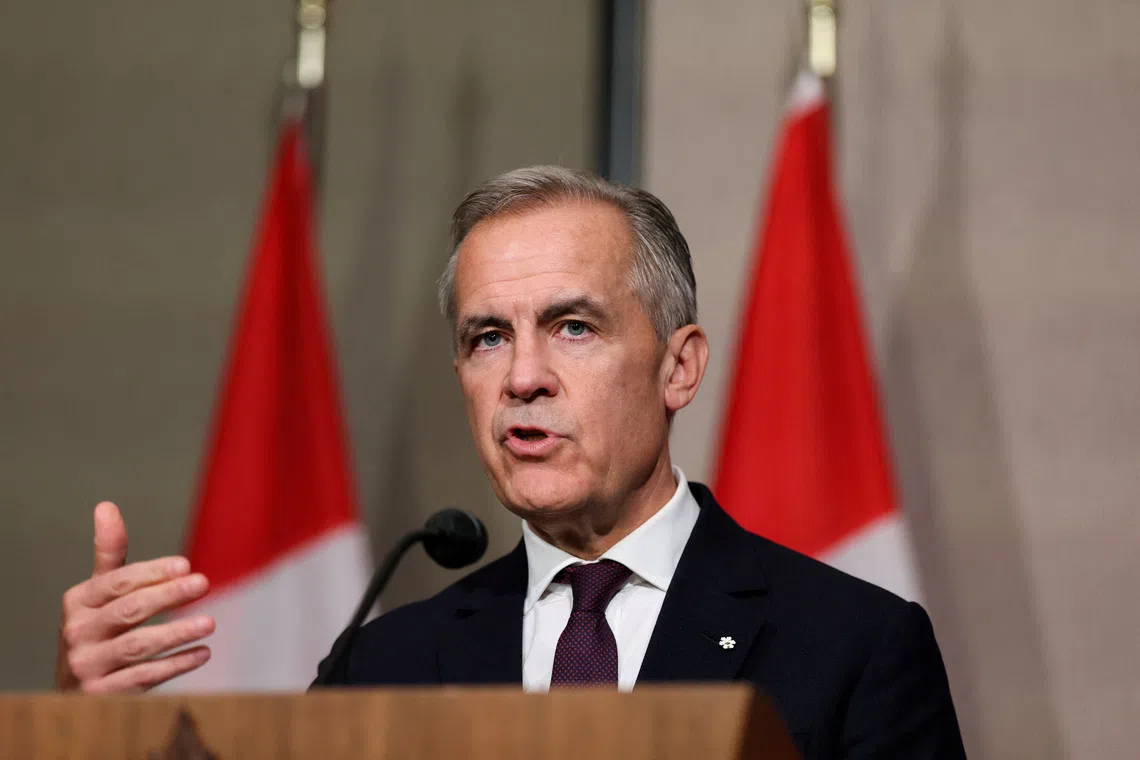
PARIS — For the better part of a year, the relationship between Washington and Ottawa has been less of a diplomatic partnership and more of a psychological war of attrition. But on Monday, standing in the shadow of the Élysée Palace and later on the cobblestones of Downing Street, Prime Minister Mark Carney transitioned from defense to a calculated, public offense.
In a move that has stunned the West Wing, Mr. Carney has issued what diplomats are calling a “pre-condition for conversation.” He has informed the Trump administration that Canada will not participate in the mandatory July 1 review of the United States-Mexico-Canada Agreement (USMCA) unless Donald J. Trump ceases his recurring rhetoric labeling Canada as the “51st State.”
The ultimatum is a departure from the “quiet diplomacy” that has characterized Canadian foreign policy for decades. By making the cessation of a rhetorical trope a non-negotiable requirement for trade talks, Mr. Carney is attempting to dismantle the very foundation of Mr. Trump’s negotiating strategy: the erosion of Canadian national identity as a source of leverage.

The Architecture of Intimidation
Since returning to the White House in January 2025, Mr. Trump has treated Canada’s sovereignty not as a legal fact, but as a flexible concept. He has posted altered maps of North America, referred to the Prime Minister as “Governor,” and characterized the 49th parallel as an “artificial line.”
To the casual observer, these are mere “Trumpisms”—theatrical flourishes designed for a domestic base. But to Mr. Carney, a man who spent decades analyzing the mechanics of global power at the Bank of England and the Bank of Canada, they are a “load-bearing wall” of economic coercion.
“If you can make a partner feel like their independence is a gift you can revoke, you’ve won the negotiation before it starts,” said a senior Canadian trade official. “The Prime Minister recognized that every concession made under the shadow of ‘annexation talk’ would be framed as an act of survival, not a trade-off. He had to kill that frame to save the deal.”
The European Pivot
Mr. Carney’s ultimatum did not happen in a vacuum. It was the climax of a meticulously choreographed European tour designed to prove that Canada is no longer an economic island tethered solely to the American mainland.
In Paris, President Emmanuel Macron stood beside Mr. Carney and pointedly spoke of “loyal partners”—a distinction that every diplomat in the room understood as a critique of an increasingly unreliable Washington. The two leaders reaffirmed the Canada-EU Comprehensive Economic and Trade Agreement (CETA), which has seen bilateral trade surge by 65 percent.
In London, Prime Minister Keir Starmer echoed this sentiment, deepening defense and intelligence ties while the Strait of Hormuz remained choked by the ongoing Iran conflict. By the time Mr. Carney reached the microphones at 10 Downing Street, he was backed by the collective weight of the European and British establishments. He wasn’t just speaking for Ottawa; he was speaking as the leader of a diversified global coalition.
The Trap with Three Exits
The brilliance—and the danger—of Mr. Carney’s ultimatum lies in its precision. The USMCA review deadline of July 1 is a hard date that the American business community, particularly the auto sector in Michigan and Ohio, views with mounting anxiety. Mr. Trump himself has praised Mr. Carney as a “big step up” and expressed a desire for a deal.
By setting this condition, Mr. Carney has presented the President with three uncomfortable options:
-
Compliance: Mr. Trump stops the “51st State” comments, signaling a rare public retreat from a signature rhetorical stance and acknowledging Canadian sovereignty as an equal.
-
Stalemate: Mr. Trump refuses, the talks collapse, and the USMCA enters a period of “annual review chaos” that would likely send shockwaves through the American stock market and agricultural heartland.
-
Escalation: Mr. Trump responds with further tariffs, a tactic he has already deployed with diminishing returns as Canada continues to pivot its supply chains toward China, Indonesia, and the European Union.
The Central Banker’s Calculus
For twelve months, Mr. Carney has been “making the unthinkable thinkable.” He has aggressively signed trade deals across four continents, reducing the share of Canadian exports bound for the U.S. and cutting long-term aluminum contracts that were once Detroit’s exclusive domain.
He is negotiating not as a politician seeking a headline, but as a central banker who has already checked the data. He knows that 65 percent of Canadian exporters are now actively pursuing non-U.S. markets. He knows that his domestic approval rating for his handling of the trade war stands at a staggering 93 percent.
“He isn’t being theatrical,” noted Melissa Carraway, a geopolitical analyst. “He is stating the terms of a transaction. He has built the leverage, and now he is using it.”

Conclusion: A Republic of Equals
As the 15-week countdown to the July 1 deadline begins, the ball is firmly in Washington’s court. Mr. Carney’s gamble is that the American President’s desire for a “win” on trade will ultimately outweigh his penchant for rhetorical bullying.
But beyond the immediate trade numbers, the ultimatum signals a permanent shift in the continental geometry. The era of Canadian “subordination” is being replaced by a doctrine of “Strategic Reliability.” Whether Mr. Trump accepts the terms or not, one thing is clear: the country he calls the 51st state is behaving more like a sovereign nation than ever before.






