OTTAWA — In the grand, wood-paneled corridors of Langevin Block, the atmosphere has undergone a chemical shift. For a decade, Canadian soft power was personified by the charismatic, if occasionally substantive-light, brand of Justin Trudeau. But as the geopolitical weather turned from sunny to stormy, Ottawa has traded its celebrity for a technocrat.
Just over a year into his mandate, Prime Minister Mark Carney has emerged as an unlikely global protagonist. It is a transformation that owes as much to the volatility across the border as it does to Mr. Carney’s own resume. By positioning himself as the “Adult in the Room” against the unpredictable backdrop of Donald J. Trump’s Washington, Mr. Carney has not only stabilized his party’s flailing brand but has arguably become the most effective Canadian leader in a generation.
The Architecture of Contrast
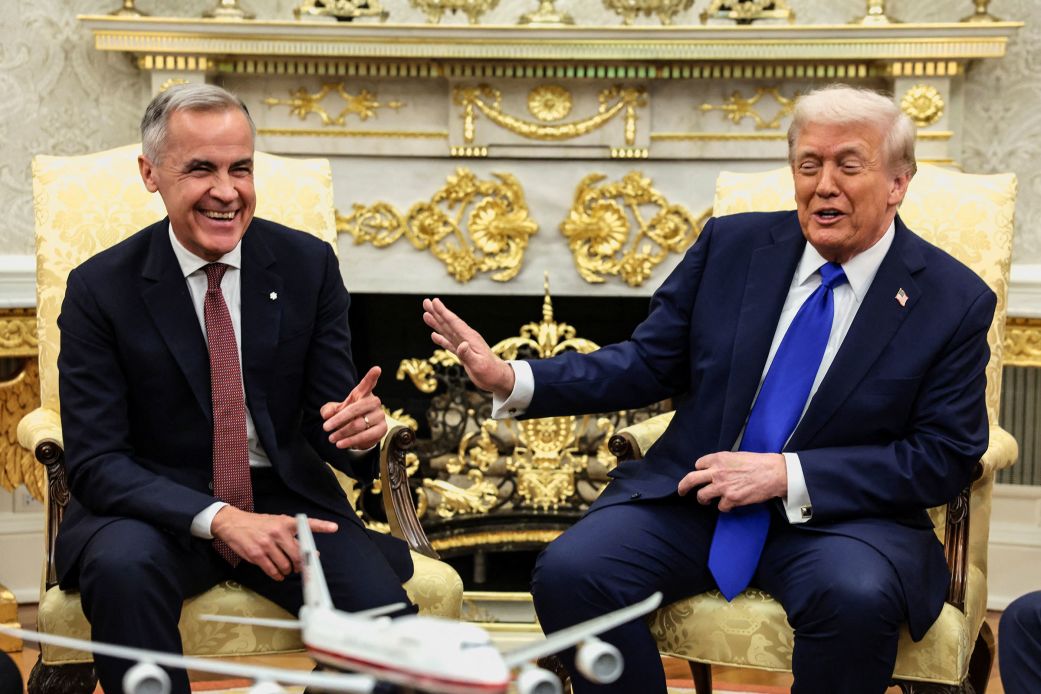
To understand the “Carney Draw,” one must look at the dunce chair. During a recent high-stakes meeting at the White House, Mr. Carney sat through a characteristic barrage of interruptions and trade ultimatums from President Trump. The resulting clips, which went viral across the Commonwealth, showed a Prime Minister who did not lean into the bait of a Twitter war. Instead, he responded with the cool, data-driven precision of a man who once ran the central banks of two G7 nations.
It is this contrast—substance over spectacle, restraint over rage—that has redefined Canada’s international standing. While Mr. Trump utilizes leverage and short-term pressure to crack open old alliances, Mr. Carney is quietly reinforcing them.
“The world is exhausted by the ‘Art of the Deal,’” noted one European diplomat during the recent G7 summit. “They are looking for the ‘Science of Stability.’ Carney gives them a person they can actually rely on to follow through on a memorandum of understanding.”
The Nordic Alignment
Nowhere was this “substance-first” diplomacy more evident than during Mr. Carney’s recent tour of Norway. In a meeting with all five Nordic heads of state, the conversation bypassed the usual diplomatic platitudes. Instead, the leaders engaged in a granular discussion on Arctic sovereignty and shared environmental security—a dialogue that focused on the long-term strategic reality of being a “Rim Nation” in a warming world.
Under the previous administration, such trips were often viewed as branding exercises. Under Mr. Carney, they are being treated as board meetings for a new coalition of middle powers. These nations, increasingly wary of a Washington that views alliances as transactional, are gravitating toward Ottawa not out of habit, but out of a desperate need for a predictable partner.
The Domestic Dividend
The international acclaim is having a potent, if unexpected, effect on the home front. According to the latest Nanos Research data, the Liberal Party has surged to a 16-point lead over the Conservatives—a dramatic reversal from the double-digit deficit they faced just prior to Mr. Trudeau’s resignation in early 2025.
Nearly 57 percent of Canadians now prefer Mr. Carney as Prime Minister, a figure that dwarfs the 22 percent support for Conservative leader Pierre Poilievre. The polling suggests that the Canadian public, much like the international community, has developed a profound appetite for competence over combat.
“Carney is outperforming his own party’s brand,” said Nik Nanos, the veteran pollster. “He has managed to frame his background in global finance not as an elite liability, but as a survival kit for an era of global economic risk. Canadians are looking at the chaos south of the border and deciding that ‘boring’ is actually a luxury they want to afford.”

A Historical Re-evaluation
Is it too early to place Mr. Carney in the pantheon of great Canadian Prime Ministers? Historically, such judgments require the distance of decades. However, the sheer gravity of the moment he inherited—a fracturing North American trade engine and a shifting global security architecture—makes his first-year performance a candidate for serious consideration.
He has done what few leaders manage: he has turned a defensive position into a strategic advantage. By refusing to mirror the confrontational style of his American counterpart, he has made the Canadian model of “consistent multilateralism” look like a revolutionary act.
As the second year of his mandate begins, the challenges remain immense. The 100 percent tariff threats still hang over the border, and the domestic cost-of-living crisis continues to simmer. But for now, the consensus in Ottawa and abroad is clear. Canada is no longer a bystander to global disruption; under Mark Carney, it has become the anchor.
In the high-stakes game of geopolitical chess, Mr. Trump may have thought he was clearing the board. Instead, he may have accidentally handed the game to a grandmaster.






