
Australia’s newest anti-extremism laws are now facing their biggest legal test yet — and the battle is exploding straight into the High Court. Nationalist activist Thomas Sewell has launched a dramatic constitutional challenge against the federal government after the White Australia Party was officially banned as a prohibited hate group, a move that instantly criminalised support for the organisation and shocked political observers across the country.
The legal showdown comes just days after the Albanese government formally listed the White Australia Party — also known as WA or WAP — under sweeping new hate-group legislation introduced after the Bondi Islamic terrorist attack. The laws were backed by both major parties and promoted as a necessary response to rising extremism and social violence.
But now, Sewell claims the legislation crosses a dangerous constitutional line.

In documents filed before the High Court, Sewell and the White Australia Party argue the laws allow the government to effectively outlaw a political organisation through executive power alone. The challenge warns that such authority could become a “doorway to tyranny” if left unchecked.
That phrase alone has already ignited fierce reactions online.
The case is expected to become one of the most controversial freedom-of-speech and political-rights battles Australia has seen in years. Supporters of the legislation say the government is protecting Australians from racism, extremism, and organised hate movements. Critics, however, fear the laws give Canberra unprecedented power to criminalise political groups without convictions or traditional judicial safeguards.
And at the centre of the storm is Prime Minister Anthony Albanese’s government.
Under the new legislation, anyone found directing, joining, funding, recruiting for, or supporting the White Australia Party could face prison sentences of up to 15 years. The ban officially took effect at midnight on May 15, immediately transforming the organisation from a fringe political movement into a criminally prohibited entity.
That escalation stunned even some legal observers.
According to official government documents, Home Affairs Minister Tony Burke relied on advice from ASIO and other agencies before declaring the group a prohibited hate organisation. Authorities cited alleged racist propaganda, public Nazi salutes, confrontations with left-wing activists, inflammatory demonstrations, and leaflet campaigns as evidence supporting the ban.
The government insists the move is necessary to prevent further social harm and extremist radicalisation.
“The specification will prevent White Australia from legitimately operating in Australia,” the official listing states, arguing the organisation’s ideology is rooted in white supremacy and racism.
But Sewell’s legal filing fires back aggressively.
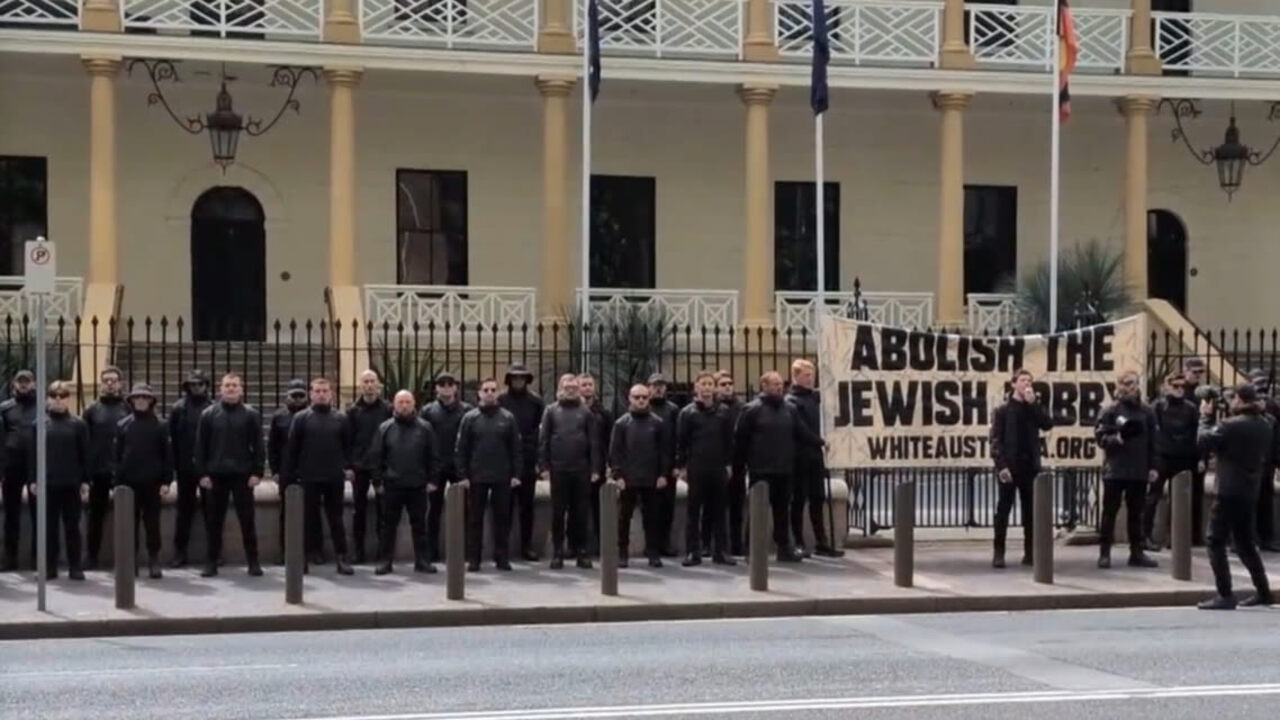
The documents repeatedly invoke the famous 1951 Communist Party Case, one of Australia’s most important constitutional rulings, where the High Court struck down attempts to ban the Australian Communist Party during the Cold War. Sewell’s lawyers argue the current legislation similarly allows Parliament and the executive branch to bypass constitutional protections in the name of national security.
Their central argument is explosive: that governments should not have the power to decide which political ideologies Australians are allowed to support.
“One key purpose of representative government is to accommodate the full spectrum of political debate,” the filing reportedly argues. “What is poison to one citizen is tonic to another.”
That wording has already become highly controversial across political and legal circles.
Sewell is also framing the battle as something much larger than one organisation. In public statements, he claims the case will determine whether “White Australians” can still organise politically without facing criminal penalties.
Those comments have triggered outrage from anti-racism groups, who accuse Sewell of attempting to cloak extremist ideology behind the language of civil liberties and constitutional rights.
Still, even some legal scholars who strongly oppose the White Australia Party have quietly raised concerns about how broad the legislation appears to be.
One particularly contentious aspect of the law is that a group can reportedly be banned without prior criminal convictions. Critics argue the ministerial designation process grants enormous discretionary power to the executive government, especially when decisions can rely partly on classified intelligence unavailable to the public.
That detail is now fueling fears about precedent.
If governments can outlaw one political organisation through ministerial declaration, critics ask, where does the limit eventually sit? Could future governments apply similar powers against radically different ideological groups?
Supporters of the legislation reject those fears entirely.
They argue Australia is confronting a growing wave of extremist activity and that democratic societies cannot simply wait for violence to escalate before acting. For them, the White Australia Party is not merely controversial but fundamentally dangerous.
The Albanese government has consistently framed the legislation as a national-security measure rather than a political tool. Officials argue the laws are specifically designed to disrupt organisations that promote hatred, intimidation, and extremist mobilisation before such movements become larger threats.
But politically, the optics are becoming increasingly volatile.
The High Court challenge is rapidly transforming into a wider debate about freedom of expression, state power, political extremism, and the limits of democratic tolerance in modern Australia. Social media is already flooded with furious arguments from both sides, with some Australians praising the crackdown while others fear the legislation hands too much power to the government.
And Thomas Sewell appears determined to maximise the attention.
He reportedly raised around $150,000 earlier this year to prepare the constitutional fight, presenting the case to supporters as a defining battle over political rights in multicultural Australia. His rhetoric has become increasingly dramatic, warning followers that Australians risk becoming “second-class citizens” if the legislation survives judicial scrutiny.
Those statements have only intensified public anger toward him.
For many Australians, the issue is simple: the White Australia Party represents openly racist politics that should never be normalised within democratic institutions. They see the ban not as censorship, but as a necessary defence of social cohesion and public safety.
Others, however, fear democratic systems become vulnerable when governments begin deciding which political movements are legally acceptable.
That tension now sits directly before the High Court.
Justice Jayne Jagot is expected to hear Sewell’s urgent application for temporary injunctive relief, which seeks to prevent enforcement of the hate-group laws against the White Australia Party and its alleged members while the broader constitutional challenge proceeds.
If the injunction succeeds, it could temporarily shield thousands of former members and associates from prosecution while the court examines the legislation itself.
If it fails, the government’s crackdown moves forward immediately.
Either way, the outcome could reshape Australia’s political and legal landscape for years.
Because beneath the outrage, the slogans, and the political warfare lies a deeper question Australia may now be forced to answer: how far can a democracy go in banning extremist politics before it begins redefining the boundaries of political freedom itself?






