A fatal encounter involving federal immigration agents has ignited a national debate not only over the use of force by Immigration and Customs Enforcement, but also over how the incident is being framed in partisan media—and what it says about public trust in government authority.
The case centers on the killing of Renee Good, an American citizen who was shot during an ICE operation. Federal officials have said the agent involved acted in self-defense. Video footage released from multiple angles has raised questions about that account, prompting protests, demands for investigation, and intense media scrutiny.
The incident took on new visibility after a contentious exchange on Fox News, where commentators debated responsibility for the shooting and whether Ms. Good’s actions contributed to the outcome. That discussion, and the sharp rebuttal it drew from a member of Congress, has become emblematic of a broader struggle over accountability, policing, and executive power under Donald Trump.
A Media Clash Over Responsibility
During the Fox News segment, a host suggested that Ms. Good bore some responsibility because she was behind the wheel of a moving vehicle when agents approached her car. The implication—that her movement justified the use of deadly force—immediately drew criticism from civil rights advocates and lawmakers.
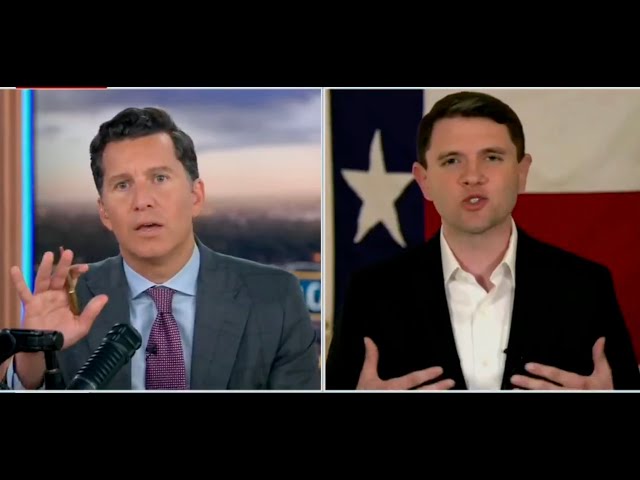
Appearing on the same network, a Democratic congressman pushed back forcefully. “This is entirely the responsibility of the officer,” he said, emphasizing that law enforcement personnel are accountable for the totality of an operation, particularly when they are armed, masked, and acting under federal authority.
He challenged the framing directly, asking whether any family would consider it acceptable for a driver to be shot multiple times simply for attempting to move away from officers who were opening a car door. “You have a badge, you have a gun,” he said. “You are accountable for everything that happens or fails to happen.”
The exchange circulated widely online, drawing attention not just to the facts of the shooting, but to the way narratives are constructed around police use of force.
What the Video Shows
Footage reviewed by journalists and former law enforcement officials appears to show agents approaching Ms. Good’s vehicle while it was stopped. One agent steps in front of the car, holding what appears to be a phone, before drawing his weapon. Shots are fired in rapid succession. The vehicle then moves away from the agent.
Federal authorities have maintained that the agent fired because he feared being run over. Critics argue that the positioning of the agent in front of the car—and the apparent direction of the vehicle’s movement—undermines that claim.
Under Department of Homeland Security policy, firing at a moving vehicle is heavily restricted. Deadly force may not be used solely to prevent escape, and officers are trained to avoid placing themselves in front of vehicles unless absolutely necessary.
An internal investigation is ongoing. No charges have been announced.
Protest, Memory, and Historical Parallels
For many critics of the Trump administration, the shooting has become part of a larger narrative about the expansion of federal power and the erosion of civil liberties.
Some commentators have drawn parallels to authoritarian periods abroad, particularly South Korea in the early 1980s, when military rule suppressed protests and tightly controlled information. In that era, the Gwangju uprising—where peaceful demonstrators were met with lethal force—was initially hidden from the public. Only later did images and testimony galvanize domestic and international opposition, contributing to democratic reforms.
The comparison is not exact, historians caution, but the reference underscores a concern voiced by many protesters: that visible, documented violence by state agents, combined with official denial, can deepen public distrust and polarize society.
Unlike authoritarian regimes that rely on censorship, today’s United States operates in an environment saturated with video, social media, and competing narratives. Supporters of ICE argue that agents face dangerous conditions and must make split-second decisions. Critics counter that transparency makes accountability unavoidable—and that attempts to dismiss or reframe visual evidence only heighten suspicion.
ICE and the Question of Fear
The congressman who confronted Fox News hosts framed the issue not as partisan, but civic. “No law enforcement officer should be harassed or assaulted,” he said. “But no U.S. citizen should be afraid of their own government.”
That sentiment has echoed through demonstrations in multiple cities, where protesters argue that ICE has shifted from enforcing immigration law to becoming, in their words, “an instrument of fear.” Supporters of the agency reject that characterization, saying it unfairly maligns officers carrying out lawful orders.
The Trump administration has repeatedly defended ICE, with senior officials calling its agents heroes and, in some cases, arguing for expanded legal protections for them. Vice President JD Vance has previously suggested broad immunity for law enforcement officers acting in the line of duty, a position that has alarmed civil liberties groups.
The Role of Partisan Media
The Fox News segment highlighted how sharply divided media ecosystems have become. On one side, conservative commentators questioned protest tactics and individual behavior. On the other, critics accused the network of minimizing state violence and shifting blame onto victims.
Media analysts note that such framing can shape public perception as powerfully as official statements. When violence is discussed primarily through ideological lenses, the underlying facts risk being overshadowed by partisan loyalty.
“This is not just about one shooting,” said a professor of media studies. “It’s about whether Americans believe institutions are telling them the truth—and whether they think those institutions are accountable when they fail.”
An Unsettled Moment
As investigations continue, the death of Renee Good remains unresolved in the public mind. The case sits at the intersection of immigration enforcement, police accountability, and political polarization.
For some Americans, the footage represents a clear abuse of power. For others, it is a tragic but justified outcome of a dangerous confrontation. What is clear is that the incident—and the way it is debated—has deepened an already profound divide over the role of government force in a democratic society.
Whether that divide leads to reform, retrenchment, or further mistrust may depend less on rhetoric than on what investigators ultimately conclude—and whether their findings are widely accepted.
In the meantime, the questions raised on live television continue to reverberate far beyond the studio: Who is responsible when federal power turns lethal, and who decides how that story is told?






