A $22 Billion Power Move Just Redrew Canada’s Energy Future — And Asia Is Watching Closely
For years, global energy giants treated Canada as a reliable supplier. Now, it’s becoming something far bigger: a strategic gateway to Asia at a moment when the world’s energy map is cracking under pressure.

In one of the most explosive Canadian energy deals in over a decade, Shell plc has agreed to acquire ARC Resources in a staggering $22 billion takeover — a move that analysts say could permanently reshape North American trade dynamics.
And this isn’t just another corporate merger.
This is a calculated geopolitical bet on Canada becoming one of the safest and most valuable energy corridors on Earth.
Shell’s CEO called the merger a move that establishes Canada as a “heartland” for the company. Canadian leaders quickly framed the announcement as a massive vote of confidence in the country’s future. But behind the headlines lies a deeper reality: global energy supply chains are under strain, Asian economies are scrambling for stability, and Canada suddenly holds a card everyone wants.
At the center of the deal is the Montney formation, a gigantic natural gas-rich region stretching across northeastern British Columbia and northwestern Alberta. By absorbing ARC Resources, Shell gains control over production assets that pumped out roughly 374,000 barrels of oil equivalent per day last year.

More importantly, the acquisition adds nearly 2 billion barrels of proved and probable reserves to Shell’s books, instantly strengthening its dominance in Canada’s natural gas sector.
But the real strategy begins after the gas leaves the ground.
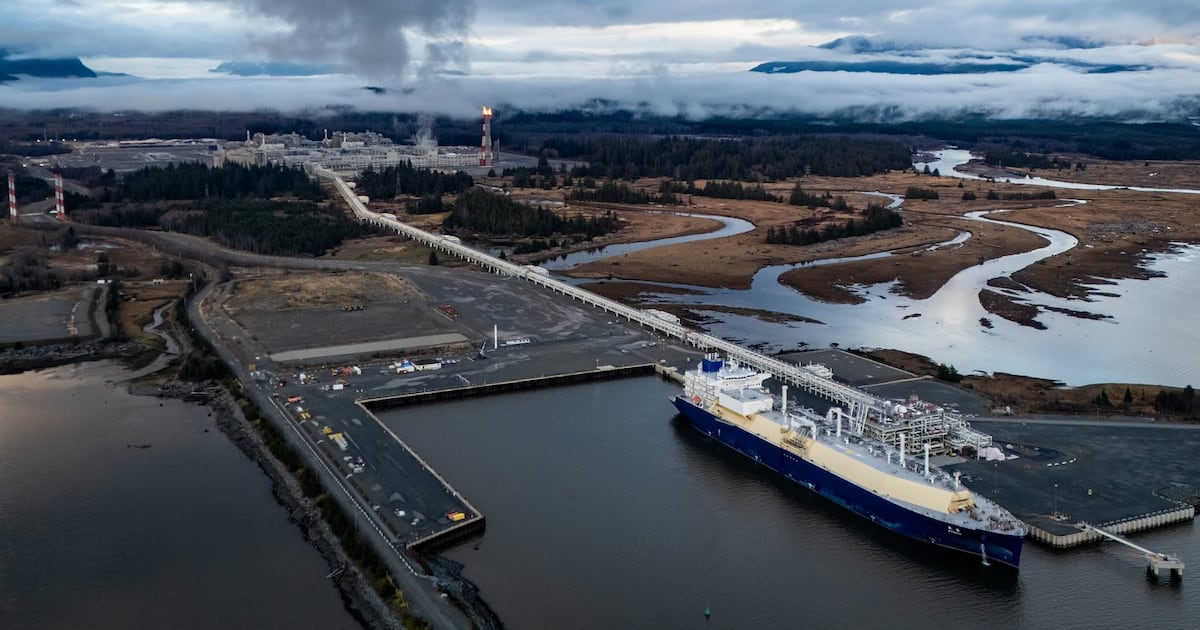
Shell already owns 40% of LNG Canada, the massive export terminal in Kitimat, British Columbia. That facility recently launched its first operational phase and is backed by major Asian investors from Japan, Malaysia, China, and South Korea.
Now the puzzle pieces fit together.
Gas extracted from the Montney can move directly through an integrated supply chain to Kitimat, where it is converted into liquefied natural gas and shipped across the Pacific to Asia. The geography gives Canada a huge advantage over U.S. Gulf Coast exporters. Tankers leaving British Columbia avoid the Panama Canal and cut significant travel time to key Asian markets like Tokyo and Seoul.
In today’s market, speed and reliability are everything.
That timing matters because the global LNG market is entering one of its most unstable periods in years. Conflict across the Middle East has disrupted production expectations from Qatar, one of the world’s largest LNG suppliers. At the same time, pressure surrounding the Strait of Hormuz — a chokepoint handling roughly 20% of global LNG shipments — has rattled governments and energy buyers alike.
Countries that once believed their supply chains were untouchable are suddenly confronting painful price spikes and growing vulnerability.
That’s where Canada enters the picture.
Analysts increasingly view Canadian energy projects as premium assets because the country offers something the market desperately wants right now: stability. No regional war zone near the Pacific coast. Predictable regulations. Long-term security.
For Asian buyers nervous about relying too heavily on Middle Eastern shipments, Canada suddenly looks like an insurance policy worth billions.
And Shell appears determined to control that route before competitors do.

The implications stretch far beyond energy markets. In roughly two months, the United States, Canada, and Mexico are scheduled to review their trilateral trade agreement. Historically, Washington’s leverage came from the assumption that Canada depended heavily on American buyers.
This deal complicates that assumption overnight.
Every LNG tanker leaving British Columbia for Asia represents energy Canada no longer has to sell southbound at discounted prices. As export infrastructure expands, Canada gains greater flexibility — and potentially more bargaining power — in future trade negotiations.
That shift becomes even more significant when considering how dependent parts of the United States remain on Canadian energy. Millions of homes and industries across states like Michigan and New York rely heavily on Canadian crude oil and natural gas. Any disruption or tariff escalation could sharply raise energy prices for American consumers.
Meanwhile, the money pouring into Canada is reaching staggering levels.
The LNG Canada consortium is already evaluating a second expansion phase that could attract an additional $33 billion in private investment. If approved, it would become one of the largest LNG export facilities in the world.
Thousands of high-paying skilled trades jobs could follow, along with ripple effects across construction, transportation, manufacturing, and pension investments. Even Canada’s national pension system stands to benefit as domestic energy assets rise in value.
Quietly, while political headlines dominate public attention, the foundations of a new economic power structure are being built along Canada’s Pacific coast.
And Shell’s $22 billion gamble may end up being remembered as the moment the world realized Canada was no longer just America’s energy supplier — but Asia’s next major energy lifeline.






