The Alliance After America
For three quarters of a century, the architecture of the Western alliance rested on a single assumption: when the moment of crisis arrived, the United States would carry the decisive burden.
Its aircraft carriers would move first.
Its bombers would patrol the skies.
Its intelligence systems would watch the Arctic and the Baltic.
Its logistics networks would sustain Europe’s defenses.
And its nuclear umbrella would remain the final guarantee beneath NATO’s entire strategic order.
Now, for the first time in a generation, that assumption is being openly reconsidered inside the alliance itself.


This week, General Alexus G. Grynkewich, NATO’s Supreme Allied Commander Europe, delivered a statement before the United States Senate Armed Services Committee that landed in European capitals with the quiet force of a tectonic shift.
“There has been an unhealthy codependence in the NATO force model on U.S. forces,” he said.
The words were notable not because they came from a critic of the alliance, but because they came from the officer who oversees NATO’s military operations themselves. (NATO)
For years, officials in Brussels and Washington had hinted at the same conclusion through diplomatic language and spending targets. European allies should contribute more. Burden-sharing had become politically unsustainable in the United States. The strategic center of gravity was shifting toward the Indo-Pacific.
But this was different.
This was no longer theory.
It was operational doctrine.
The American military establishment, under pressure from President ŤRUMP’s administration and Defense Secretary Pete Hegseth, is now openly preparing for a NATO in which Europe — and increasingly Canada — must shoulder far more responsibility for the alliance’s security. (Guardian)
The consequences of that shift extend far beyond defense budgets.
They touch trade.
Diplomacy.
Industrial policy.
Arctic sovereignty.
And the future political identity of the Western alliance itself.
For decades, NATO’s structure reflected postwar realities.
The United States possessed unmatched naval power, unmatched strategic airlift, unmatched intelligence infrastructure, and unmatched industrial capacity.
European allies built capable militaries, but many did so knowing that Washington would ultimately provide the backbone.
American satellites.
American missile defense.
American ISR systems.
American command-and-control networks.
American deterrence.
That model survived the Cold War, the Balkan conflicts, Afghanistan, and the first phase of Russia’s war against Ukraine.
But the geopolitical environment surrounding NATO has changed with remarkable speed.
China’s military rise has forced American planners to reconsider force allocation across multiple theaters simultaneously.
Russia’s invasion of Ukraine has transformed European security thinking.
And inside the United States, bipartisan frustration over European dependence has hardened into something more structural.
The result is an alliance entering a new era of strategic decentralization.


At recent NATO summits, alliance leaders have increasingly emphasized “readiness,” “deterrence,” and “resilience” as central organizing principles for the coming decade. (NATO)
But behind those institutional phrases lies a more direct message.
Europe must prepare for scenarios in which American military resources are constrained elsewhere.
The implications are especially acute in the Arctic.
For much of the twentieth century, the Arctic functioned as a distant strategic buffer between Russia and North America.
Today, it has become an increasingly contested theater.
Russian submarine patrols have intensified.
Chinese research and infrastructure interests in the High North have expanded.
Melting ice has transformed shipping routes and access to natural resources.
And NATO planners increasingly view the Arctic not as peripheral territory, but as a frontline.
That reality places Canada in an unusually important position.
For years, Ottawa was often criticized within NATO circles for underinvestment in defense.
Yet in recent months, Canada has begun assembling precisely the kinds of capabilities NATO commanders are now demanding.
The shift has not occurred through rhetoric alone.
Canada has moved aggressively to expand Arctic coordination with allied states.
It has strengthened its forward presence missions in Eastern Europe.
It has invested in airborne surveillance.
And it has attempted to position itself not merely as a beneficiary of the alliance, but as one of its emerging institutional anchors.
Perhaps most symbolically, Canada recently supported the nomination of General Jennie Carignan for chair of NATO’s Military Committee — the alliance’s highest military advisory body.
The timing is striking.
As NATO begins redefining its strategic balance away from overwhelming American centrality, Canada is attempting to move closer to the alliance’s operational core.
That ambition would have seemed improbable a decade ago.
Today, it appears increasingly aligned with NATO’s evolving needs.
One of the clearest examples of that transformation is Canada’s interest in the Saab GlobalEye airborne early warning platform.
The aircraft is designed to provide long-range surveillance capabilities across air, sea, and land domains. Saab has actively promoted the system for Canada’s airborne warning and control modernization efforts.
At first glance, the purchase might appear technical.
In reality, it reflects a deeper strategic calculation.
Countries that depend entirely on American ISR architecture remain structurally dependent on American priorities.
Countries that build sovereign surveillance capabilities gain autonomy.
Inside NATO, autonomy increasingly matters.
The alliance’s future will likely depend less on a single dominant military power and more on interconnected regional capabilities operating within a shared strategic framework.
That transition will not be smooth.
European militaries still face significant procurement bottlenecks.
Industrial capacity remains uneven.
Recruitment challenges persist across much of the continent.
And defense spending increases, while politically popular in some countries, remain deeply controversial in others.
Germany has accelerated rearmament efforts.
Poland has emerged as one of NATO’s fastest-growing military powers.
France continues to advocate for greater European strategic independence.
Britain is rebuilding portions of its force structure after years of austerity.
Yet even taken together, Europe’s capabilities cannot rapidly replace the scale of American power that has underwritten NATO since 1949.
That gap explains the urgency behind Grynkewich’s remarks.
He was not describing a distant future.
He was describing a transition already underway.
And transitions of this magnitude carry risk.
If deterrence appears uncertain during periods of military restructuring, adversaries often probe for weakness.
Russia understands that dynamic well.
So does China.
That is one reason NATO leaders have attempted to frame the current moment not as American withdrawal, but as allied maturation.
Publicly, officials emphasize partnership.
Privately, planners are recalculating force assumptions that governed the alliance for generations.
The psychological dimension of this shift may prove just as important as the military one.
For decades, Europe’s security culture evolved within the comfort of overwhelming American support.
Now European governments must persuade voters that defense spending is not temporary emergency policy, but a long-term structural necessity.
That is politically difficult.
Modern Western electorates are more accustomed to debates over inflation, healthcare, housing, and energy prices than naval tonnage and missile defense systems.
Yet geopolitical realities rarely wait for domestic political comfort.

Canada’s expanding role inside this evolving NATO order also carries domestic implications.
Defense manufacturing, once treated largely as an industrial afterthought, is rapidly becoming part of national economic strategy.
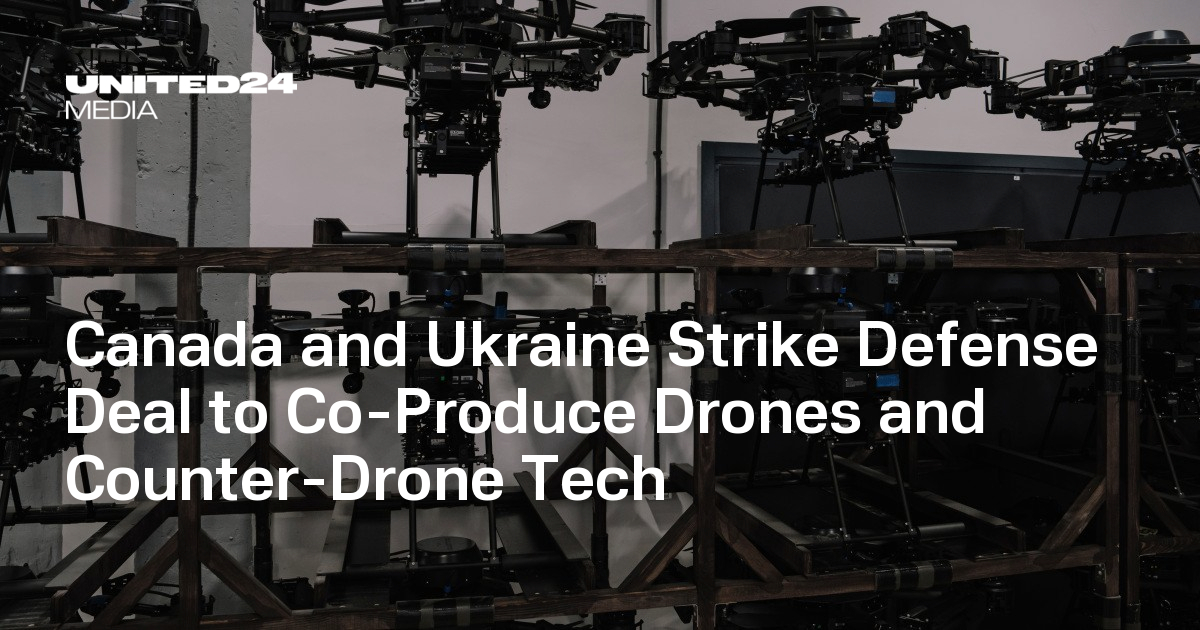
The expansion of drone production partnerships linked to Ukraine reflects not only wartime demand, but the broader emergence of a reindustrialized defense economy across NATO states.
Military production is increasingly tied to questions of technological sovereignty, supply chain security, and geopolitical resilience.
In that environment, countries able to combine industrial flexibility with political stability gain influence.
Canada believes it may fit that category.
Whether it succeeds remains uncertain.
The country still faces procurement delays, infrastructure gaps, and difficult budgetary trade-offs.
But the direction is unmistakable.
Ottawa is preparing for a world in which NATO no longer functions as an alliance overwhelmingly carried by Washington.
That preparation may ultimately reshape Canada’s international position more profoundly than many Canadians yet realize.
A nation once viewed primarily as a middle-power diplomatic broker is gradually repositioning itself as a strategic security actor in the Arctic and the North Atlantic.
That transformation reflects a broader truth about the alliance itself.
NATO is not collapsing.
Nor is America abandoning Europe.
What is ending is something more subtle but equally consequential: the assumption that the United States alone will permanently absorb the overwhelming burden of Western defense.
Future historians may look back on this period as the moment NATO evolved from an American-centered alliance into a more distributed security system.
Or they may see it as the beginning of deeper fragmentation inside the transatlantic order.
Much will depend on whether European and Canadian governments can convert urgency into sustained capability.
For now, one reality is becoming increasingly difficult to ignore.
The post-Cold War era of strategic complacency is over.
And across NATO headquarters in Brussels, military planners are already preparing for what comes next.