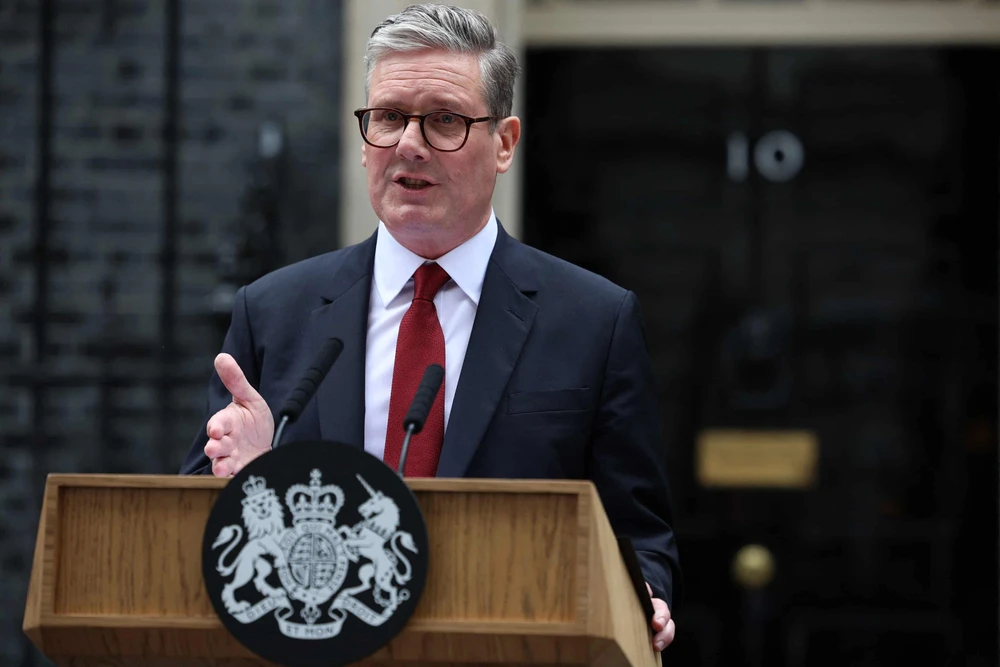
The pressure on Prime Minister Keir Starmer is no longer coming only from the opposition benches. It is now emerging from within Labour’s own ranks, as frustration grows over falling poll numbers, election setbacks, and a government struggling to regain political momentum.
What was once considered a commanding political position has become increasingly fragile. Following disappointing local election results and a series of controversies that have damaged public confidence, Starmer is facing renewed questions about whether he can still lead Labour into the next general election. Reports suggest that a growing number of Labour MPs have privately discussed the possibility of a leadership change, while some have openly called for him to step aside.
Yet the biggest threat to Starmer may not come from inside Labour.
It comes from Nigel Farage.
For years, Farage operated on the fringes of British politics. Today, he sits at the center of the national conversation. As leader of Reform UK, he has successfully tapped into public anger over immigration, the cost of living, crime, and what many voters see as a political establishment disconnected from everyday concerns. Reform UK’s electoral gains have transformed Farage from a protest politician into a serious challenger to Britain’s traditional political order.
The contrast between the two leaders has become increasingly stark.
While Starmer speaks about stability and responsible government, Farage presents himself as the voice of disruption and change. Every government setback creates another opportunity for Reform UK to attract dissatisfied voters. Every decline in Labour’s support strengthens Farage’s argument that Britain’s political establishment has failed.
Recent political tensions surrounding immigration and the Henry Nowak case have further intensified the rivalry. Starmer has accused Farage of exploiting national tragedies for political gain, while Farage continues to argue that the government has lost control of key issues facing the country. The battle is no longer simply about policy. It is becoming a struggle over who defines Britain’s future direction.

Meanwhile, polling data paints an increasingly difficult picture for the Prime Minister. Public approval ratings have deteriorated significantly since Labour’s election victory, while Reform UK continues to gain ground among voters who once supported both Conservatives and Labour. Some analysts now describe Farage as the most influential opposition figure in Britain, despite not leading one of the traditional major parties.
Starmer insists he has no intention of resigning. He argues that Labour was elected to govern through difficult circumstances and that changing leadership would only create further instability. But politics is often shaped by perception as much as reality. The longer Labour struggles to reverse its decline, the louder the calls for change may become.
For now, Keir Starmer remains Prime Minister.
But the question dominating Westminster is no longer whether Nigel Farage can challenge Britain’s political establishment.
It is whether Keir Starmer can survive the challenge.